Islands of Ireland: Inishlacken is so beautiful it will take your breath away
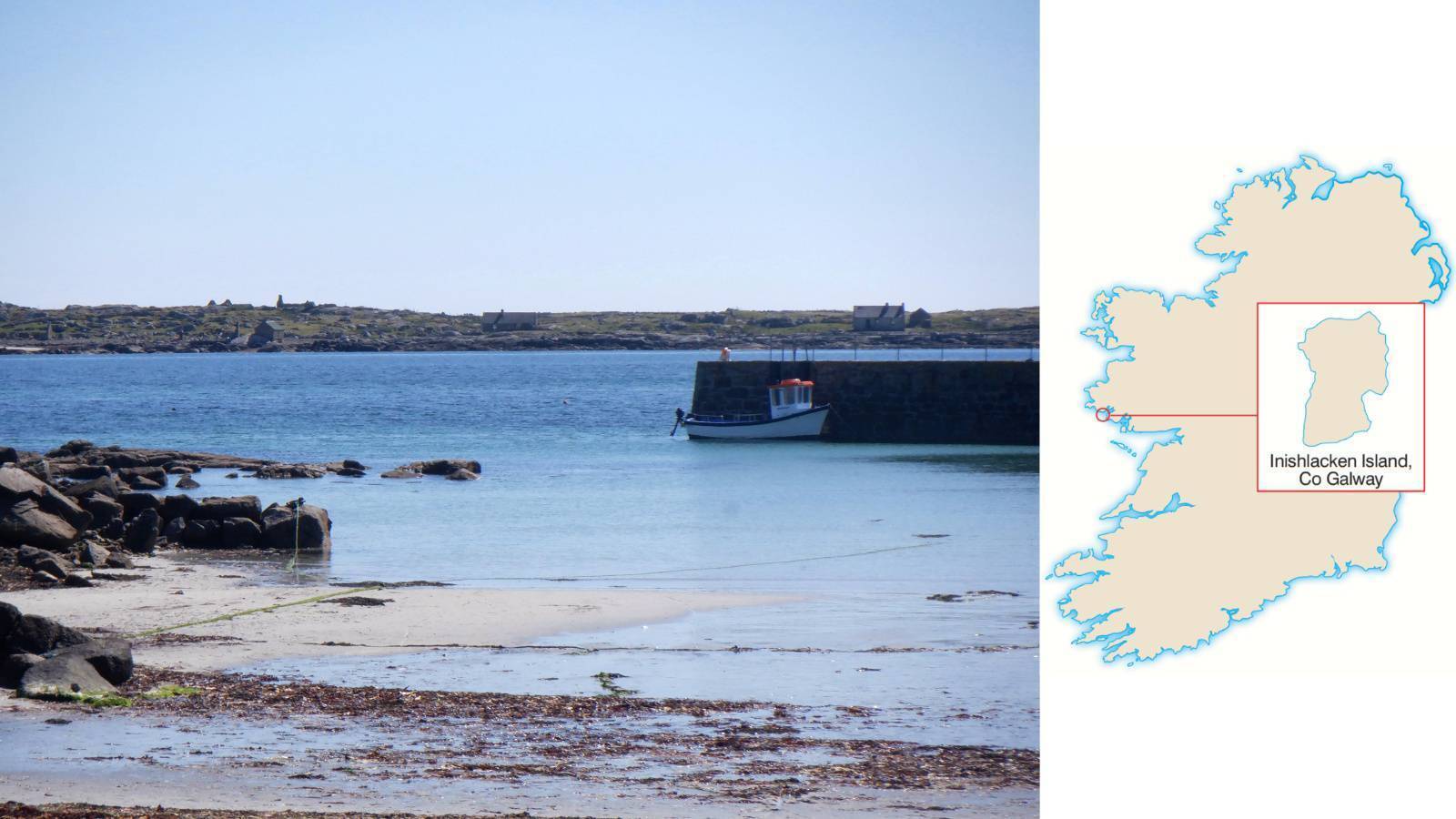
Islands of Ireland: Inishlacken, County Galway. Picture: Dan MacCarthy
Inishlacken is one of those truly exceptional places that just takes your breath away. Sherkin Island, County Cork and Inishbofin in Galway are also in this category of truly magical places. To stand on the small ridge overlooking the pure-white beach offset by the turquoise waters of Gurteen Bay and the distant Twelve Bens and Maumturk mountains is to feel your insignificance on this planet. A beautiful walk along old boreens and along the shoreline can be made from the beach to complete a full circle of the island.
The island is uninhabited now save for a few holiday homes occupied in the summer. There are, at a guess, about two dozen roofless ruins of finely built houses whose occupants have long gone. The population of the 129-acre island peaked at 126 people in 1841, before declining over the years.
The prominent names associated with the island are Baker, Coneely, Greene, McDonagh, Reilly, Toole, Walshe, and Woods. That's present tense — as, judging by genealogy websites, there is plenty of interest among American descendants in tracing their ancestors. There was even a Michael Flatley. There was a school too to cater for the many children.
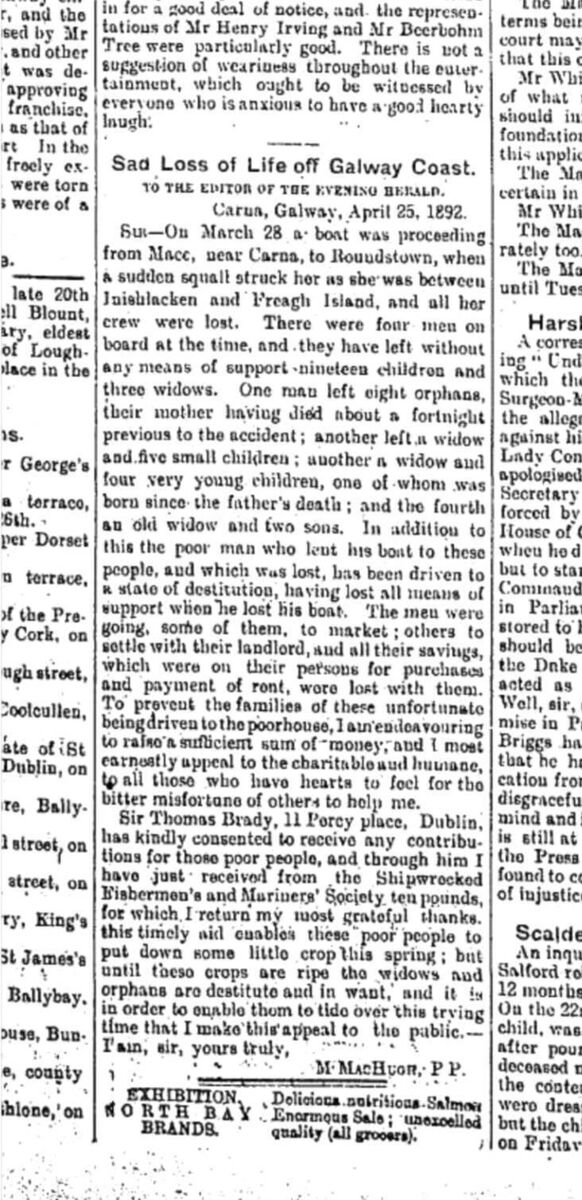
The main source of income for the inhabitants was, of course, fishing, with some farming to supplement it. And, with the sometimes furious seas on this part of the coast, earning a living by this means was a continuous risk for the fishermen. This is underscored by the loss of four local men in 1892 when their boat sank near the island having been hit by a squall. They left three widows and 19 children without means of support, reported the Evening Herald. The event was particularly tragic as the men were on their way to pay rent to their landlord “and all of their savings which were on their persons for purchases and payment of rent were lost with them”. A letter to the newspaper from parish priest M MacHugh appealed for funds to support the destitute families. The Shipwrecked Fisherman’s and Mariner’s Society donated) the not inconsiderable sum of) £10.
Farming too, was not a reliable source of income. In 1904 the Irish Daily Independent reported that soil was lost after a severe storm that swept Connemara and the resulting potato crop was just one third of the usual yield. On Inishlacken and the neighbouring Inishnee there were 120 families in need of support.
Inishlacken Couple
— Francisco Ribeiro (@fraveris) October 11, 2017
Gerard Dillon
date unknown pic.twitter.com/85XLjJQqmh
Time moves on and where once hardship was the order of the day now Inishlacken is a place of artistic interest. The association began in 1951 when the artist Gerard Dillon rented a cottage there for the summer to record scenes of working people. ‘Innishlacken Couple’ captures a man and a woman in a domestic setting. The island was reinvented in a sense. In 2020 the Inishlacken Project saw artists including Rosie McGurran, Mick O’Dea, and Noah Rose depict the landscape in new interpretations. This work has been exhibited from Inis Oirr to Belfast to New York.
The name derives from Inis Leacain or Island of the Flagstones. Alternative name are given as Enishlackery and Leith Dhuine.
There is evidence of human settlement probably from the Mesolithic period 7,000 to 8,000 years ago in the form of a midden where remnants of shellfish have been found. On the north of the island is a structure relating to the nearby St Macdara’s Island.
The writer David Thomson spent some time on Inishlacken in the 1930s when he was employed as a tutor for the Kirkwood family of Woodbrook, Co Sligo. He described his enchantment with the island in his memoir Woodbrook. “The island was idyllic too at least for those of us who did not have to work or stay the winter.” While staying on the island, the Second World War broke out and Thomson described a sense of detachment from the cataclysm about to be unleashed across Europe. “The island was so pure and simple, and our life there so unmuddled that such thoughts quickly slid away.”
Trips available with Damien O’Malley 0851751809.
facebook.com/roundstonebayandisland/
Inquire at pier or kayak from a beach directly opposite.
: Woodbrook, David Thomson, Vintage; logainm.ie; webworld.org; Evening Herald, April 27, 1892; Irish Daily Independent, December 24, 1904.
CONNECT WITH US TODAY



Be the first to know the latest news and updates