Richard Collins: What's quieter than a fish swimming? A whole school of fish
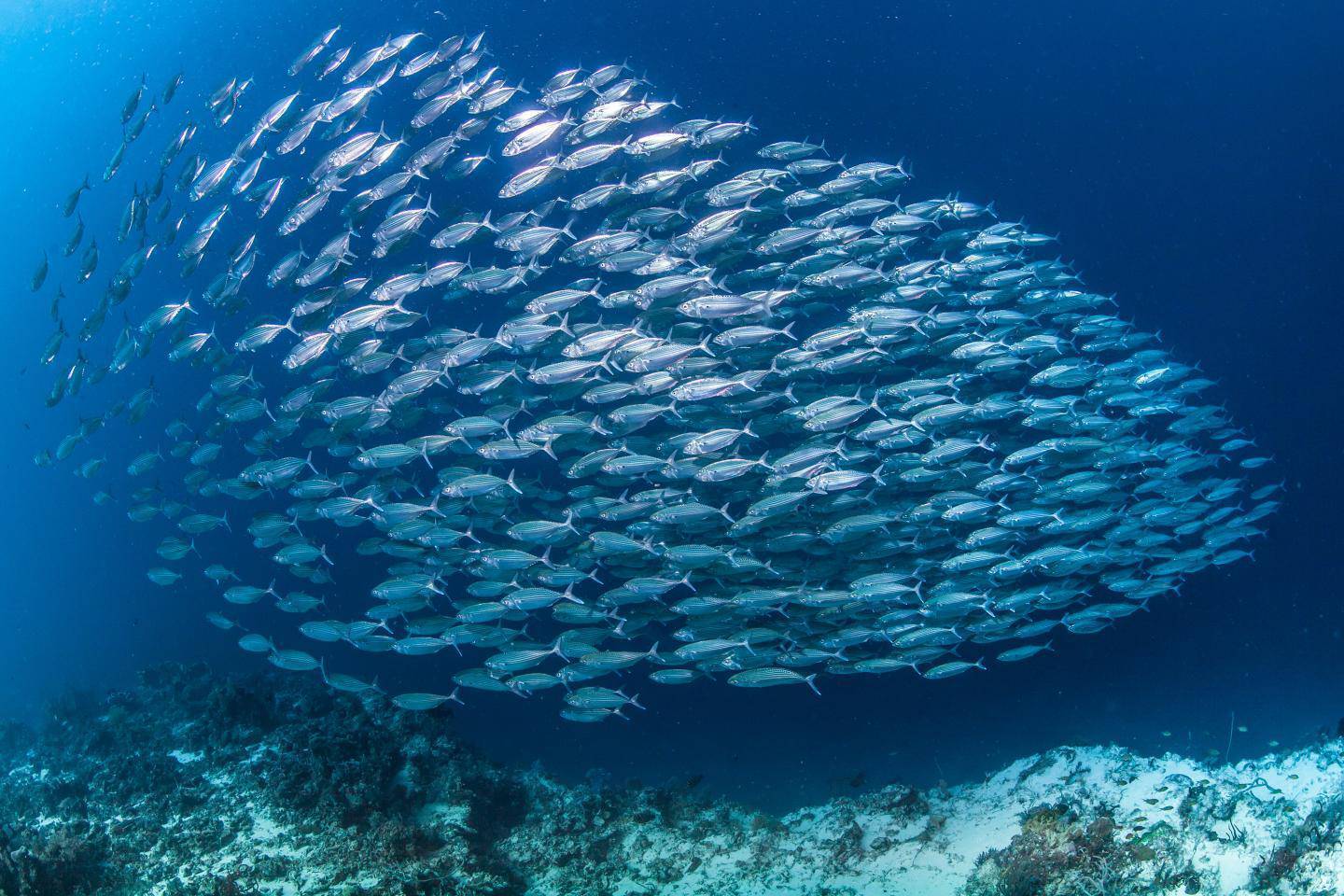
School of mackerel. Picture: Getty / Johns Hopkins University
The murmuration season has come to an end. Only small starling flocks remain. Our resident Irish ones haven’t far to go to nest. Many of them will have paired in the autumn and remained together through the winter. It’s a different story for the visitors, particularly those from mainland Europe. Their journeys home can be very long indeed. Males usually arrive at their destinations first.
Flocking is a starling thing; these gregarious birds like to breed in loose colonies, nesting birds associating with others when feeding. Needless to say, ‘extra-pair copulations’ occur, but variety is the spice of life and nobody is perfect. In one Belgian study, up to 60% of males had ‘flings’. Later in the summer, bands of newly-fledged teenagers roam the countryside, merging eventually into next winter’s murmurations.
There are pros and cons to clubbing together. Communal roosting reduces the heating bill during cold winter nights; warm bodies, huddled together in bushes and reed-beds, raise the ambient temperature. Roosting facilitates the grapevine. Following fat individuals in the morning may lead to rich pickings.
But the chief benefit of cosying up to others is enhanced security. A sparrow-hawk or peregrine may target a roost, picking off the odd unlucky bird. But, in the lottery of life and death, you hope it won’t be you! With all those eyes and ears around to watch out for danger, you can afford to let your guard down and sleep in peace.
There is safety in numbers even when travelling. According to starling expert Chris Feare, birds migrate in flocks of about 50 to 200, occasionally more. Military pilots fly in formation, exploiting the slipstream of the plane in front to save fuel. The enemy is easier to spot, information is pooled and the risk of navigational error reduced. But there’s also a downside. Whereas a lone aircraft may slip past an enemy undetected, a formation is noisier and more conspicuous.
Using a high-tech simulation of schooling mackerel, Johns Hopkins engineers were able to gain new insight into why fish swim in schools and promise for the design and operation of much quieter undersea vehicles. https://t.co/5pwPCT33h7
— Johns Hopkins University (@JohnsHopkins) April 10, 2024
But birds and war planes are not the only communal travellers; fish of many species move in shoals. The security benefits of bird flocks, especially the added protection from predators, apply also to them. But swimming generates noise, drawing the attention of predators. Engineers from Johns Hopkins University, however, claim that shoaling reduces the noise problem. Research they carried out suggests that fish are able to cancel out the sounds their tail-fins make when swimming.
The researchers simulated the movements of mackerel. They varied the numbers of fish in shoals, the separations of the fish from each other, and the degree to which tail movements could be synchronised. The result was extraordinary — they found that "a school of fish swimming together in just the right way was stunningly effective at noise reduction. A school of seven fish sounded like a single fish".
That "schools of fish can make less noise than a solitary swimmer" seems contradictory. But sound is a wave phenomenon. If waves of equal amplitude collide at the right moment, their peaks cancel each other out. By adjusting the distances between neighbours, and synchronising their swimming, fish can reduce the noise they make to a minimum.
Â
- Ji Zhou et al. Effect of schooling on flow generated sounds from carangiform swimmers. Bioinspiration & Biomimetics. 2024