Solar eclipse FAQ: What time will it happen in Ireland and how can I see it?
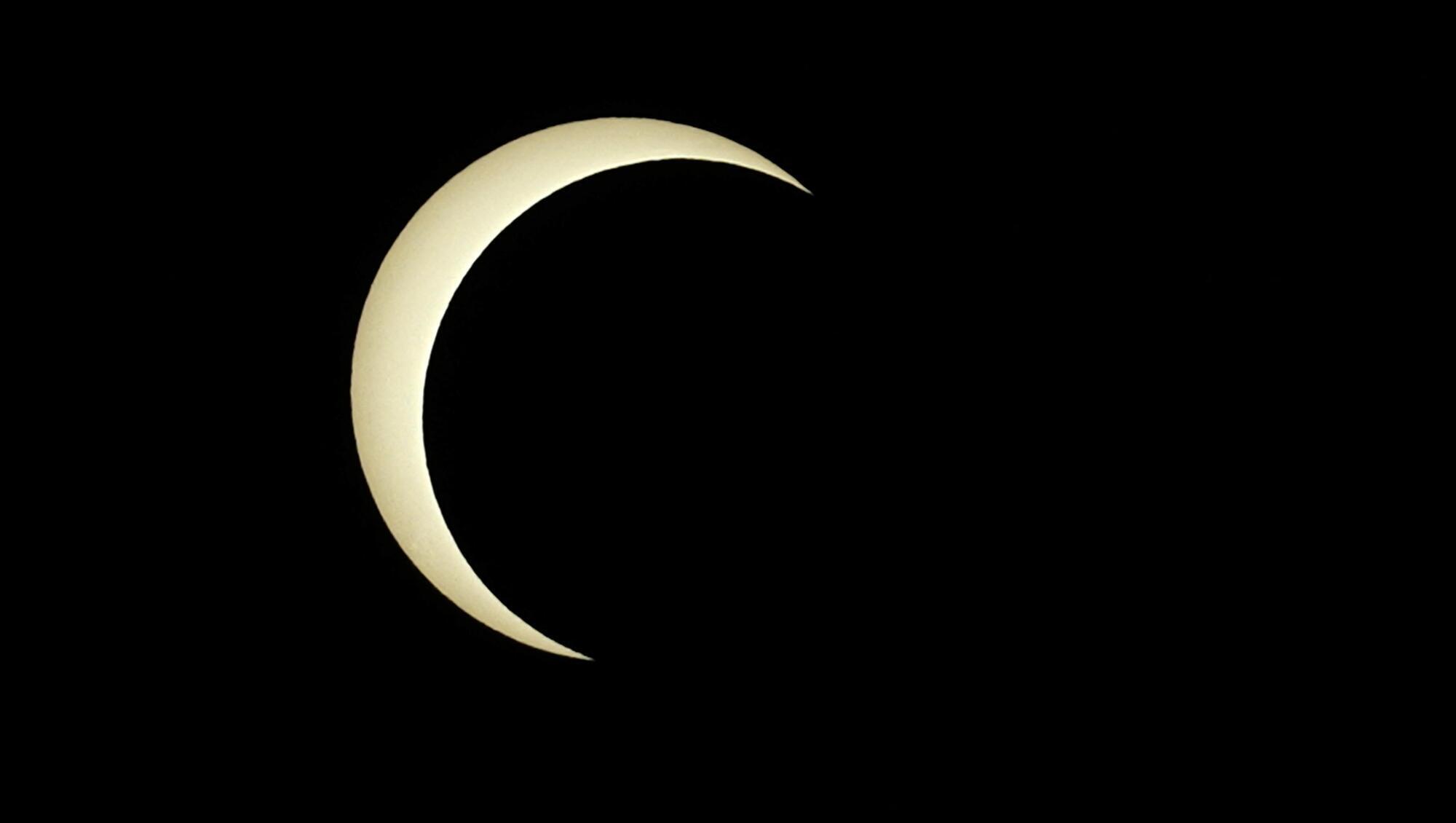
A solar eclipse is seen from Richardson, Texas, Saturday, Oct. 14, 2023. (AP Photo/LM Otero)
The astronomical highlight of April is the solar eclipse on April 8, when the Moon passes in front of the Sun.
While this is a total eclipse in the US, we unfortunately don’t get a great view in Ireland and only 20% of the Sun’s disk is covered.
If you want to observe the event you must either project the Sun through a pinhole in a sheet of paper or card onto a flat surface, or use special eclipse glasses – but NEVER look directly at the Sun.
The eclipse is at its maximum around 20:08 (East Coast) to 20:24 (West Coast), but the Sun is only 0.6 degrees above the horizon, so you’ll need to have a viewing point on higher ground with an unobstructed view to the west.
Alternatively, somewhere on a west-facing coastline could result in spectacular opportunities for a unique photograph with the partially-eclipsed Sun reflected in the water. Depending on the local atmospheric conditions, the Sun might be golden or deep red in colour.
If you are unable to view the eclipse due to cloud cover in your area, you can watch it online through one of the services listed here.
Total eclipses of the Sun are rare from any given location. In Ireland, the next total solar eclipse will occur on 23rd September 2090. If you want to see one before then, you’ll have to go travelling.
The next one is on August 12th 2026 and will be visible from the Arctic, Greenland, Iceland and Spain – time enough to make those planning arrangements!
One of the greatest achievements of early 20th-century science was the discovery that we live in a very large universe that is constantly expanding.
The infamous Monty Python crew even incorporated this realization into the lyrics of their 1983 “Galaxy Song” from the film The Meaning of Life – “The universe itself keeps on expanding and expanding, in all of the directions it can whizz …”
Roll the clock forward 100 years to the present day and one might imagine that we would have a better idea of how fast the universe is expanding.
But recent observations have rather set the cat amongst the pigeons in this regard.
Using two of the most famous satellites, the Hubble Space Telescope and the James Webb Space Telescope, astronomers have honed their calculation of the rate of expansion, and indeed these two telescopes agree extremely well on the value.
However, a much less well-known satellite called Planck which was operational from 2009 until 2013 also measured the rate of expansion using a completely different technique to Hubble and Webb and finds a different value for this expansion.
The problem now is that two different values mean there’s something going on which is currently not well explained by any models we have to explain our universe.
We’re pretty sure it’s not a problem with any of these satellites – it seems to be something that’s embedded in the very fabric of the Universe.
Does this discrepancy matter, other than as something to debate over coffee & cake? Well, yes – possibly.
Isaac Azimov, scientist and science fiction writer once commented that: “The most exciting phrase to hear in science, the one that heralds new discoveries, is not "Eureka!" but "That's funny...".
This discovery that there’s something amiss with our view of our home universe may remain in the realm of being merely ‘funny’.
Or it could lead us along pathways of discovery that we can hardly imagine today.
Could there be new laws of physics that we should know about? Did the universe behave differently when it was younger, and if so, how might it behave in the future? Are some of the laws of the universe subject to change? And how we will resolve this conundrum?
Not surprisingly, new and renewed theories of how our universe works have found their way into the scientific literature in recent months, as teams from around the globe scramble for the definitive explanation.

CONNECT WITH US TODAY



Be the first to know the latest news and updates