Richard Collins: Gigantic penguins are extinct — will climate change take Emperor penguins next?
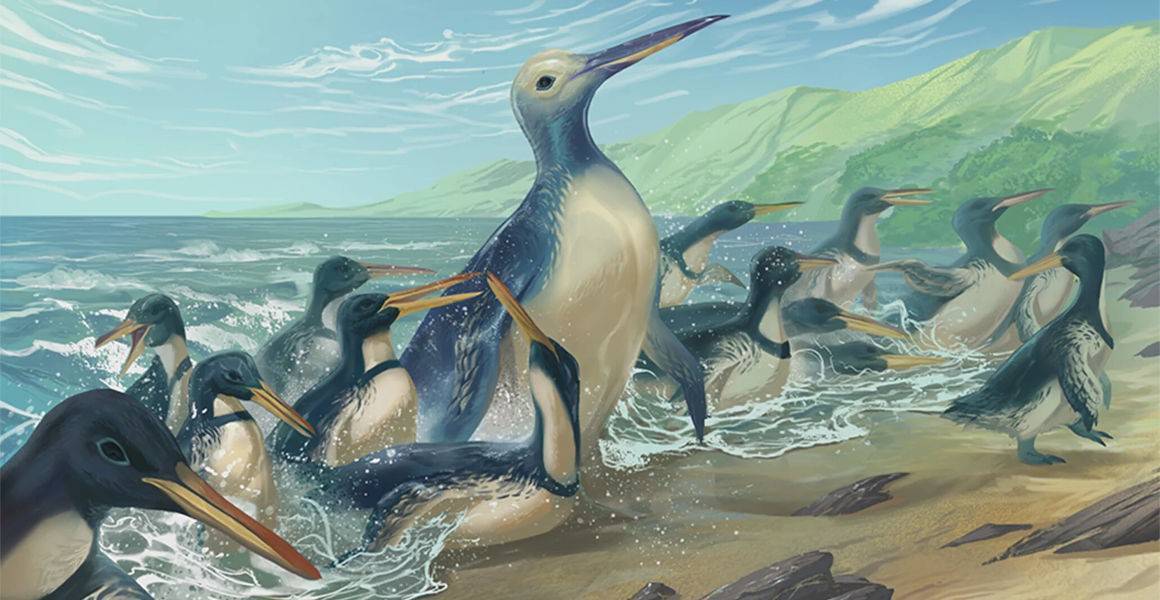
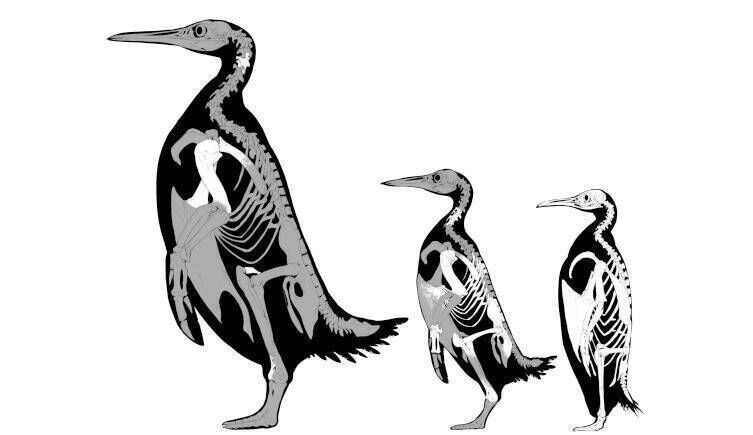
The penguin Kumimanu fordycei would have towered over other species such as Petradyptes stonehousei more than 55 million years ago. Picture: Dr Simone Giovanardi / Natural History Museum
Are you in the wrong job? Would a different path have suited you better? Or is it just that far-off hills are greener?
Some wild creatures seem to have similar doubts. Red squirrels, for example, flit about in the treetops, seldom descending to the ground. They seem to wish they were blue tits. Ostriches have powerful legs and eyes larger than their brains to alert them to danger. Do they yearn to be horses?
But the biggest 'square pegs in round holes' are surely the penguins. So impressed were they with the antics of dolphins that they abandoned flying to be like them. It was a risk, but it paid off: there are 17 surviving penguin species, all in the Southern Hemisphere. But success comes at a price — three are considered to be ‘endangered’, and seven more are listed as ‘vulnerable’.
Giving up flying wasn’t a recent development. The British Natural History Museum has just published its list of species newly-discovered in 2023.
Our team is thrilled to announce two new species of fossil penguin, named in honor of two legends in the field. Kumimanu fordycei pays tribute to Dr. R. Ewan Fordyce and Petradyptes stonehousei celebrates the legacy of the late Dr. Bernard Stonehouse.https://t.co/VDf5Z8i0JZ
— Daniel Ksepka (@KsepkaLab) February 8, 2023
It includes an ancient penguin, fossils of which were found in New Zealand. Kumimanu fordycei, ‘Fordyce’s monster bird’ in Maori, was a penguin that roamed the southern oceans 60 million years ago. Two metres tall, it weighed 150kg, four times as much as an emperor penguin, the largest living member of the tribe. Fordycei was not the only such giant, but it’s the largest one recorded to date.
Like all birds, penguins lay eggs. They can’t do so at sea, so they must spend long periods on land incubating and raising chicks. Adapted to life on the ocean, they are 'fish out of water' when away from it. Clumsy and vulnerable, they nest in the remotest of places.
Congrats to @KsepkaLab & @TennysonAlan on leading work revealing the largest penguin ever! At approximately 350 pounds, Kumimanu fordycei was heavier than @SHAQ. Much shorter, though! Grateful to have been involved and excited to introduce The Shaq as a unit of mass. https://t.co/omPS7Zi1wy pic.twitter.com/IHD47Op9QU
— Field Palaeobiology Research Group (@fieldpalaeo) February 8, 2023
Emperors lay their eggs on the Antarctic ice, the harshest of environments. Courtship begins in March, the start of the southern winter, when the ice cover is increasing. By the time the chicks fledge in December, it will be retreating. Would-be parents therefore must trek up to 100km or more from the sea to ensure the ice won’t melt under the nestlings before they fledge.
Now, global warming is accelerating the thaw. Two years ago, says a BBC report, 10,000 chicks perished when the ice melted before their feathers could become waterproof. It is estimated that climate change will reduce the emperor population by 90% by the end of the century.
Big birds usually remain faithful to their breeding partner from year to year. Doing so would seem to benefit emperors, considering the challenges they face breeding in such god-forsaken places. Monogamy, however, is a luxury that emperors can’t afford. Penguin spouses go their separate ways after the breeding season. A suitor, having arrived back at its colony following an arduous trudge from the sea, can’t afford to wait around for last year’s partner to return so, usually, ‘it taketh another’.
Did the giant penguins face similar difficulties? They owed their existence to the asteroid which wiped out the dinosaurs and marine reptiles. Whales and seals had yet to evolve. The early penguins had the habitat all to themselves allowing them to become huge. But their halcyon days were numbered — they disappeared from the fossil record about 20 million years ago.
CLIMATE & SUSTAINABILITY HUB
CONNECT WITH US TODAY



Be the first to know the latest news and updates