Islands of Ireland: Wherroon Island — rough reefs and a drowning tragedy
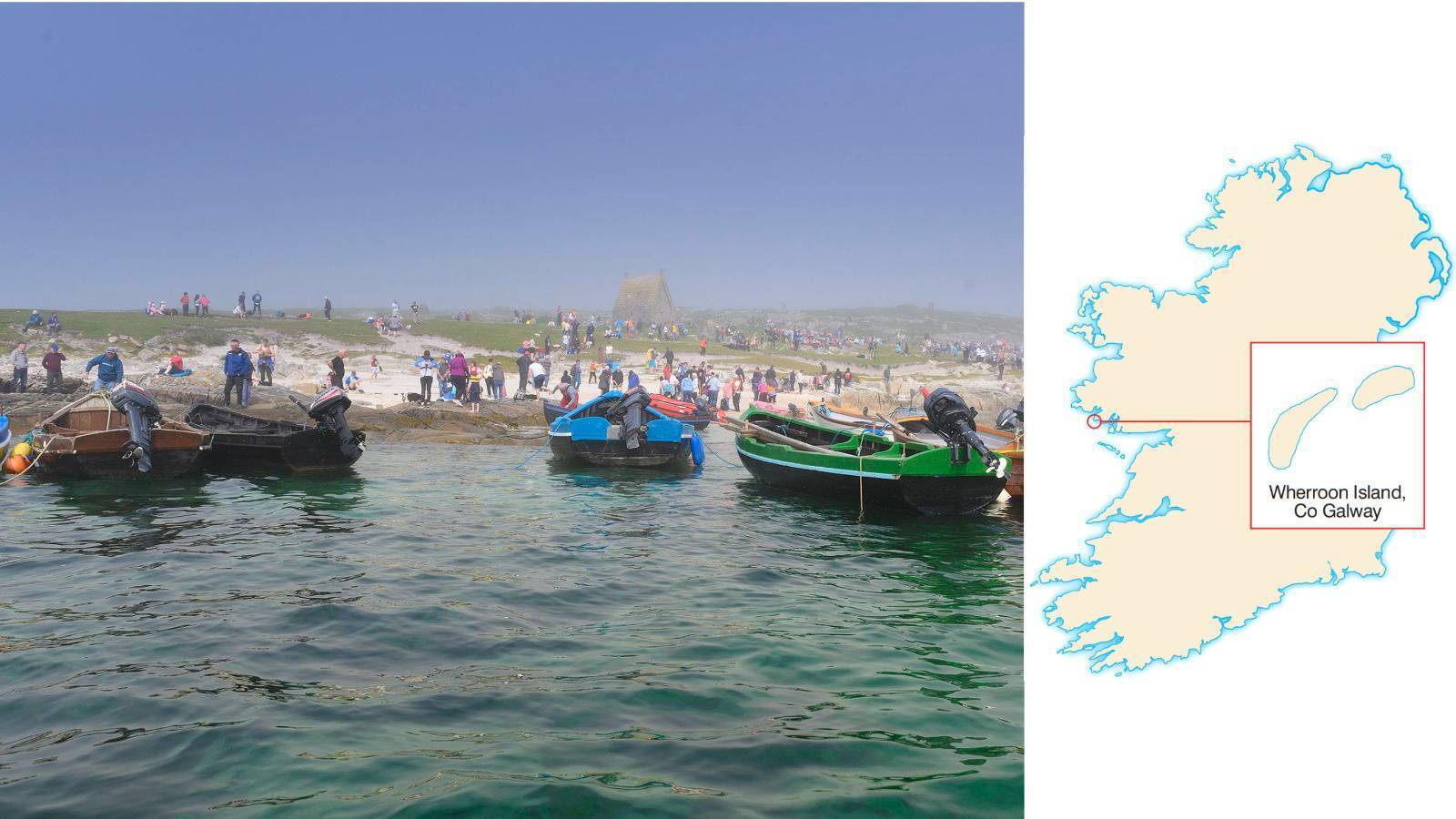
Despite a high tide completely covering this island, people went here to gather seaweed, but rough seas prevented locals from collecting the women working here and they were drowned
Islands of Ireland: Wherroon Island — rough reefs and a drowning tragedy

Islands of Ireland: Casadh Na Taoide — an epic cultural journey connecting five offshore islands and which goes past Wherroon Island. Picture: Michael McLaughlin

It is a name not based in reality and is of the sort which was mined by Brian Friel in his play Translations for the rich ridiculousness English cartographers made of Irish placenames. Wherroon is an island in Connemara that evokes zilch but, reminds one of similar invented words for people or places: Houyhnhnms in Jonathan Swift's Gulliver’s Travels for an exotic race of intelligent horses springs to mind.

The genesis of Wherroon is the Irish from which it is derived of course, Na Foiriúin, whose meaning is itself evasive. The name appears again and again in Connemara Irish. The late Tim Robinson produced a very informative map of Connemara which pinpoints the placenames and the locations where they pop up.


At Slyne Head, to the southwest of Clifden, there is Foirúin. Near Cleggan there are Foiriúinach Thiar agus Foiriúinach Thoir; there is another standalone Foirúin just east of Slyne Head near to Fox Island; and lastly, Na Foirúin Bháite.

The ambivalence in the meaning can be explained by the several spellings of the name which creates a smokescreen of interpretation. Robinson acknowledges this with his attributed meaning of ‘outer rocks’, ‘probably accurate’. The ‘Carraig Bháite mentioned above relates to sunken rocks or reefs. Altogether, an insalubrious place to bring a boat.

In fact, Foirúin rivals if not outstrips another prolific Connemara placename in Freaghillaun (Heather Island) which has an abundant presence there.

The story and music archive of Connemara, thiarwest.com, carries a story about Na Foiriúini that includes a warning to every seafarer: never forget your passengers. The story of these minuscule isles came from local man Peadar Ó Ceannbháin, in the 1930s and related to the folklorist Heinrich Becker.

A high tide was known to completely cover the island, in effect four islets. These did not deter people from going to gather to creathnach, or duileasc (red seaweed).

“When the tide was out, the women went in to pluck this creathnach, or duileasc. They were brought in there by boat and the men put them ashore, on the rocks. They went perhaps into Galway Bay. The sea got very rough,” stated Ó Ceannbháin.

When the men returned they were unable to pick up the women as the sea was too rough. It was not possible to rescue the women as the boat could not get past the rough reefs.“When the tide rose, the rocks were submerged and the women were left on the rocks. They were looking at these from outside the island, being drowned.”

Ó Ceannbháin ended the sad tale of 300 years before with an unarguable truism: “Well, no boat could go ashore in a place of this kind as it would become matchwood. It was a sailing boat, a púcán, they had, a boat of up to about four tons. It would not be as big as a turf boat.”

True for a fishing boat, but when the tide is right a kayak can nose its way in through the reefs for a safe landing. Any landing will of necessity be brief as this is not a place to stretch the legs.

As much as these islands are dwarfed by the adjacent Avery Island they are much more dwarfed by the comparatively huge St MacDara’s Island and Mason’s Island which are in turn dwarfed by the relatively vast Mweenish Island. St MacDara’s is the site of an annual pilgrimage where locals pay tribute to the saint and passing boats dip their sails as a sign of respect. Barely a glance will be cast at Wherroon nor its rubble-strewn friend, Avery.

And as seemingly insignificant as it may seem, Wherroon still managed to find its way into a poem celebrating MacDara’s Island, referenced here by its Irish name: Sweet Cruach na Carra, hallowed Isle/ The evening lights are on thy breast/ The Skirds in wondrous beauty smile/ And Wherroon’s waters wash thy crags/ That kiss the cloudless welkin blue.” The author of the 1926 poem was Connemara native James O’Neill Moran.

  • How to get there: No ferry. Kayak from a small strand in the townland of Ard just west of Carna, Co Galway.
  • Other: thiarwest.com
  • Connemara: A little Gaelic Kingdom, Tim Robinson
  • facebook.com/MVNaomhEanna

x

More in this section

Revoiced

Newsletter

Sign up to the best reads of the week from irishexaminer.com selected just for you.

Cookie Policy Privacy Policy Brand Safety FAQ Help Contact Us Terms and Conditions

© Examiner Echo Group Limited