Islands of Ireland: Inisherkin is a pretty bleak — but also majestic — spot in Clew Bay
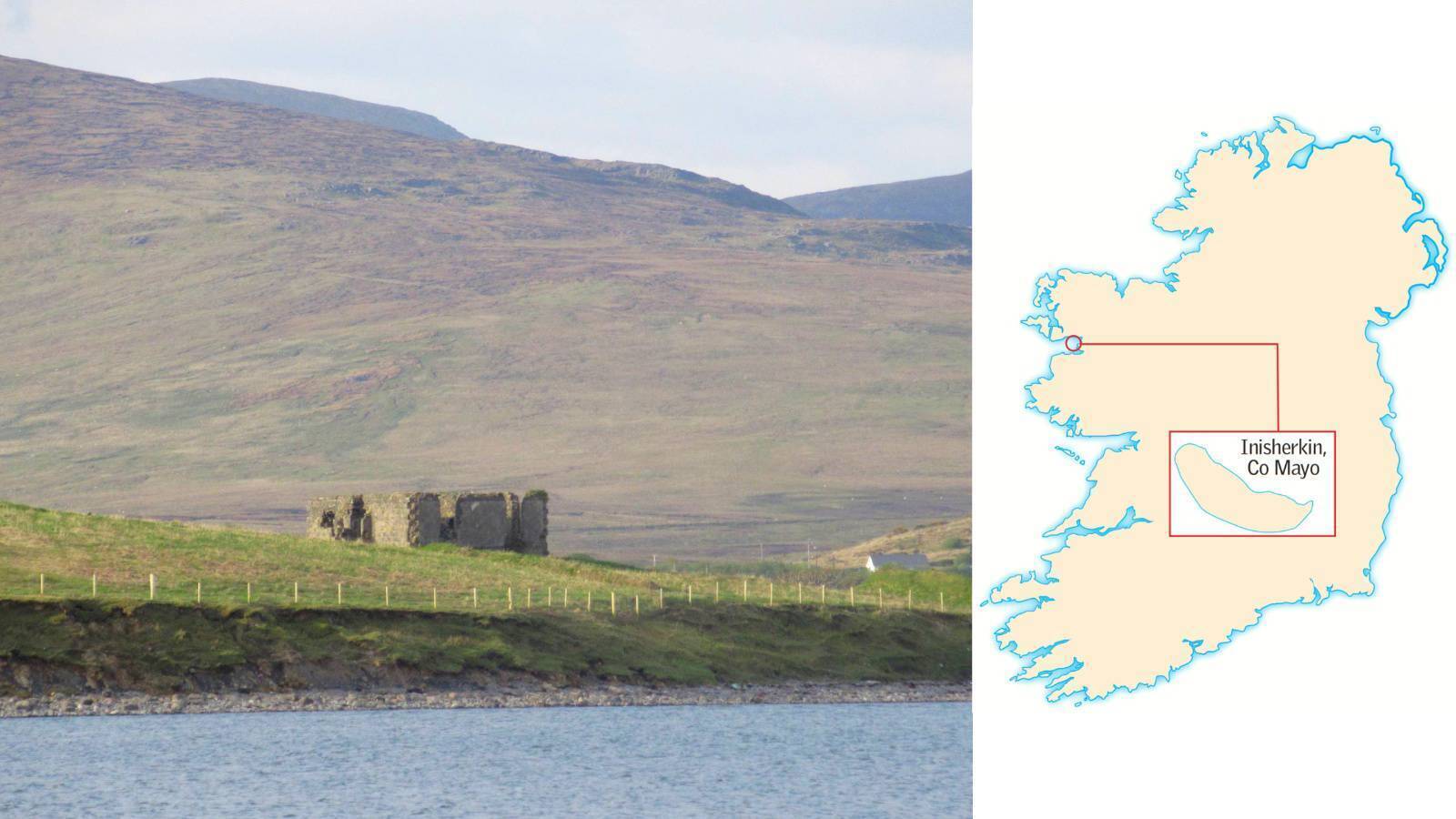
Islands of Ireland: Inisherkin, Clew Bay, County Mayo. Picture: Dan MacCarthy
As the picture suggests, this particular island is a pretty bleak place. And yet, majestic in its own way. There is no one there living there now but in the 19th century several families called it home. Its treeless 'quality' is most striking. Then of course, the unforgiving sea, and the also treeless mountain range lying behind it — part of the Nephin range looking like an uncoiled snake — are also striking. No names of any places on the island, such as headlands, bays or cliffs, are extant so the mountain's also unforgiving peaks of quartzite, must provide: Nephin Beg, Maumthomas Corranabinnia.
Inisherkin, County Mayo shares its name with one in West Cork (Sherkin in English) but has much less going for it than the latter’s audacious beauty.
Ringfort - rath
— everyringfort (@everyringfort) June 21, 2022
INISHERKIN ISLAND,
County Mayo
Ireland
MA03514
MA067-017----https://t.co/BnPeATHckW#everyringfort pic.twitter.com/fwb6I2JeQd
Excluding the most westerly of the Clew Bay islands, Inisherkin, and its three immediate neighbours stand in a straight line and are the first islands a sailor entering Clew Bay north will meet. They are distinguished by their similarity... in fact you could add the vast majority of the rest of Clew Bay’s islands to that description which leans towards the oxymoronic. Their morphology is explained by the gravel oozing from retreating glaciers along with a sea-level rise at the end of the last Ice Age around 12,000 years ago and, in something akin to a potter’s hand on a lump of clay, produced beautifully curved forms.
The Ordnance Survey map reveals a solitary house on the east of the island, bunkered down from the prevailing westerlies but still subject to them. However, records show the island did have a population of 28 people in 1841 which is hard to believe, so austere is the environment. Neither is there a trace of other houses besides the one pictured. It is as though the slate, for these Clew Bay islanders, has been wiped clean.
Though fairly desolate now, apart from a few fishermen, these waters once teemed with life. And while some of Inisherkin’s immediate neighbours were unpopulated (Roeillaun and Inishcooa), Inishkeel did have 23 people pre-Famine living there.
These islands are bereft of archaeological remains save for the latter as well as Inisherkin which have sizeable ringforts indicating the importance of these islands to our Iron Age forebears. And both are also situated on the eastern tips of the islands showing that man’s ability to find refuge from the elements changed little over the millennia.
In the 1920s, the island was rented by the family of Rose Ellen Cleary whose father would swim the cattle at low tide from there to the mainland for sale in the autumn marts. The practice has virtually died out but was once the mainstay of cattle-rearing on many islands around the country. In the spring, the Clearys grazed sheep on the island. Rose Ellen would later emigrate to Australia and later the United States.
More than 24 versions of Inisherkin’s name are given in logainm.ie which in itself is a fascinating study of changing linguistic and social preferences. In 1617 it was Inishurken; by 1635 it was Enishurten or Inishorckane. Gradual changes ensued before it was known by its Irish name in 1838, Ínnísh Cercín — and by its current iteration also in that year.
And though it shares its name with Sherkin (Inisherkin), they arrived at that word by different routes. Both are Anglicised to Inisherkin but the Mayo one is Inis Earcáin and the Cork one is Inish Arcáin. Both are thought to refer to ‘piglet’ or ‘young boar’. The Mayo island is also a townland in its own right.
Inisherkin’s 30 acres is again grazed by sheep today which range over its 32metre height, lords of all they survey. The island lies at the border of the intertidal zone beyond which is deep water. Thus, at low tide it is possible to walk to it and the other islands within the zone which the prior inhabitants would have done.
Whatever its current state, forces of geomorphology and linguistics guarantee that Inisherkin will continue to evolve.
: No ferry. Kayak from one of several small piers east of Mulranny
: , Berry Print, Michael Cusack;
CONNECT WITH US TODAY



Be the first to know the latest news and updates