‘A gentle calm’: France’s streets once again echo to sound of working horses
Towns say they are not driven by nostalgia as they opt for horse-powered bin collections and school runs
‘A gentle calm’: France’s streets once again echo to sound of working horses

Dispar is one of two draft horses used for municipal duties in the French town of Hennebont. Among the tasks are rubbish collection and horse-drawn carriages taking children to school. Picture: Ville d'Hennebont - Henbont

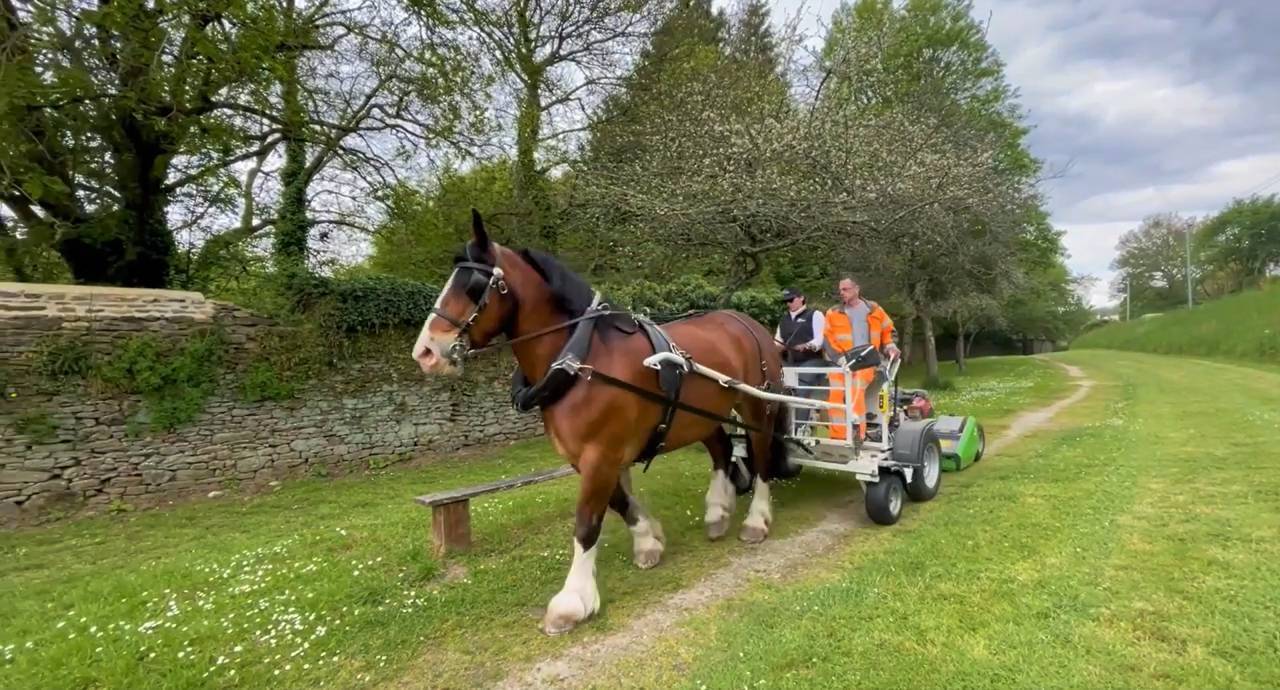
The clip-clop of hooves marked the start of the morning rubbish collection in the Brittany town of Hennebont, as Dispar, a Breton draft horse, pulled a small cart towards the waste bins on a central street.

“This job is so much nicer with an animal,” said Julien, 38, who usually worked emptying bins onto a motorised rubbish-truck in another town. “People see you differently, they say hello instead of beeping. This is the future, it saves on pollution, petrol and noise. And it makes people smile. Normally, I’d be constantly breathing in exhaust fumes behind my lorry, so this feels much healthier.”

Faced with climate breakdown, the energy crisis, and modern stress levels, there is a growing movement in French towns to bring back the horse and cart as an alternative to fossil fuels and a way to slow down urban life.

Florence, an estate agent in Hennebont, always stepped out of her office to watch the horse-drawn bin cart pass. She said: “When I hear the sound of the hooves it’s just total happiness to me. It brings a kind of gentle calm in these frantic times. It brings a bit of poetry into daily life, a reminder that things can be more simple. If I could live in a worldwithout cars, I would.”

Circus and Dispar in Hennebont. Picture: Haras National d'Hennebont

Since the first trials to reintroduce draft horses for municipal tasks in the mid-1990s, the number of French towns and urban areas using them has multiplied by almost 20 and continues to rise. Up to 200 urban areas have used draft horses in recent years. The most frequent tasks are rubbish collection and pulling carriages taking children to school.

In the southern town of Vendargues, where the horse-drawn school carts are so popular that waiting lists have been 100 families long, a study found they had improved the children’s relationship to learning. Some children who could walk or cycle to school preferred travelling by horse-drawn cart, despite it taking longer, because they found it “calming”.

Municipal draft horses have also been used for the maintenance of green spaces, public transport to markets, local forestry work and collecting Christmas trees for recycling. In parallel, there has been an increase in the agricultural use of horses and donkeys, with hundreds currently used in vineyards and for market gardening. Carriage driving, which was once a man’s domain, is increasingly attracting women.

Local politicians like the symbolism of a horse to show they are acting for the environment. As one said, horses bring a “feel-good factor”.

Towns argue they are not driven by nostalgia. At the start of the 20th century, there was one horse for every five people in France, and draft horses often did perilous work in industry or down mines.

Hennebont's municipal draft horses, Circus and Dispar. Picture: Haras National d'Hennebont

Vanina Deneux-Le Barh, a sociologist at the French Institute for Horses and Riding said: “It’s absolutely not a return to the past. It’s a sustainable development approach, about respecting nature and welfare in new, innovative ways — for example with electric assistance for horses going up gradients, or with progress in new types of harnessing.”

Hennebont, a town of 15,000 people in west Brittany, is the latest to offer a new training scheme for municipal horses, carriage drivers and local authority workers. Its municipal Breton draft horses, Dispar and Circus, are brothers aged 8 and 9 who weigh about 900kg (1,984lb) each, and live outdoors in a vast paddock with limited work hours. Their plodding pace, at 6-8km/h (3.7-5mph), includes transporting children from an after-school club to the canteen, taking shoppers to market, activities at a local care home and collecting rubbish. But much of their time is spent resting.

Morgane Perlade, a carriage driver, coordinates Hennebont’s unique service to employ the horses across all areas of urban life: “The presence of a horse rehumanises a town. If the town hall wants to conduct a survey on the renovation of a housing estate, they might not get many replies. But if we bring a horse along to the housing estate, everyone will come over to talk and answer the survey.”

Attitudes towards rubbish collection have changed, with local residents setting apart their glass bottles to make it easier for the horse-drawn workers. “I’m not sure they would do the same for a bin lorry,” Perlade said.

At the local care home, residents have regular visits from Hennebont’s municipal horses. “Some people here who rarely speak in phrases will say full sentences when speaking to a horse,” said Magali, a care-home coordinator. She said that when the horse and cart comes to transport residents to cultural events, they dress up smartly, in a way they don’t for the minibus.

Bernadette Lizet, an ethnologist and historian of draft horses, said their return to the urban landscape is rooted in growing global concern to protect biodiversity. Draft horses remain popular with the public, because “they represent a link between generations”, said Lizet. “Horses disappeared from farming life in France relatively recently, it’s the 60s, 70s, even 80s. Their presence represents a connection between old and young.”

Véronique, 73, a pensioner who had retired to Hennebont from Paris, said: “Just the sound of the horse crossing the town makes me happy for my grandchildren.”

— The Guardian

x

More in this section

Revoiced

Newsletter

Sign up to the best reads of the week from irishexaminer.com selected just for you.

Cookie Policy Privacy Policy Brand Safety FAQ Help Contact Us Terms and Conditions

© Examiner Echo Group Limited