Why do starlings fly long distances to join murmurations?
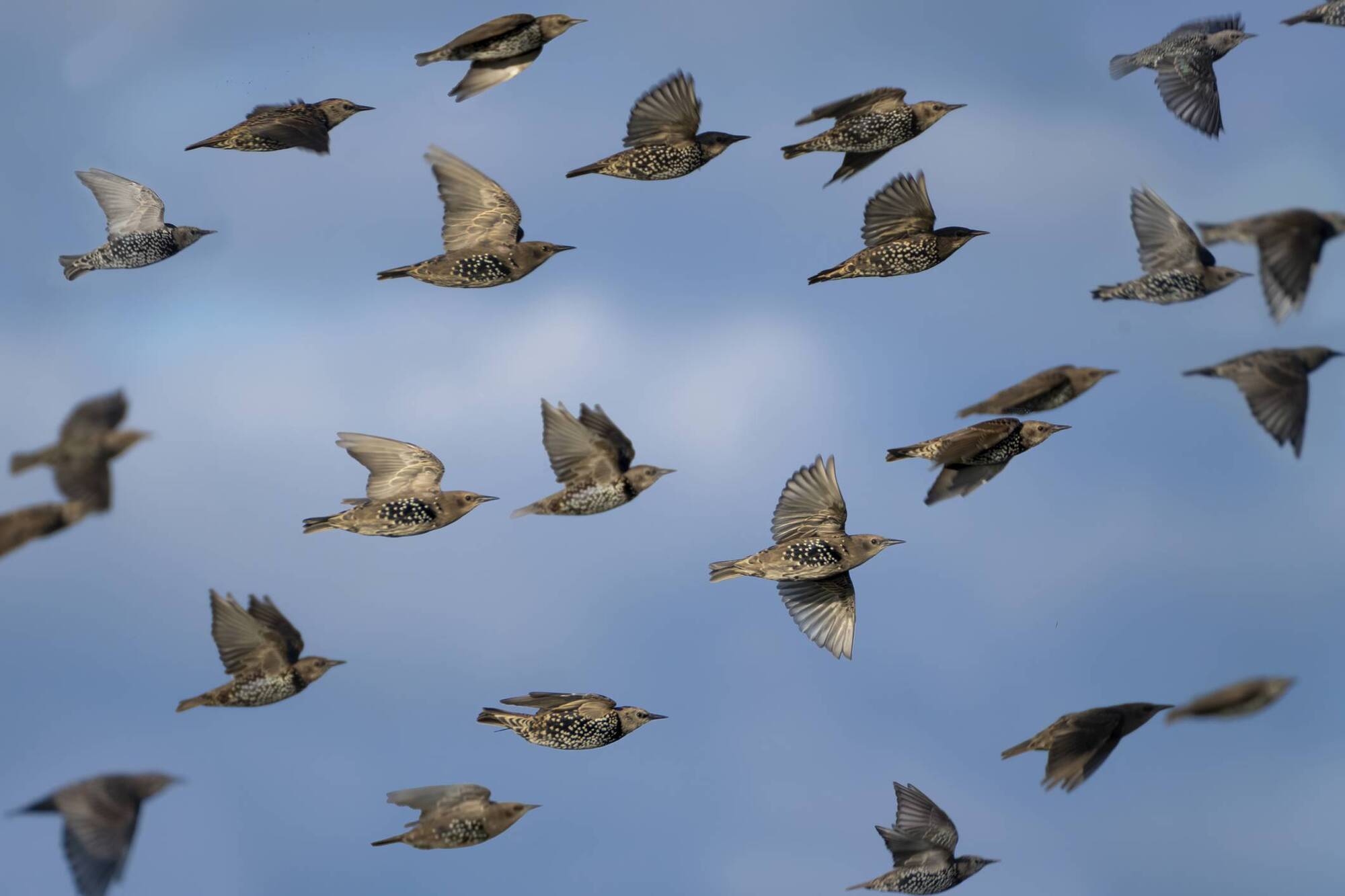
Large roosts offer ‘neighbourhood watch’ security. Picture: iStock
Bands of starlings are roaming the countryside; the winter flocking season has arrived. Reinforcements from mainland Europe will join them, assembling into huge ‘murmurations’ at dusk. There will soon be hundreds of thousands of birds at traditional locations.
Why starlings fly tens of kilometres to join a multitude of their peers has not been fully explained. Protection from cold during winter nights is probably a factor. All those warm bodies, huddled together on branches, raise the temperature of a roosting site. But travelling long distances to avail of this seems slightly daft. Surely more energy is used flying to and from the site than will be gained overnight. Wouldn’t joining smaller, more local, aggregations be just as effective? And cross-country flying is risky; predators may be lying in wait around the murmuration site.
Large roosts offer ‘neighbourhood watch’ security. With so many pairs of eyes and ears to spot an intruding cat hawk or owl, a starling can afford to sleep in peace. In any case, a victim will be one in thousands. With so many birds all around, it’s unlikely to be you!
Sparrowhawks mount hit-and-run raids on the perched birds and peregrines wheel on high, preparing to ‘stoop’. But catching a bird flying in a flock is no pushover. In a teeming mass of fast-moving feathers, an attacker may become confused and fail to catch anything; ‘poverty in the midst of plenty.’ Nor is the problem confined to birds. Predators attacking bats or shoals of fish face similar challenges.
The little merlin, the ‘lady’s falcon’, has solved that problem. Frequenting estuaries in winter, it flies at roosting flocks of small waders to ‘put them up’. Heading into the flying tumult, it selects a particular individual. Keeping its eye on the ball, the merlin pursues the unfortunate bird relentlessly, ignoring temptations to chase others, until the victim becomes exhausted. Once the target bird drops out of the flock, it is doomed. That merlins had to develop this ‘exhaustion hunting’ technique shows that raptors have indeed a problem targeting flocking birds.
Plunging into the teeming mass, hoping that an unwary bird will stumble into your talons is not very productive, so is there an alternative? Caroline Brighton of Oxford University has studied Mexican free-tailed bats, up to 900, 000 of which roost in the Jornada caves in New Mexico. The bats swarm forth as dusk when birds of prey, mainly Swainson’s hawks, lie in ambush for them.
Brighton’s team set up paired high-speed video cameras at strategic locations outside the roosting cave. The footage obtained enabled the flight trajectories of bats and hawks to be modelled in three dimensions. Analyses of these showed that predators don’t swoop and swerve within the flock. Instead, they head for a fixed point within the flock, reducing the ‘confusion effect’. ‘Hawks display no evidence of confusion’ the researchers found.
Sailors will know that when another boat appears stationary, you are on a collision course with it. A bird seeming stationary to a predator in the tumult is heading towards it and, therefore, will be easy to catch.
- Caroline Brighton et al. Raptors avoid the confusion effect by targeting fixed points in dense aerial prey aggregations. 2022.


CONNECT WITH US TODAY



Be the first to know the latest news and updates