Damien Enright: Basking sharks are back to delight tourists and locals alike
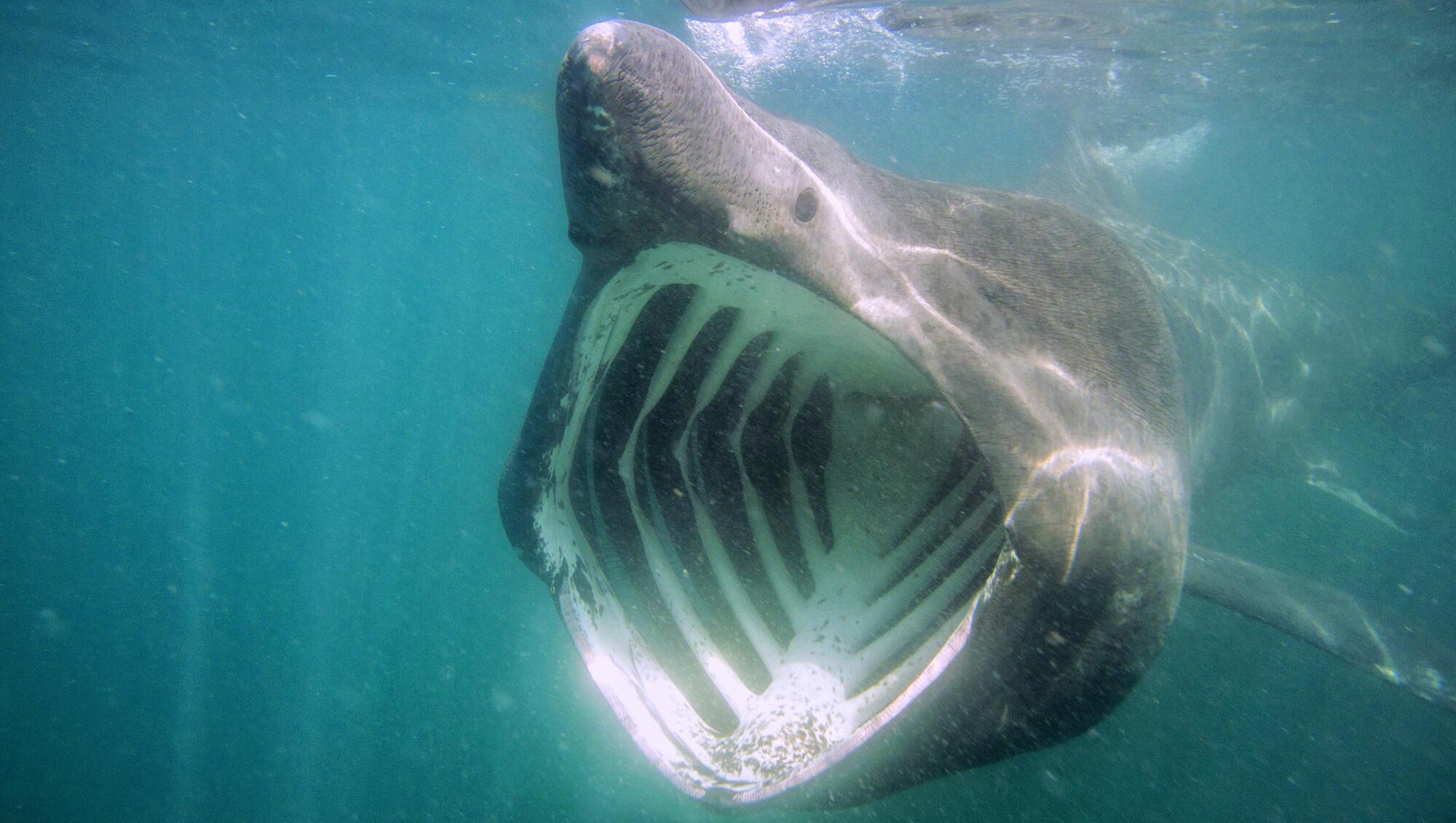
A basking shark feeding off Baltimore, Co. Cork in recent years. Picture: Youen Jacob/Provision
Last week, Mark Gannon, owner of The Courtmacsherry Sea Angling Centre, told me that he and the daytrippers aboard his boat were treated to the phenomenal and inspiring sight of nine basking sharks slowly and, one might think, lazily touring the crystal sea around and beneath his boat as it gently bobbed off the Old Head of Kinsale.
Not only "awesome" but "inspiring" indeed: basking sharks are back. Harmless to humans, this extraordinary creature, readily available for viewing from our native shores, is the world's second-largest fish. It zig-zags through the plankton fields at less than two miles per hour, its huge maw hourly ingesting 2,000 tons of water, enough to fill an Olympic swimming pool. This is filtered through huge gill rakers, leaving tonnes of minute, life-sustaining plankton for consumption.
Circling one another, it might be assumed there was some sort of mating ritual apace. But, probably not; they were gathered to scoop up a particularly rich drift of plankton. Anyway, the visitors aboard Mark's boat will remember the spectacle of these giant fish as the highlight of their trip and the experience that made their Irish holiday more exciting than holidays elsewhere. Like half the visitors to Ireland, wildness was what they came for, and wildness was what they got.
One will find more sun on the Costas, more casinos in St. Tropez and more Mickey Mouse parks in Florida, but one will not find cliffs crowded with the nests of seabirds and huge, basking sharks cruising alongside their boat, their large, floppy fins, like small sails, lazily slicing the sea's surface and their giant, ghostly forms, fourteen feet or more long, and four-foot broad passing just a few metres beneath their feet.
Populations of basking sharks in the north-east Atlantic were decimated in the past century by over-hunting and their numbers reduced to a fraction of what they used to be. Ireland twice had the indecent distinction of almost putting paid to these populations altogether. The largest basking shark fishery in the world was on Achill Island, processing up to 1,800 sharks per year. Having cleaned out the seas, the fishery closed at the end of the 19th century but reopened again in the early 1940s when population levels recovered. It shut for good, due to the scarcity of sharks, in 1975.
By 1993 the global population of basking sharks had dropped by 80% since the 1950s. With their slow pace and just a few metres below the surface, they were "sitting ducks". They were also hunted by Scots, Norwegians, Portuguese, Chinese, Japanese and others.
Mature specimens weigh 4.5 metric tonnes; the liver is 25% of their body weight, and yields 200 to 400 gallons of oil; it was once used in oil lamps and now sometimes used in cosmetics. Bodies were, and are, used as fishmeal for livestock. Nowadays, the Asian appetite for shark's fin soup targets the species — a fin can be as big as a tabletop, and fetch €500 a kilo. On Lombok Island, in Indonesia, I saw amongst other shark species, a giant basking shark cut into four sections, being too heavy to be transported whole.
Irish waters are vital in their migration routes which annually taking them from north to south along the European continental shelf. They arrive here in April and by August have moved on to deeper water where they will hibernate for the winter. Summer is when the seas around Ireland are, literally jumping, or used to be. In August 1995, I wrote about basking sharks in Rosscarbery Bay drifting "amongst shoals of sprats and mackerel milling on all sides. With their gapes, wide as open dustbins, how did they avoid swallowing the mackerel and sprats?" This is unlikely to happen nowadays: the sprat have been hoovered up by unregulated pair trawlers, and the bays are empty of mackerel shoals as a result.
Dr Simon Berrow of the Irish Basking Shark Group is quoted as saying our waters could hold a “significant proportion” of the estimated population of 8,000 to 10,000 worldwide. Nine mature specimens of them off the Old Head is boast-worthy.
Not so boast-worthy, unfortunately, has been our government's tardiness in protecting the species but now, years after the UK government initiated protection measures, Ireland is, at last, instituting protection under our Wildlife Act. Unfortunately, these huge fish are slow breeders. The females bear a small number of 2m long young after a pregnancy of two years. While 'basking' is their usual leisurely behaviour, sometimes, in a burst of energy, they "breach" like whales, leaping high out of the water. A fish big as a double-decker bus in mid-air must be quite a sight!
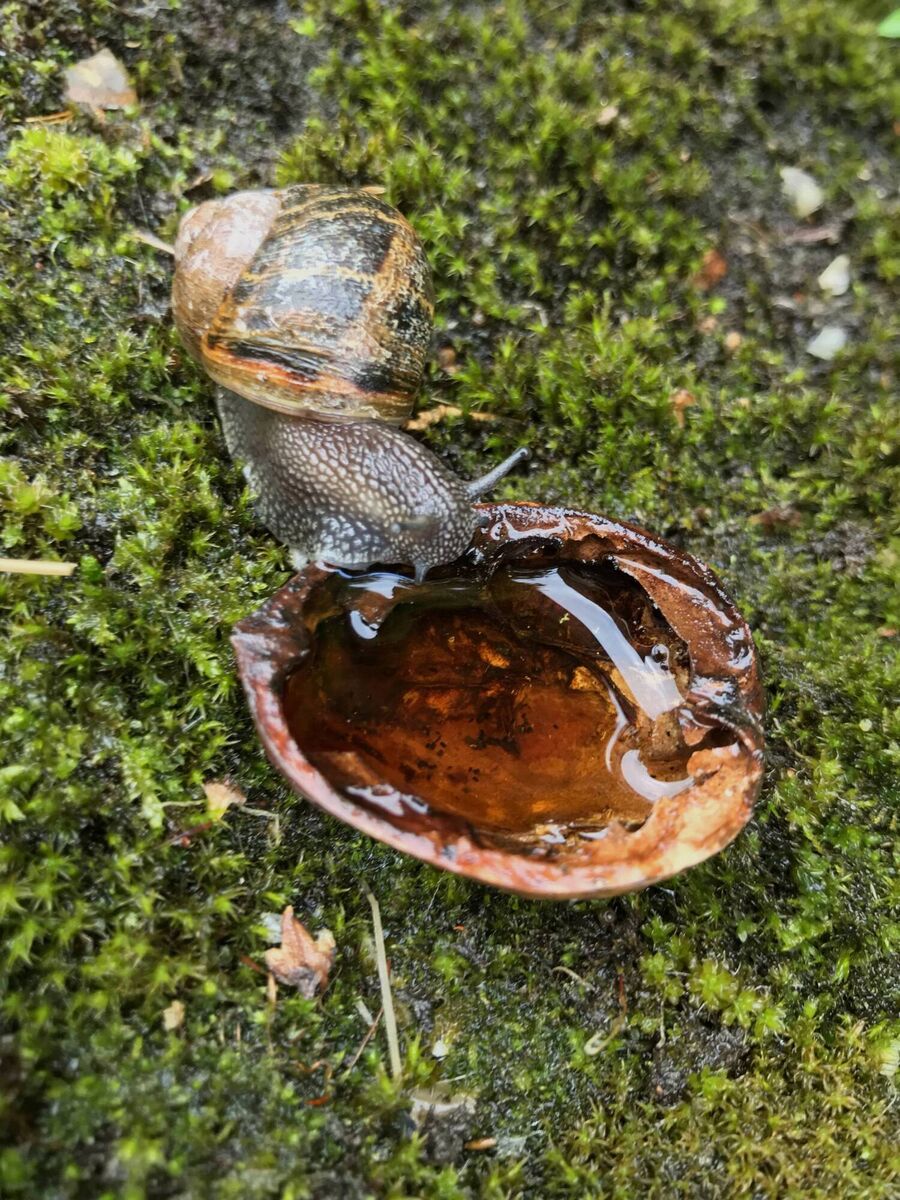
As an endpiece to this fishy article, I must share my daughter's account of her coming upon the touching sight of a thirsty garden snail drinking water from a discarded walnut shell in her north London garden. Previous days had been dry and sunny and the creature was, no doubt, fortunate in finding this life-giving water source. The photograph above was taken by her.
- Damien Enright's final column for the Irish Examiner will be published in print and online on Monday, May 23.
CONNECT WITH US TODAY



Be the first to know the latest news and updates