Damien Enright: How herons hunt and why invasive garlic should be controlled
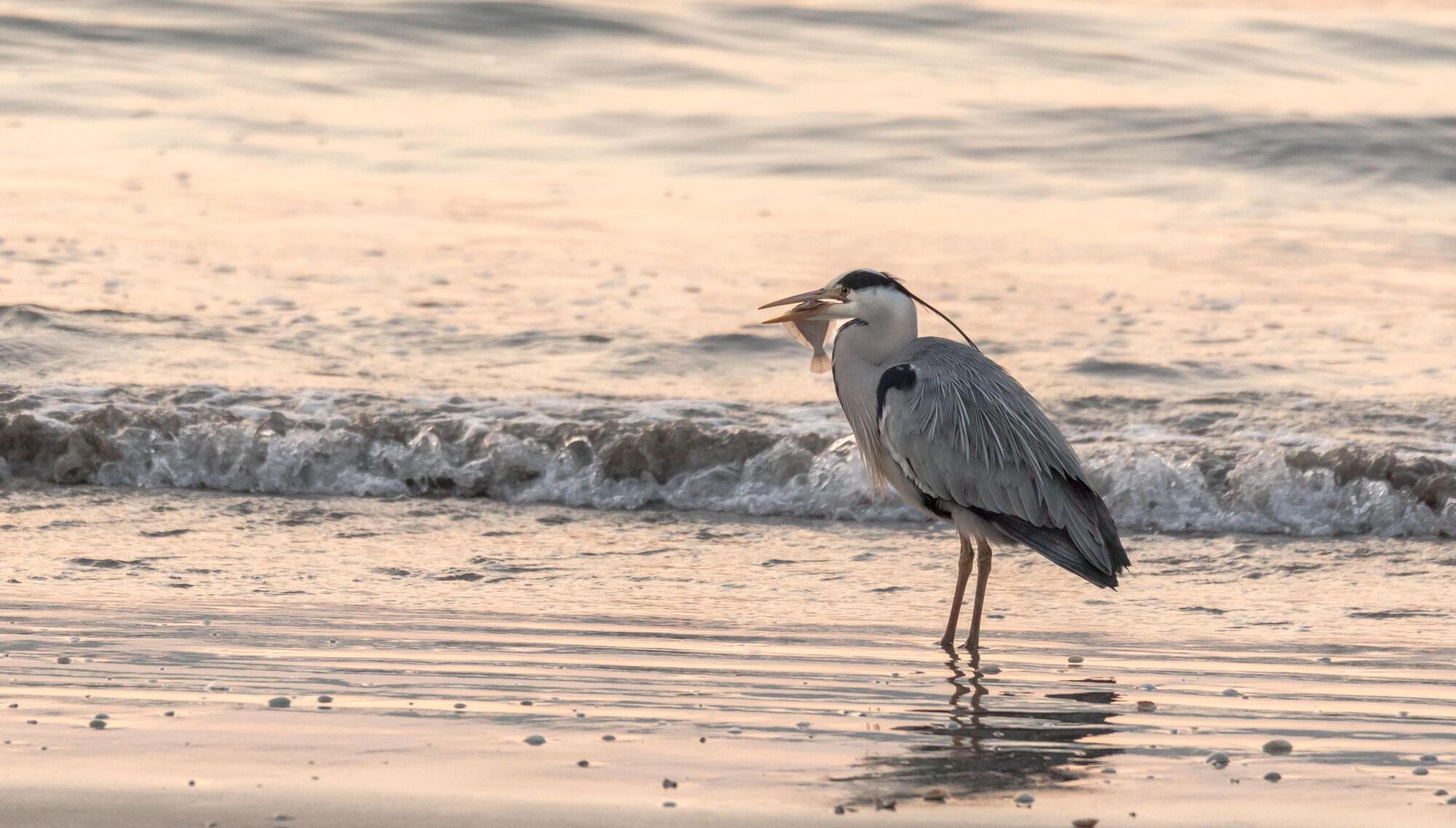
A grey heron with the catch of the day on the shore at Loughbeg, Ringaskiddy, Co. Cork. Picture: David Creedon
On Wednesday last, that day of glorious sunshine, we sat in a friend's house overlooking the Sovereign Islands and the mouth of the wide inlet between Newfoundland Bay to the east and Kinsale Harbour to the west. A lone raven sat on a solitary post on the cliff below us, and our hosts remarked that they thought it was one of the same ravens that nested lower down on the cliff every year. As always, after fledglings had departed, the pair were alone, if together; ravens pair for life. The talk turned to the dispersal of ravens: where did the young go?
They "disperse" is the term used by ornithologists. This year, the pair that nest on the cliff wall overlooking at Coomalacha, southeast of Courtmacsherry, as they do every year, also had a successful rearing and the young had also "dispersed" when I went to see the nest in early April. Happily, there are numerous coves along the nearby coast where nesting sites can be found. Just as well! Incumbents guard their territory jealously, and woe betide usurpers.
In conversation with Noel Fleming, of the Anchor pub in the village, he observed that in 2021, when the Coomalacha pair had a rare, failed nesting, they left the nest intact, but this year, after success, they had, apparently, deliberately dismantled it. We wondered if this might have been effected in order to discourage any newly-paired-up birds from attempting to occupy it.
Herons do not mate for life: they are monogamous and stay together only for the breeding season. The young reared at the various sites along Courtmacsherry Bay have plenty of space for dispersal. The bay supports dozens. Sometimes, individuals will fish only fifty yards from one another. They are deadly hunters, and lethal "fish snatchers", stabbing or scissoring victims in their long, sharp beaks. They've had 60 million years of evolution to hone these skills.
Once in a heron's beak, even a sizeable eel has little chance of escape, albeit it may wrap itself around the bird's neck as if trying to strangle it. Herons will happily capture and consume rats, small cats, rabbits or rodents. Their gullets can expand to accommodate substantial prey. As readers will know, an infant, as yet flightless heron that my family and I rescued and reared in an open fish box opted to stay with us for life, while flying off annually to raise a family in the nearby woods. It was with us for eight years.
Herons were popular on royal menus in Tudor times, and in Victorian times the survival of herons and Little Egrets – since 1997 a breeding bird in Ireland – was seriously threatened. In the Victorian era women wore plumes — or even stuffed birds – in their hats. In the US, 33,000 pounds of snow-white, gossamer-fine egret plumes were imported between 1899 and 1912; this required the slaughter of around 15 million egrets. In 1903, American shooters got $32 an ounce, twice the value of gold, for egret plumes. As the egret became scarcer, an ounce sold for $80. By 1914, breeding plumes of egrets were worth up to 28 times the equivalent weight of silver.
On our drive over to Kinsale, I noticed that long verges of roadside grass were white with 'pretty' flowers. Yes, triquetrous garlic (the stem is triangular, hence the tri-) looks pretty when in bloom but not so when it dies off and the dense leaves go brown. Native to the Mediterranean, the nascent bulbs were brought to the UK and Ireland by gardeners. It is exceptionally invasive. Where it gains hold, native bluebells, and the lovely, star-flowered forest ramson, also white, are crowded out, literally drowned in deep seas of wild garlic, aka onion weed, wild onion, etc. It should, somehow, be stopped.
I notice two greenfinches in our garden. Over the last two decades, finch populations were greatly reduced by a parasitic worm ingested, largely, on bird tables. Greenfinches were hardest hit and locally disappeared. Bird tables should be cleaned regularly, otherwise one is doing goldfinches, chaffinches and green finches no favour by inviting them to dine.
This afternoon, the garden is bathed in warm sun when a sudden, isolated blast of breeze sends beech mast flying like a muslin curtain across the view. Cherry blossom from an ancient tree carpets the yard. The apple and crab apple blossom holds its grip. Our grape vines look like they'll double the crop of last year, when we were astounded by the dozens of kilos of white and red grapes, all sweet, firm and succulent, with which our two vines blessed us.
Oil prices rise as a result of EU sanctions following Russia's murderous assault on Ukraine. A long-term solution to the economic ransom which oil and gas exporting nations can exert on those that rely upon them is to build more energy efficient homes and business premises. Building with hemp is an answer.
A book entitled Hemp Buildings, 50 International Case Studies, written by Steve Allin, an expert in the use of hemp for industrial purposes, provides extensive and intensive information on a variety of projects with diverse economic, cultural and climatic benefits, and all of which include the use of hempcrete and hemp fibre insulation.
It is published by Seedpress of Kenmare (www@seedpress.ie) and illustrates 50 exemplary projects from all over the world, including buildings in Carlow, Kerry and Longford. It is a beautiful book and an impressive compendium detailing what can done with a material that will grow well on marginal land and has diverse uses beyond its psychically transportive and medical applications.
CONNECT WITH US TODAY



Be the first to know the latest news and updates