Paul O'Connell: 'We need to have some obstacles in life' 
The former Ireland captain says a little bit of competition is good for children who can learn essential life skills from sports 
Paul O'Connell: 'We need to have some obstacles in life' 

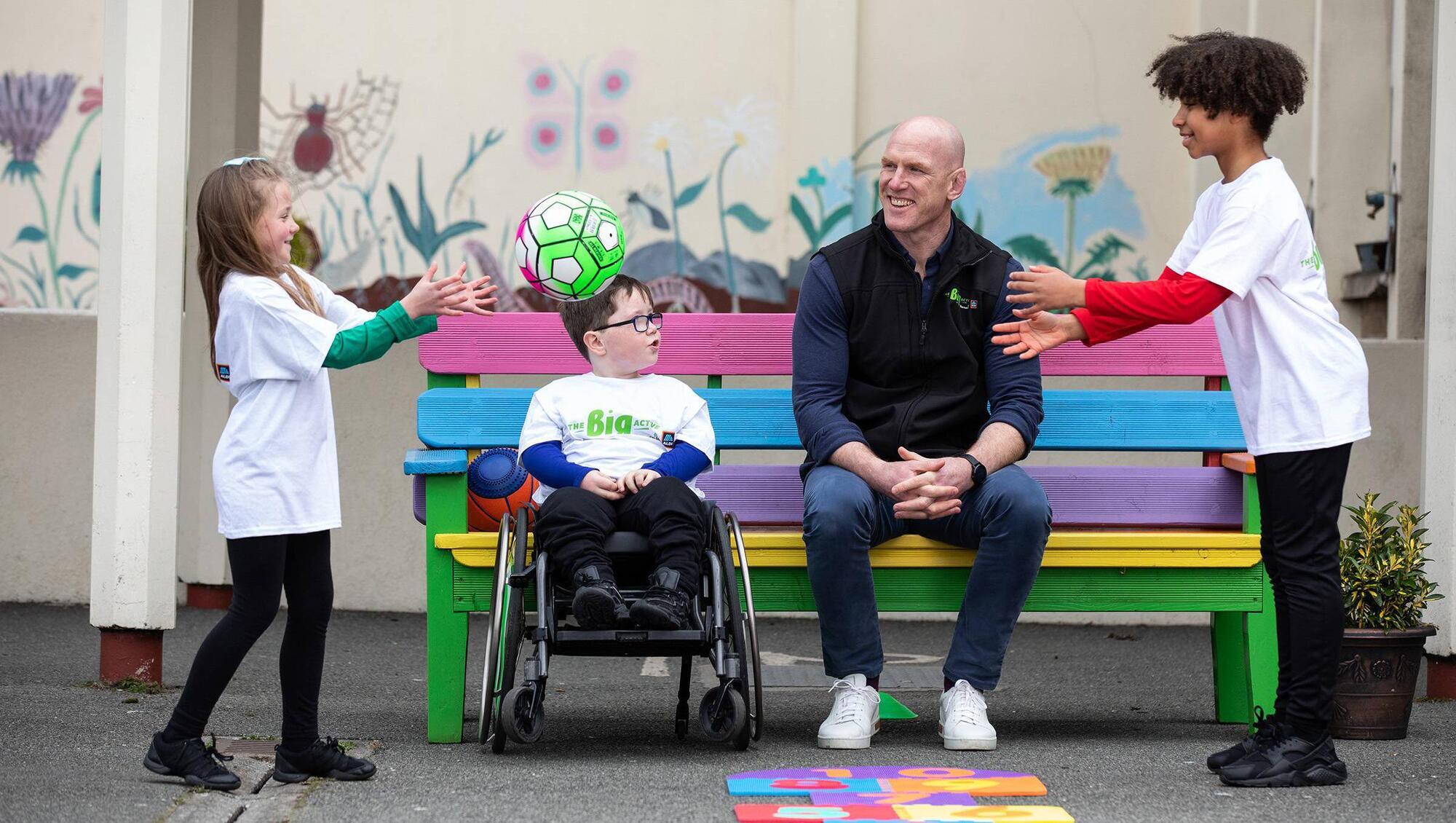
Barnardos children’s charity was joined by Paul O’Connell to launch a brand-new school campaign – The Barnardos Big Active supported by Aldi. Pictured at the launch were: (l-r) Elodie Curry, age 9, Oscar McDonald, age 6, Paul O'Connell, and Romeo Wusu, age 10. Pic: Patrick Bolger

Paul O’Connell had what he describes as a ‘blissful’ childhood, growing up in the countryside in Co Limerick with his parents and two brothers. When the rugby legend teamed up with children’s charity Barnardos, however, he realised that not everyone had the same happy and stable experience.

“I visited one of their centres in Limerick and it hit home how lucky I had been, living in the country, having two parents at home, big breakfast in the morning, sent to school with a packed lunch, and help with my homework in the evening, then a big healthy dinner. I thought it was the same for everyone but it isn’t really, when you come to these centres, you see how I had an unbelievably lucky, blissful childhood.” 

Since that visit, the former Ireland and Munster player has tried to get involved with as many Barnardos initiatives as he can. The latest is the Barnardos Big Active, a school-focused campaign that aims to help students of all ages and abilities be resilient in dealing with stress and anxiety and to take care of their physical and mental wellbeing.

“I love that a lot of what Barnardos do is about educating kids. The Big Active is about trying to get kids active but it is also about making them a little bit aware about mindfulness, confidence, self-esteem and leadership,” he says.

Focus on the body, mind and heart 

As a former captain of Munster, Ireland, and the Lions, O’Connell knows all about leadership and the importance of looking after one’s physical fitness. However, he says what is important about the Big Active initiative is that it also focuses on the mind and heart.

“It is about body, mind and heart. The heart part is teaching kids about giving, sharing, doing charity work, helping other people out. It is a holistic approach, it is not just about being healthy and active and eating well. There is a whole load of little things that we can do that we are not aware of — if kids become aware of them young, they can be great tools for them as they get older,” says O’Connell.

This holistic approach is something we see more of now in sport, certainly in comparison to when O’Connell was playing. When rugby would have previously been seen as a tough and macho sport, he says there is strength now in showing vulnerability.

“Absolutely, for example, if you feel a little bit nervous coming into a game, asking does that make you perform better or worse, having a chat about it and figuring it out. Those kinds of conversations, we didn’t have those, maybe we thought you had to put on a brave face on it, you couldn’t admit to any vulnerabilities. One of the most enjoyable things about the game now is that players are good at sharing that and learning from other players that would have experienced the same thing.” O’Connell and his wife Emily have three children, Paddy, Lola, and Felix, ranging in age from four to 11, who all play sports, and he says it is a great introduction to how we deal with life in general.

“I think chatting about some of the setbacks they experience and also being curious about how to get better is really important. The best players we have in the Irish team are constantly talking to other people about how to get better. It’s important that kids don’t feel ‘I have to be unbelievably good at this’. If they feel ‘I know how to get better at this’, that is all you need.” 

Learning to deal with obstacles

While, understandably, there is an emphasis on winning in professional sport, O’Connell says a little bit of competition is also good for children, as long as it doesn’t come at the expense of enjoying themselves.

“We need to have some obstacles in life. Sport puts obstacles in front of you that you learn to deal with — you get picked for the team, you might not get picked, you win, you lose, you might have to deal with a little bit of criticism from a coach. You have to be able to work in a team, to support people in your team and make them feel good about themselves. Sports is life in many ways.

"For young kids, it is a great way to prepare them for life. But with young kids, it is about keeping them in the game, letting them enjoy themselves, and then a little bit of competition as they get older is great. I don’t think it should ever come with losing kids from the game. I saw something recently about the definition of good coaching for underage kids: are they coming back year after year? That is a really good sign.” 

O’Connell may have hung up his boots but he is still very much involved in sports, as a member of the coaching staff for the national team, as a spectator and for enjoyment — he is a keen golfer. He says his enthusiasm comes from being steeped in sports of all kinds as a child.

“Even though I probably fought with my parents over it, we didn’t have a Nintendo, an Atari or anything like that but we could do any sport we wanted — we lived on half-an-acre and there were balls, golf clubs, sliotars, basketball rings everywhere.” O’Connell applies some of the same rules his parents did when it comes to his own kids playing sports — he sees commitment as another important element of building resilience.

“They all play a multitude of sports, it is all about movement, having a laugh, being healthy, getting to training. I would be big into not missing training. That was something I always remembered in my house when I was young — even though there was never any pressure on us to play any sport, if you did take one up, you weren’t allowed to miss training. It is important for kids to learn that if you say you are going to do something, you have to do it. We always say that if one of them wants to pack something in, that’s fine, we’ve paid until the end of the term, go until then and there’s no problem giving it up after that. They will be thankful for it in ten years’ time.”

  • For more about the Barnardos Big Active, supported by Aldi, see thebigactive.ie
x

Celebrating 25 years of health and wellbeing

More in this section

Lifestyle

Newsletter

The best food, health, entertainment and lifestyle content from the Irish Examiner, direct to your inbox.

Cookie Policy Privacy Policy Brand Safety FAQ Help Contact Us Terms and Conditions

© Examiner Echo Group Limited