Fertility on ice: does freezing your eggs work as a biological clock 'insurance policy'?
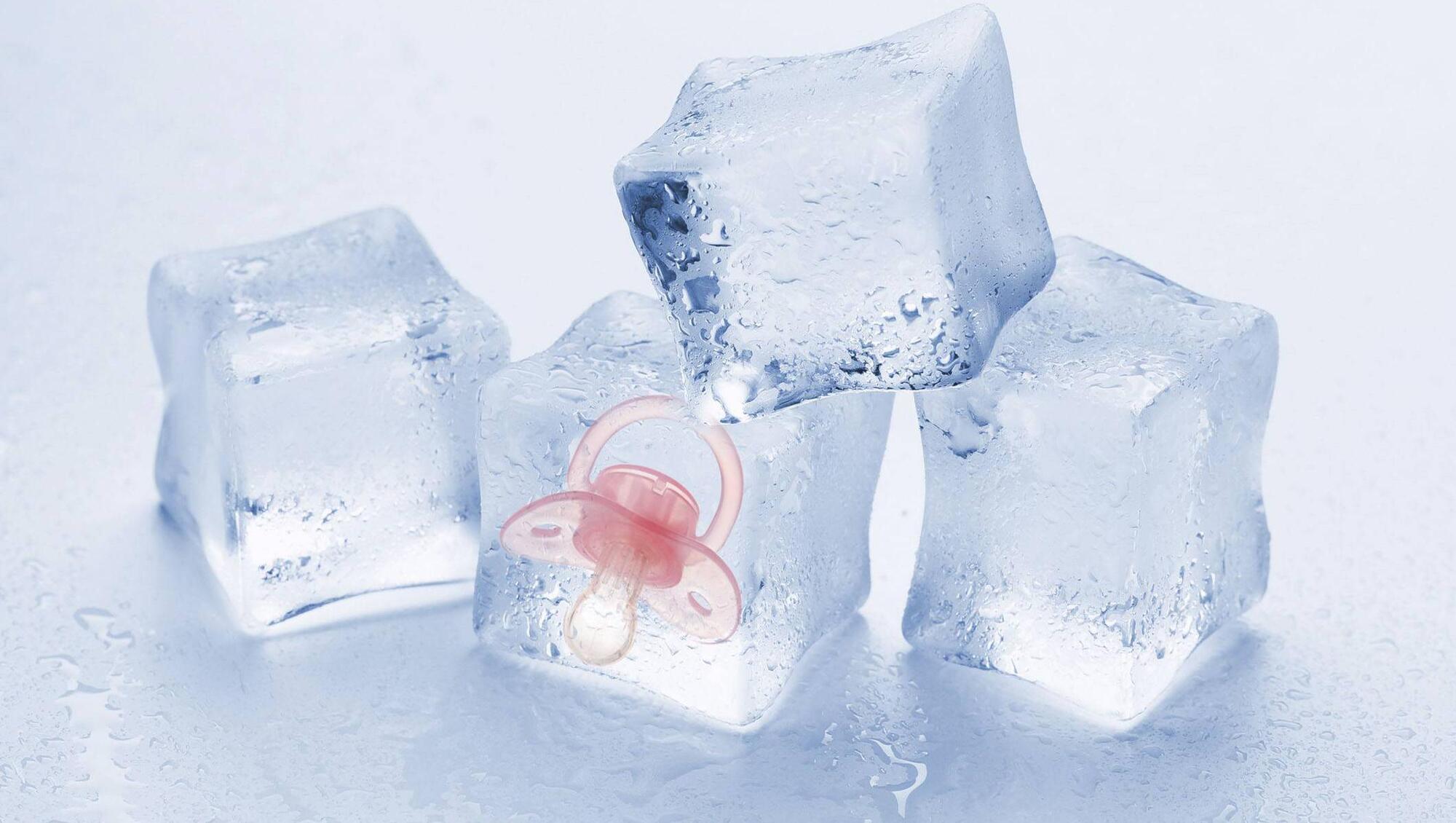
Melted ice cubes close up isolated on white background
One of the most frustrating facts of life is that women's fertility levels decline with age. We are born with a certain number of eggs that deplete over time, taking a nosedive in quantity and quality from our mid-30s onwards.
While the likes of Rod Stewart and Josh Brolin prove that men's sperm remains fertile well beyond the age of 50, the same is not true of women.
The decision to have a baby cannot be made in isolation. There's a range of issues a woman needs to address first. How will she manage to get an education, progress her career, meet the right partner, and settle down to have a family before it's too late?
In 1981, women aged under 30 accounted for 59% of all births here in Ireland. That figure now stands at 27.4%. Women delaying the age at which they start their families is one of the reasons why one in six couples in Ireland struggles to conceive. It's also the main reason why there has been an increase in the number of women investigating the option of freezing their eggs.
It appears to be an approach many women support. A 2017 study of 663 women aged between 18 and 44 by the Merrion Fertility Clinic in Dublin and the National Maternity Hospital found that 72% would consider freezing their eggs to preserve fertility.
Dr John Waterstone has witnessed this shift. His fertility clinics in Cork and Dublin started offering egg freezing three years ago and demand for the service has risen year on year.
"Demand has risen by 100% since the start of the pandemic, although that was admittedly from a low baseline," he says.
He attributes this to women in their mid to late 30s stopping to consider their lives and fertility over lockdown. "If they're single and want a family, many feel a sense of panic," he says. "Having their eggs frozen is one way in which they can be proactive about their situation."
It's something that is increasingly common in the celebrity world. Khloe (36) and Kourtney (39) Kardashian recently shared their stories of egg freezing in a YouTube video. Love Island's Amy Hart (28) told her followers on Instagram that a fertility check motivated her to get her eggs frozen. And actress Rebel Wilson (41) told American media she'd been through the process too, comparing it to a "back-up plan for career women".
But is she right? Does egg freezing press pause on women's biological clocks and give them a real chance at motherhood when they're finally in a position to start a family?
We're not able to answer this question yet, says Dr Waterstone. "Egg freezing offers a lot of promise, but there hasn't been much delivery because, while an increasing number of eggs are being frozen, very few have been thawed.
"At our clinic, we haven't taken any eggs out of the freezer yet. No one can tell how successful the process will be until we do."
Egg freezing was first offered as a medical treatment to women prior to cancer treatment in the 1980s. In cases where treatment required the removal of ovaries or potential damage to eggs, doctors were able to remove and freeze patients' eggs for possible future use.
In a process is similar to IVF, women are administered drugs that stimulate their ovaries to produce a surplus of healthy eggs. Those eggs are then collected in a surgical procedure that takes place under sedation and involves a fine needle being inserted into the ovaries via the vagina.
Where it differs from IVF is that those eggs are then frozen in liquid nitrogen until they are needed. There is currently no legislation here in Ireland stipulating how long they can be frozen.
When the woman decides to get pregnant, her eggs are thawed and those that survive the process are fertilised by IVF, with all of its attendant risks and variables.
The first baby conceived in this way was born in 1986 but success levels remained low until a new egg-freezing process called vitrification was introduced in 2010. Since then, egg freezing is no longer just offered to women who are about to start cancer treatment. It’s become increasingly popular with women who see it as a way to preserve their fertility.
For them, it’s an insurance policy of sorts. However, Dr Waterstone warns that it’s one that may not payout.
"An egg is one big cell versus an embryo which is a collection of up to 200 tiny cells. It's more prone to damage during the freezing and thawing processes."
In Britain, where egg freezing has been available since the 1990s, the British Human Fertilisation and Embryology Authority reports that women using their own frozen eggs in IVF treatment currently have a success rate of 18%.
If freezing eggs is akin to having an insurance policy for fertility, it's one that comes with lots of terms and conditions. "A woman would want to have 20 eggs in the freezer to have good odds," says Dr Waterstone. “But while some women produce 20 eggs in one treatment, others may only produce five and require a further treatment cycle."
So much depends on the woman’s age at the time of freezing her eggs. Dr John Kennedy, who has recently been appointed medical director of Thérapie Fertility Clinic in Dublin, says this is because the number of eggs likely to be produced in each treatment cycle declines with age. Egg quality also deteriorates.
“If a 31-year-old goes through the process, she is likely to end up freezing 20 eggs, and will have a 60% to 70% chance of having one child from those eggs,” he says.
“A 38-year-old woman is far less likely to get 20 eggs from one treatment cycle. She might get ten, which gives her a 20% chance of a baby. Women under 35 have the highest chance of success.”
This is why all women who attend fertility clinics in Ireland seeking egg freezing services have their ovarian reserve tested before they undergo the process.
“This shows the reproductive potential left in a woman’s two ovaries based on the number of eggs there,” says Dr Kennedy. “It allows us to make an educated guess as to how many eggs are likely to be produced in a single cycle and whether a woman has a decent shot at freezing enough eggs.”
The biggest problem with egg freezing is that the typical client enquiring about the process is beyond peak fertility.
"The sad reality is that the average age of women turning up at fertility clinics in Ireland is aged 38 and a half," says Dr Kennedy. “The odds are against them if they hope to freeze their eggs.”
The average treatment cycle costs €3,000. Annual storage will set you back €300. Subsequent IVF treatment will amount to another €3,000 or so. That's an expensive insurance policy, unaffordable for many women.
That’s why there was such a media furore in recent years when companies such as Facebook, Apple, and Goldman Sachs started offering elective egg freezing as a benefit for their female employees. Were these women being encouraged to focus on work to the detriment of family life? Or were they being given options that simply aren’t available to those in less well-paid jobs?
Egg freezing is still a perk of the job in these companies. However, the small print reveals that even in the world of tech and high finance, a woman's age is still a defining factor in fertility. Most of these companies only offer this service to women under the age of 35.
"It highlights just how important a woman's age is," says Dr Waterstone. "As a woman gets older, her eggs only diminish in quantity and quality."
This is a difficult topic that fertility doctors are required to discuss with women. "If a woman comes into my clinic asking about egg freezing, I am ethically obliged to break down the physical, financial, and emotional cost of the process for them," says Dr Kennedy.
"I have to make sure I am clear, candid, and honest about their chances and then they can decide if it's worth the effort involved."
During that conversation, women will also be informed of their other options.
Calling on the government to commit to improving egg freezing services in Ireland, Dr Waterstone says: "Women who freeze eggs for social reasons are one thing but there are also women who have to freeze their eggs for medical reasons. These may be the only eggs she's got. We have a responsibility to offer her the best chance of success."
As part of this process, he would like to be able to offer the option of freezing ovarian tissue. "Countries like Denmark and Belgium do this, and its advantage is that ovarian tissue contains thousands of eggs, which can be used in multiple fertility treatments increasing a woman's chances of success."
Both doctors would also like to see more fertility awareness in the general population.
"We need to move away from the traditional Irish model of desperately avoiding pregnancy until you desperately want to become pregnant," says Dr Kennedy.
“I’d like the goalposts to change for women,” says Dr Waterstone. “Their 20s should be for fun but come 30, I’d advise them to start thinking about if they want children and who they might have them with. Once they get to 35, they should get their skates on.”
A national fertility check could help with this. "In the same way that women take part in the national cervical screening programme from the age of 25, that same cohort of women should have a fertility check," says Dr Kennedy.
"That would identify those with a lower ovarian reserve of eggs, and they could then opt to have their eggs frozen in their 20s or early 30s, when time is still on their side."
He thinks it would also give women a sense of agency in their own fertility. Rather than anxiously noting the passing of time, they could stop the biological clock in its tracks.
"Basically, I'd like women to be able to make decisions for themselves and not have decisions foisted on them by age and biology," says Dr Kennedy.
Age and biology are defining factors in every woman’s life. That’s been true forever and remains true today. Egg freezing may give women more time, but only if they act early.
In 2019, journalist Dearbhail McDonald presented , an RTÉ documentary that looked at fertility in Ireland. In the programme, the then 42-year-old revealed that she had frozen her eggs in her mid-30s. She described the process as painful yet pragmatic and empowering and said she wished she'd done it earlier.
Feelgood spoke to 40-year-old Anna* about her experience of the same fertility treatment.
Anna works in Dublin and by her mid-30s, her life had all the trappings of success. She had her own apartment and a job that earned her a good salary. She took several foreign holidays a year. All she lacked was a partner and a longed-for family.
"I always thought I'd have children one day and when I read those articles about Facebook offering egg freezing to women, I thought I should check it out for myself," she says.
Aged 37 at the time, the clinic she approached was very clear about her chances of success. "They told me that compared to regular IVF and other fertility treatments, not that many women have tried to get pregnant using frozen eggs. Most of those who have used donor eggs provided by women who are typically very young and healthy. So nobody could guarantee how well it might work for me. I still thought it was worth it though and went ahead to freeze 17 eggs."
She found the process itself gruelling. "I didn't realise how emotional the daily hormone injections would make me feel," she says. "Going through that all by myself was hard."
She is currently in a new relationship and while it's still too early for talk of children, she is glad to have frozen her eggs. "I know they are not a guarantee that I'll get pregnant and have a baby, but I feel my chances are higher than they would be without them," she says.
"I feel they bought me a bit more time and there's a sense of relief that comes with doing something rather than doing nothing and just letting time go by. If I'd stopped to think about it, I'd probably have frozen them earlier."
This is a sentiment that Dr Kennedy comes across time and again in his work as a fertility doctor. "It's the one thing that all women having fertility treatment agree upon," he says. "They wish they had done it earlier."

CONNECT WITH US TODAY



Be the first to know the latest news and updates