“We realised she’d flourish in a home of her own, close to family, within her community"
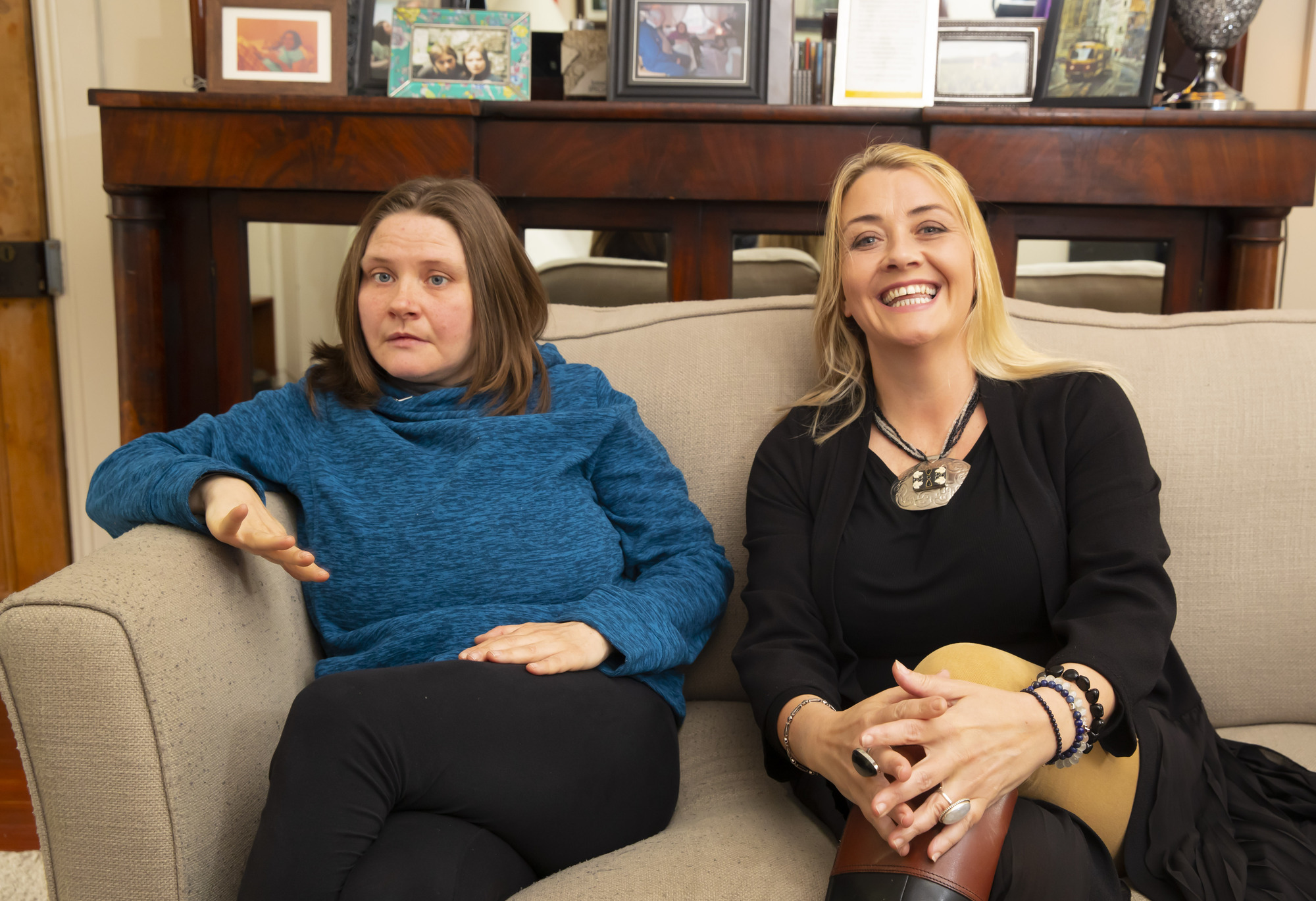
Molly O’Keeffe (right) who is founder of Positive Pathways an organisation that supports people with disability, also pictured is her sister Fran O’Keeffe from Tallow, Co Waterford. Picture: Patrick Browne
Growing up on a farm in West Waterford in the 1980s, Molly O’Keeffe didn’t think it was fair she and her older brother could have a “real” life, while their younger sister, Fran, was doomed to stay forever in life’s waiting room.
“Fran was labelled as profoundly intellectually disabled,” says Molly, describing how barren the landscape was around disability in 1980s Ireland. With few practical and family supports and scarce educational options, families felt abandoned.
“Disability was very much based on a medical model, on what was wrong with the person, how they were deficient. Society wasn’t looking at the potential within,” says Molly, now aged 43.
She describes their mother, Nuala, as the living embodiment of the idea: if you can imagine it, you can do it. “She was the game-changer in Fran’s life. She believed Fran had the right to live her best life.”
In a world without recourse to physiotherapy and OT support, Nuala created wooden structures to enable Fran to stand and to walk. “This allowed Fran to develop the skills that mean she’s fully mobile now,” says Molly.
Nuala also refused to accept the experts’ recommendation that Fran be placed in long-term institutional care. “It meant she’d live in a large residential setting, two hours away in Kilkenny, away from her family and community.
Molly says her mother often tells the story of sitting, crying in Fran’s bedroom because she didn’t know how to avoid sending her then four-year-old away. “I was six at the time and she says I came bounding in, gave her a big hug and said there’s no way Fran’s leaving us, we’ll figure it out and things will be ok.”
Experiencing from childhood a family perspective on disability that was based on love, that saw the possibilities (their mum, on her own, found Fran the best special school in the county), Molly continued to be bothered by Fran’s limited life options as they all reached adulthood. “While I headed off to Dublin for college and our brother, Tony, went to agricultural college, Fran was sentenced to a life attending a day centre and living in a group home, to daily activities often without real meaning or purpose, to group bus outings enabling her to be a visitor to community rather than part of it.”
Having studied theatre at Trinity College, Molly used the creative arts to give people with disability “an opportunity to be seen beyond their label”. She was also course director for Trinity’s Certificate in Contemporary Living, the first fulltime course for adults with intellectual disabilities in Ireland. The perspectives she gained reinforced her instinctive and lived conviction that family members can be positive agents for change in the lives of loved ones with disabilities.
“My work enabled me to see other models of service provision – alternative, flexible and positive ways that families could be supported to help create meaningful lives for all their family members. It showed me when families are offered supports in the right way they can achieve wonderful ordinary things,” says Molly.

Through a personalised budget – which took 10 years to put in place for her – Fran, now aged 40, lives in her own home since 2015, next door to her parents, close to her brother’s home and down the road from where mother-of-two Molly lives. “We realised she’d flourish in a home of her own, close to family, within her community. She recruits local women – she currently has three wonderful women in her life – to support her to live her best life.”
Explaining the concept of a personalised budget, Molly says it means money follows the person with the disability – rather than Government giving money to an organisation through block funding, for example, 10 people go into a facility and the facility then gets certain amount of funding. “Personalised budget means funding’s allocated to the person based on their unique need.”
Fran has her own micro-business. “We all need a purpose in our day. Everyone has gifts to offer, no matter what their label,” says Molly, explaining that being in a house full of the smells of cooking and baking on Saturdays was part of Fran’s history. And because their mum has always been a talented cook/baker, Molly thought Fran could have inherited this and that she could bring it to life, with the right supports.
“Fran worked with staff and a chef to develop a recipe around brown bread. With an artist, she looked at developing a logo that’d represent who she was. And over a year, she was supported to develop a skill-set around baking the bread. Now she has private customers who buy her bread every week and her bread’s in a local shop.
Seeing Fran so far removed from the life she was sentenced to – “so joyful, curious about life and disproving the label every day even in small ways” – Molly wants to facilitate change for families in similar situations all over Ireland.
She has created the In Conversation eight-week programme as a space where families can come together, be respected and listened to, as they discover other ways – away from traditional provision – to support loved ones to reach their potential to lead ordinary lives in ordinary communities. The philosophy underpinning it is that in most cases families are best placed to support.
“We have no other agenda but love. We carry the person’s history and we know them deeply. We remain in their lives after everything else goes. When families are supported wonderful things can happen for that family,” says Molly.
Currently, 51 families are taking the course and there’s a waiting list. “We desperately need new positive stories of disability in the community. It’s about choice and control and reaching one’s potential – not being segregated or separated, but being seen and valued.”
The HSE is running a Personalised Budgets Demonstration Projects Pilot and is looking for up to 180 adults with a disability to participate. The project has been extended until June 2022.
Running over eight weeks – the In Conversation involves:
Eight e-learning modules, based on topics/information used by families worldwide that have enabled their loved ones to create meaningful lives within their communities.
Five reflective booklets containing useful resources, practical advice, helpful pathways and the voices of Irish families already on this journey.
Four peer-support facilitated webinars inviting families undertaking the series to meet, explore and discuss the contents of the series with other families – to share their lived experience within non-judgmental environment.
In Conversation is for those searching or on a new path – it could be associated with a personalised budget, transition from school, move into employment, development of a micro-business, or moving into the community.
The programme is delivered in partnership with the Inclusive Living Network (ILN), a network of family members, individuals, advocates, professionals, agencies who are passionate and committed to enabling and supporting people to live inclusive lives.
Access In Conversation, which is free and funded by Genio, at inconversationseries.webflow.io; and at inclusivelivingnetwork.ie
Celebrating 25 years of health and wellbeing