The top 6 trends for S/S 2017 from London Fashion Week
DO READY-TO-WEAR fashion shows — which were conceived as trade shows — still matter when anyone can shop them?
With more and more designers opting to skip the traditional six-months-ahead show in favour of a see-now, buy-now model, it seems a practical evolution to simply dispatch clothes to retailers. I really hope that doesn’t happen.
Haute couture lines, which sell only to a tiny, super-rich clientele, are still presented to the world each season, at massive expense.
This is for prestige — even a tube of lipstick is elevated by a name that would spend millions to parade models around a colossal tweed-jacket sculpture (Chanel Haute Couture, Spring 2008) — but the spectacle also makes a statement about where a brand is at a given moment.
Ready-to-wear shows can do this for any designer. They tell a story, defining even the smallest brand in an increasingly crowded market.
Speaking to Interview magazine earlier this month, Canadian designer Erdem Moralioglu said of the bi-annual experience: “As a designer, we’re all striving for that moment, to show your body of work in a way that moves people — to get a reaction, even if it’s negative. We live in a funny time where we’re exposed to everything, so being able to get a reaction is so important.”
Long live the show.
The Statement Sleeve
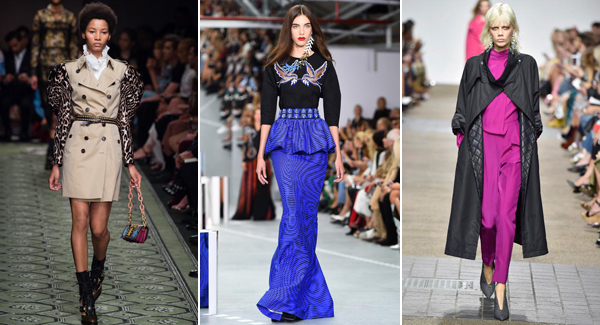
Perhaps as a result of fashion’s move towards the piece-y and patchy, sleeves are in the spotlight for spring.

Whether contrasting with their parent garment or billowing into exaggerated poet shapes, it was impossible to ignore them.
Jonathan Anderson was inspired by the Tudors for spring and his quilted doublet-like sweaters had sleeves decorated with great loops of white or tan cotton.
Burberry’s classic trench got leopard-print leg-o-muttons.
Antonio Berardi gave his mini-dresses ribbon-tied silk bishop sleeves while David Koma’s fitted sleeves split in two from the elbow.
Gingham Brights
Gingham, that most flattering of micro-checks, is back in a rainbow of colours.

Henry Holland’s, ‘Free to Roam’ collection, inspired by Josef Koudelka’s photography of Eastern European itinerants, saw the print splashed across neckerchiefs, off-the-shoulder gowns and pencil skirts.
Suede belts were a traditionally Western partner but gingham was most of styled with sporty pieces.
Peter Pilotto and design partner Christopher de Vos researched their latest collection in Colombia and Peru, and apparently had an awesome time.
From the palm tree-print invites to the floaty metallic-silk sundresses, this was the brand’s brightest collection yet.
Gingham tops in Bardot and camisole cuts look adorable with their light-wash denims.
True Romance
Sharon Wauchob’s London Fashion Week debut was a hot ticket.

The Tyrone-born designer, formerly of Louis Vuitton and Edun, took last season out to make the transition from Paris.
Her gorgeous silk and lace confections were worth the wait.
The collection featured delicate camisoles with filigree gold straps, pleated metallic French-lace dresses, and embroidered bralettes.
Wauchob’s gossamer-fine tunic tops would work as loungewear only if you truly don’t care about dry-cleaning bills, but her silky biscuit-coloured macs are more wearable.
Emilia Wickstead’s muse for the season was a “in love with love” and longing to step out in sheer blue pussy-bow blouses, yellow sundresses and strapless pink silk.
Irregular polka-dots inspired by kinetic artist Alexander Calder, creator of the mobile, decorated empire-line and princess-cut gowns.
The New Zealand-born designer’s signature crop-top and high-waist skirt will be sheer ivory with a yellow floral-print in the spring.
Erdem’s route to romantic gowns was more circuitous.
The discovery, in April, of a dress historians believe was lost at sea during a covert mission to sell the crown jewels on the eve of the English War started the designer wondering what Jean Kerr, the garment’s presumed owner and Charles I’s wife’s lady-in-waiting, might have worn had
she time-travelled to Deauville in 1930. Convoluted, maybe, but it suits the “thinking woman’s fashion” vibe of the collection’s future home: Erdem’s art and book-furnished flagship store.
Floppy sun-hats and geisha platforms would be Kerr’s beach accessories of choice.
These sound unlikely bookends to chiffon gowns with empire-line busts and Edwardian collars but gave them great sweep on the catwalk.
The designer’s signature bluestocking-sexy was also on show, with only waist cut-outs, ribbon ties and lace panels revealing slices of skin.
Spring Forward
Burberry did its first complete ‘ready-to-buy’ show this week, with clothes going on sale moments after hitting the catwalk.

Christopher Bailey used Virginia Woolf’s Orlando: A Biography as inspiration for this week’s collection.
The novel, in which time and gender are tweaked and disregarded, seemed just right for the moment.
Each model was layered up as though prepared for multiple seasons, which is styling familiar to most Western Europeans.
The three-piece suit got a makeover, with silk pyjama-tops replacing waistcoats. Military detailing was big, as were heavily sequinned mini-dresses and paisley prints.
Sheer dresses peaked out from beneath waist-cinching sweaters. It’s all very fetching and currently on sale in over 100 countries.
Temperley London’s shamelessly beach-y collection is also available via app, if you’re lucky enough to be spending winter somewhere hot.
Her “trippy” floral embroidery and body-skimming maxi had everyone missing the summer on a blustery Sunday.
Insatiable as Veruca Salt, the Topshop woman will always crave the new; 60% of the Topshop Unique collection went on sale after.
The clothes, inspired by pieces from Spitalfields Market, actually look quite autumnal. Black leather trousers, fuchsia heels and zebra-print silk tops are are as chic now as they’ll be next season.
Under Construction
Material-hybrids of the sort that wowed Vetements audience during Paris couture week in July gained wider currency in London.

Demna Gvasalia’s wildly-expensive jeans, born of the destruction and artful re-assemblage of vintage finds, may be fashion insiders’ must-have-du-jour but Christopher Kane’s an old-hand at making beautiful clothes from whatever he can gather.
A decade into his career, the Scottish designer was thinking about abandoned materials: the kind he and his sister Tammy would source for early collections but also how Second World War refugees clothed themselves.
Christopher, patron saint of travellers, was a touchstone for the collection, as was the make-and-mend spirit of the punk movement, currently in the midst of a year-long 40th anniversary celebration at various London arts institutions.
Safety pins secured lurex dresses and “roadkill” fur decorated topcoats. Pencil skirts united leather and lace.
Plastic Mary Quant-style daisies tacked to coats and polaroid prints of his own models reinforced the message that everything is material.
The prettiest pieces were mini-dresses in blue or terracotta, each collaged from different types of lace. I doubt even Kane can make us fall for Croc sandals but he did try. Are detachable crystals enough to make ugly pretty?
Simone Rocha was also feeling material “cross-pollination” for spring. Jackie Nickerson’s images of African farm girls and two paintings — Paul Henry’s The Potato Diggers and William John Leech’s The Catholic Girls — inspired her fusion of the natural and the synthetic.
Plastic macs were embroidered with handmade broderie anglaise. Deconstructed tulle and knits in fine yarn were combined with shirting and trench coats. Wellies got perspex heels.
Prints clashed with appliqués, sleeves were mismatched and often the left side of a skirt didn’t resemble the right.
It all looked fresh and yet true to the woman’s woman brand of beauty we’ve come to expect from Rocha.
Antonio Berardi’s show notes described each look as “suspended between two concepts” with deliberately contrasted fabrics and techniques.
A kimono coat morphed into a billowing blouson in back. A trompe l’oeil suit was fused with a jumpsuit, while an interesting silk brocade looked both animal and floral-printed. Embroidery faded in an out, as though cut off mid-application.
“There is always beauty to be found in the work in progress,” said the designer. “In the expectation of the next.”
Ruffles Reimagined
Ruffles are a current trend set to run into spring and if you’re put off by their ’80s iteration you should really look again.

Wexford designer Richard Malone twisted them up the arms of sporty zip-necked tops and across the bodice of a strapless gown done in the stripes that have become his signature.
The volume these details create can make them challenging, especially around the body’s centre.
Mulberry’s Johnny Coca solved this problem by putting them on bags, sandals and square-toed boots.
A well placed ruffle can also narrow the waist. Mary Katrantzou, who was very inspired by her homeland for spring, frequently interrupted Greek key stripes and ancient prints with a single peplum.
CONNECT WITH US TODAY



Be the first to know the latest news and updates