Looking under the skirt of our fashion industry — what’s it hiding?
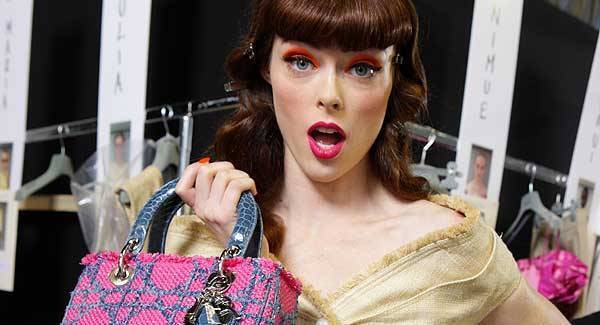
GIVEN that we tend not to live in naturist colonies, it seems both grumpy and unfashionable to be annoyed with fashion. Without fashion we would be very cold and unstylish. And who doesn’t like dressing up? Who doesn’t enjoy the comfort of a favourite garment, or the pleasure of a new one?
We are tribal creatures — clothes are our second language, historically denoting status, role, and gender. It’s more than just about keeping warm. The trouble is that while clothes are soothing, gorgeous, sensual things, fashion — fabulous, eye-catching, and occasionally pure art — tends to be thin, brittle and shallow. It is the evil twin of clothing, because it celebrates so many negatives: greed, exclusion, superficiality, exploitation, hyper-consumerism presented as freedom of choice. That’s just the humans. Don’t get me started on fur.
When you hear about people who ‘work in fashion’, you generally think of underweight individuals on runways, or deified creative eccentrics accessorised by Bond villain cats. You probably don’t think about desperately poor faraway people working in sweatshops, because you don’t want to associate the pleasure of clothes with the misery of modern slavery.
Fashion is like fairy dust — when it is sprinkled over us, we see only beauty and glamour. We all want to reflect this narrowly-defined beauty, and the fashion industry knows this, forever playing on our vanities — and insecurities — by showing us ever newer, more tantalising glamour. Fashion has never been faster, more disposable. There is no other global industry which incorporates environmental destruction, sweatshop labour, front of house racism and eating disorders without censure — yet we remain in fashion’s thrall. We are all blinded by its glitter.
Tansy E Hoskins is a journalist who loves clothes, but is unimpressed with the modern fashion landscape. Her book Stitched Up: The Anti-Capitalist Book of Fashion explores the impact the multi-billion dollar fashion industry has on the planet, on garment workers, on the body image of Western consumers, and on culture itself. Fashion, it seems, can get away with anything.
“The charge sheet against the fashion industry could read as follows,” she writes. “Fashion reinforces racism, sexism, gender stereotypes, class and unequal power relations. Fashion seriously exploits its impoverished workers and its customers. It pushes the values of wealth and greed, and promotes body insecurity and dissatisfaction.”
The list goes on. Perhaps most ironically, fashion presents itself as a promoter of individual style, yet churns out uniformly trend-based clothing for “identikit stores from Birmingham to Bangkok”. So is fashion just a series of marketing trends which we obediently trot after, like well-dressed sheep?
Hoskins, however, doesn’t just dissect the sweatshop produced garments of high street fashion, much of it made by workers whose plight came horribly into focus last year after the collapse of that building near Dhaka in Bangladesh, where 1,133 people were killed and 2,500 injured.
She is as unimpressed with the top drawer as the bargain basement, making little distinction between high end and high street.
These days the two merge — Karl Lagerfeld, Stella McCartney, Versace, Lanvin and Marni have all done collections for high street chain H&M. Upmarket fashion brands make their serious money not from haute couture, but from mass produced sunglasses, perfumes, accessories, toiletries, bags. Can’t afford a five grand frock? Have a fifty quid T-shirt instead. (Made for a fiver, the individual maker paid in pennies.)
“Why discuss only the pollution caused by high street brands in China when ‘It’ bags are being made in the factory next door?” wonders Hoskins. “Why discuss only the issues of body image and race representation on the catwalks of Paris and Milan when Topshop and H&M displace the same exclusive aesthetic?”
And then there’s what she terms “possessive compulsive disorder”, which Hoskins suggests robs us of the creative pleasures of dressing up, as we focus instead on competitive acquisition. This is not an accident. This is how the fashion industry — like any other industry, but with added eating disorders — works. And it gets away with all kinds of distasteful antics, like Vogue India’s 2008 Slum Dwellers shoot, or the concept of self starvation in order to label one’s own body something called ‘size zero’. (That’s a UK size 4. Given the average woman is size 14-16, what is the fashion industry telling us? That beauty equals hunger. That eating is disgustingly unfashionable).
Then there’s the racism. As an example, British Vogue’s September issue in 2011, featuring disgraced anti-Semitic designer John Galliano, contained 402 images of white people, but just 22 images of other races. In the same issue, 373 adverts used white models, while 24 adverts used models of other races.
Then there are the catwalks. Prada, run by a woman who describes herself as a leftist feminist, didn’t have a single black model on its runways between 1997 (Naomi Campbell) and 2008 (Jourdan Dunn). Even in multi-culti London, says Hoskins, “booking agents still receive casting briefs which say ‘no ethnics’. This accepted level of racism is unimaginable in almost any other industry”.
So what could be the solution, other than going naked? Hoskins recounts the well meaning but ultimately futile efforts of individuals to establish ethical fashion companies: Ali Hewson and Bono founded Edun, to manufacture clothing in sub-Saharan Africa, but in 2010 it became clear that the venture wasn’t working. A 49% stake of Edun was sold to luxury behemoth LVMH, who promptly relocated 70% of the company’s production from Africa to China, thus somewhat defeating the venture’s entire purpose. In general, ethically produced clothing is significantly more expensive than its high street equivalent — think sweatshop-free American Apparel — or made of fabrics and in colours that appeal only to a minority (undyed hemp, anyone?)
Not, believes Hoskins, that individual consumers can make much of a difference, no matter how well intentioned (or well off) they are. “You cannot shop workers in China to freedom,” she writes. “You cannot shop the Aral Sea [drained to irrigate Uzbekistan’s 1.47m hectares of cotton] back to life.”
What we can do, she says, is resist and reform. Hoskins cites resistance to mainstream fashion in forms as diverse as punk, 1970s feminism, and wearing the hijab, but remains realistic about any outcome. “Refusal styles encounter one insurmountable problem,” she writes. “There is no escape from planet fashion. You can refuse to participate in the system, but unless you overthrow it, it will still be there when you open your eyes. It is impossible to refuse to participate.”
In an ending to a fascinating book which incorporates culture, history, gender politics, and economics — who knew fashion could be so much more than buying a nice frock from your favourite shop? — Hoskins suggests that the only way to truly reform fashion is to overthrow capitalism as a failed system of inequality and greed-based values. So there you are. But in the meantime, you could always do things like clothes swaps, charity shops, and DIY. Or just carry on shopping, while pretending you haven’t read this. That’s probably the easiest option, given the inescapability of fashion, and its unending allure.
Stitched Up: The Anti-Capitalist Book of Fashion by Tansy E Hoskins, is published by Pluto Press
CONNECT WITH US TODAY



Be the first to know the latest news and updates