Meet the new girls in the city
AT HER book signing in Dublin last month, writer Caitlin Moran expressed her opinions on the epoch-defining series Sex & The City. After giving birth to her daughter 11 years ago, Moran was out of the social scene for a year.
When she returned, she noticed a massive change in the bars and restaurants of London; that women were wearing corsages, sipping cosmopolitans and talking about sex over brunch. Moran was not impressed, but, make no mistake, Carrie Bradshaw and her band of immaculately clad sexual libertines gave us many lessons on how to be a woman.
Fast forward 14 years, and Irish audiences are finally set to enjoy the show’s worthiest successor yet.
In TV, 14 years is a lifetime, but it took that long to create what critics have dubbed ‘this generation’s Sex & The City’. We’ve seen countless pale imitations (Cashmere Mafia, anyone?), but HBO’s latest, Girls, is the real deal … and has caused media mayhem Stateside.
“There are shows that hit exactly the right note with what’s going on at large,” says Janet McCabe, a London-based academic who co-authored Reading Sex & The City. “It hits the Zeitgeist at a particular moment and addresses all the right concerns.”
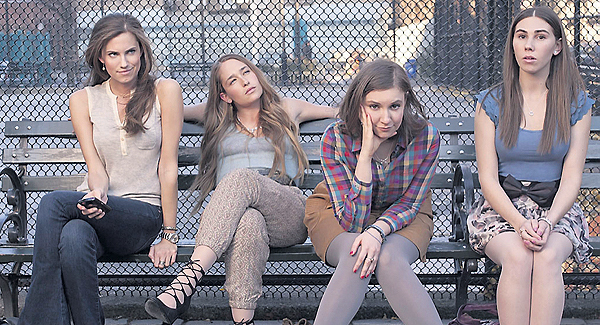
Written and directed by, and starring, 25-year-old Lena Dunham, Girls follows a careworn narrative; four women finding their way — emotionally, socially and fiscally — in the city that never sleeps.
The four characters are types familiar to SATC viewers: the main protagonist, (Hannah, played by Dunham) a vaguely neurotic and needy writer; a terminally romantic Park Avenue Princess (Shoshanna, played by Zosia Mamet); a devil-may-care sexual libertine (Jessa, played by Jemima Kirke); and the boyfriend-averse career girl (Marnie, played by Allison Williams).
But there the similarities to Sex & The City end. And that’s no surprise, given the myriad changes that society has undergone in the last 15 years.
With the help of comedy heavyweight Judd Apatow (as executive producer), Lena’s series packs an immense, almost brutal punch in each 25-minute episode.
We are living in a recession-addled world, and the characters in Girls struggle with the bills, labour over Tweets, ‘lower’ themselves by taking coffee shop and nanny jobs, and mess up their internships out of a sense of sheer entitlement.
“I think I may be the voice of a generation,” says Hannah, as she tries to finagle yet more finances out of her parents.
“Or, at least, a voice of a generation.” In reality, she’s about as productive as Carrie Bradshaw’s oven.
Cast your mind back to Sex & The City, in which there were no career, creative or money anxieties for Carrie, Charlotte, Sam and Miranda; high-powered, big-spending career players one and all.
Elsewhere, Girls tackles weight control, abortion and dispiriting sex with toxic and emotionally unavailable men. Close to the bone doesn’t cover it. And, unlike its predecessor, the underlying messages aren’t sugar-coated with pretty dresses and pink drinks.
For all its frivolity, however, Sex & The City finally gave voice to the single women in generation Y: “It kind of coalesced debates and ideas about gender identity and feminism, and shed light on what it means to be a post-feminist woman in the world,” says McCabe.
“It spoke relevantly about where we were and the struggles that we have in the age of emancipation. It dealt with issues around work and women’s sexuality, but never addressed the politics in an overt way. It was fun and sexy and said things that had never been said. There was something liberating about the way these characters were talking. It addressed the meaty issues in its own little way.”
What followed was the ‘Sex & The Citification’ of women, as Moran said. Suddenly, women were given a license to think, act and talk a certain way. In fact, Girls references women’s near-obsession with Sex & The City. Shoshanna, in particular, has taken the show’s teachings to heart.
“You know you’re funny because you’re definitely like a Carrie, but with some Samantha aspects, and Charlotte hair. That’s like a really good combination,” she tells Hannah in the opening episode.
Despite the reference, the marked differences between Girls and Sex & The City are deliberate. There’s a sense that the Girls’ characters were raised with the assumption that their adult lives in New York would be a carousel of shopping, dashing men and bar-hopping.
The land back down to earth is the backbone of the show. In Girls, there isn’t an item of designer clothing in sight, much less a kooky, ‘statement’ corsage.
“In terms of consumerism, Sex & The City is dated and old,” says McCabe. “You could never make a show like that now. In the ’90s and ’00s, women had more cash to throw about; not so much anymore.”
Girls’ depiction of New York is also markedly different to the sepia-tinted love letter to Manhattan that was Sex & The City.
“Sex & The City was a modern fairytale with an old romantic feel, with Manhattan a fantasy playground,” says Janet. Rather, Girls’ Brooklyn is a hipster no-man’s-land that threatens to financially devour our (anti) heroine at any second.
And, if the city doesn’t devour Hannah, her relationship with toxic Adam (Adam Driver) just might. Mr Big, he ain’t. A skinny, tortured artist who has about as much debonair charm as a pair of week-old socks, Adam is non-committal, detached and not a little bit kinky.
It’s a radical departure for a series made largely for women. “The Sex & The City series was part of the traditional romcom genre, and even watching some of the episodes, they seemed dated at the time,” says McCabe.
There’s a slight variation on this motif in Girls: in episode one, Marnie is thinking about dumping her overly attentive, affectionate boyfriend (Christopher Abbott).
Yet, just like their Sex & The City foresisters, the other characters in Girls are still grappling with the idea of getting a boyfriend.
“The Girls’ age group is in a tricky place — they aren’t ready to grow up, but they’re thinking about the moment when they are going to,” says Michael Cobb, author of Single: Arguments For The Uncoupled.
“They’re dreaming of being in a couple, but still dwelling in this unattached world. The single life is portrayed as something that’s opportunistic, gross and mean-spirited. Still, they’re all longing for an important relationship to save them from the world.”
Still, Girls is fast shaping up to be a radical feminist text of its time. In 2012, women are facing more body anxieties than ever before.
The media is bombarded with images of beautiful, flawless size-zero women; a grim epidemic that didn’t affect women in 1998.
That Lena Dunham strips off for awkward sex scenes throughout Girls is a topic of much-heated discussion in the US, mainly because we’re not used to seeing slightly overweight female leads.
Better again, Hannah’s chunky thighs, cellulite and jelly belly are not grist for the comedy mill; they just happen to be there.
And in an industry obsessed with perfection, Dunham’s lack of vanity is as astonishing and refreshing as it is admirable. For this, and many other reasons, critics Stateside have heaped praise on Girls. The Hollywood Reporter called it “one of the most original, spot-on, no-missed-steps series in recent memory”.
And so the question looms large; will Girls manage to fill that Carrie-shaped hole in our TV schedules, or will this foursome of entitled, self-loathing kids prove to be a turn-off ?
Finally, this week, we get to make up our own minds.
Girls starts on Sky Atlantic at 10pm on Monday, Oct 22.
CONNECT WITH US TODAY



Be the first to know the latest news and updates