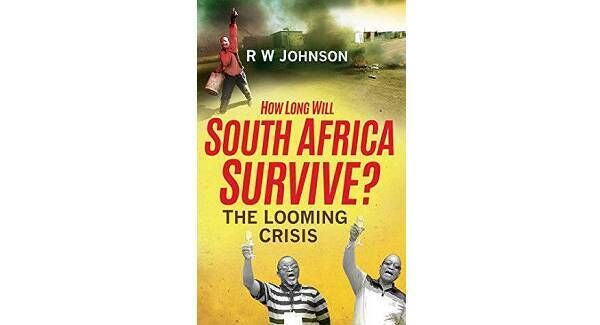
Book review: How Long Will South Africa Survive? The Looming Crisis
t’s the economy, stupid…!
At first sight it seems strange to write two books with the same title.
But RW Johnson has written How Long Will South Africa Survive? twice.
His first book (1977) prophesied South African military strikes on neighbouring countries followed by an international ‘solution’.
Now he says he was wrong and that international sanctions forced regime change.
So he has written a second title after witnessing what he describes as “20 years of almost complete fecklessness”.
I have often heard this word used to describe Irish politics but if you think it is the same thing, read on.
A South African by birth, Johnson, (73) is an emeritus fellow of Magdalen College, Oxford, although, unlike many compatriots, he returned to South Africa after the fall of apartheid nearly three decades ago.
The 1977 book questioned “how long it would be before the ruling white establishment encountered a regime crisis” and the second iteration posits that “South Africa is now heading fast for another investment crisis which will in turn end in another regime change”.
Johnson is a brave man.
He is frequently on the college lecture circuit and TV, expounding his doom-laden views in a seemingly fearless manner.
Johnson’s voice is patrician in register: stating, for example, that there is “not enough talent” in the government to run even a medium-sized European town.
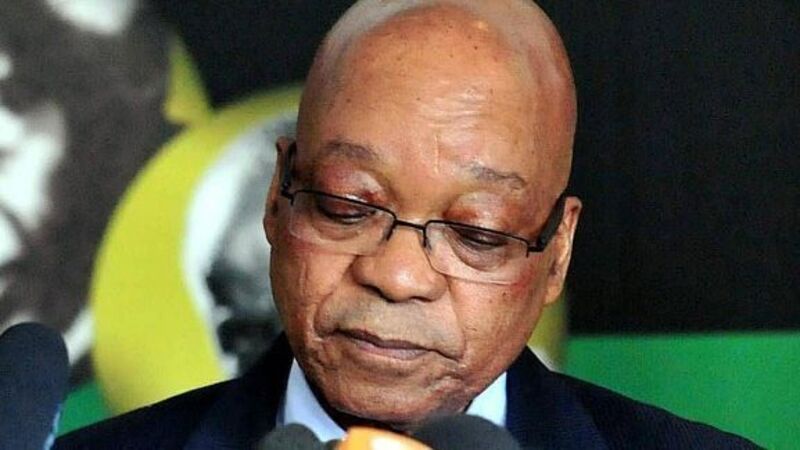
He sees the African National Congress (ANC), and its leader, the Zulu president, Jacob Zuma, as interested “to be quite frank” only in their personal wealth and in nepotism.
But, surely, you respond, South Africa is a democracy and allows free speech?
As evidence you cite that it is a country in which Mmusi Manimane, the leader of the opposition, the Democratic Alliance (DA), can stand in parliament and state that the “honourable president” is so-called only “out of respect for the traditions of this august house”.
That he, Zuma, is a “broken man presiding over a broken society” and one who “laughed when the people of South Africa cried for their beloved country”.
Zuma laughed, apparently, when armed police in plain shirts entered the chamber and assaulted the members while they were in debate. A true democracy then?
So you and I can both admire Johnson for his decision to live in his heritage country and to speak out repeatedly about the corruption of the ruling party and the likely collapse of the regime.
According to Johnson it is not politics, not corruption, not immorality which will destroy the “dream world” but perpetual failure to manage the economy. And he says that there is no political will to avoid an economic crisis.
Johnson argues that deep-level gold-mining is at the centre of the South African economy and that, for this “centre” to “hold”, the country requires substantial international backing.
He calls inward-flow investment the “iron law of South African history”. He points out that South Africa’s credit rating is likely to fall below the vital criteria and that large investors, such as insurance and pension companies (that’s you and me) will, eventually, dump South African bonds.
Johnson says that the country will “haemorrhage” capital resulting in falls in the exchange rate and in the stock market.
Interest on the substantial South African debt will rise, resulting in a debt trap.
He thinks that the politicians will not realise what is happening as they are too busy feathering their own nests.
An exception, he says, is the first black finance minister, Nhlanhla Nene, who Johnson considers as having been “set up to fail”. The finance minister would be a lone voice without support from the government.
And the International Monetary Fund (IMF) will descend on South Africa as it did on Ireland.
An IMF bailout? We had one of those. But more perils lie ahead for South Africa.
A lesson, according to Johnson, is Zimbabwe. Zimbabwe “sabotaged” the IMF con
ditions. Johnson fears that South Africa could go the same way. He points out, however, that unlike Zimbabwe, South Africa is urbanised.
City people will not be able to return to their homestead to scratch a living. Additionally a large number of Zimbabweans left their country for South Africa.
There is nowhere south for the South Africans to go – other than Antarctica. Thus Johnson hopes that when the IMF arrive the ANC and DA will cooperate.
Otherwise he fears there could be “xenophobic riots”. The “centre” would “not hold” and the country could “fall apart”. Literally it could divide along tribal lines.
Johnson’s answer is unsurprising: austerity. Unlike Ireland, however, South Africa does not have reliable provision of water or electricity. Austerity would be worse for them.
Perhaps not so bad for the government ministers who have stashed money abroad. Perhaps not so bad for Zuma who, according to the opposition, has 783 unanswered counts of corruption, fraud and racketeering against him.
It would be embarrassing though for the ANC to lose economic sovereignty and to have to admit that after 22 years their regime has ended in humiliating and public failure.
My copy of How Long Will South Africa Survive? is a paperback published this year and with this imprint comes a useful postscript, dated April 2016.
The first section is titled “The ethnic facts of life” and its opening statement declaims that in “the new South Africa there was supposed to be no such thing as tribalism and it was therefore highly politically incorrect to notice that it still existed”.
Johnson, who “dared to notice that exist it did” identifies the power of the “Zulu bloc” and the discomfort of the Xhosa, Tswana and the Northern and Southern Sotho groups. This is why Johnson expresses a real fear of xenophobia.
In parliament the Economic Freedom Fighters (EFF) wear the scarlet uniforms of domestic servants and African workers.
They disrupt the procedures, sometimes shouting “give back the money” and being so provocative that the speaker of parliament called their leader, Julius Malema, “a cockroach”.
Johnson comments that this brings back memories of the Rwandan Hutus using that word about the Tutsis during the genocide of 1994.
Amidst the chaos of South African politics, finance minister Nene, was sacked in December 2015, causing international consternation and negative market reaction.
Johnson, in his 2016 postscript, describes him as “of stolid good temper” and of having “played a straight bat”. Nene had “flatly dismissed” proposals and said that “things simply could not be afforded”; thus he lost his job.
In spite of calls for his resignation or impeachment Zuma survived, supported by the ANC’s secretary-general, Gwede Mantashe, in an attempt to keep the ANC together and avoid a backlash from the Zulu kingdom.
On the final page Johnson quotes Belinda Bozzoli, a DA MP, who wrote: “What we see is unambiguous evidence of unstoppable decay.
We become unavoidably aware that there is barely a realm of administration which is not rotten to the core, a minister who is not compromised, or a department which is not ineffectual”.
As I write, I note that in the recent local elections the ANC won an overall majority, taking just 54% of the national vote whilst the DA surged to 27%.
Maimane of the DA enthused that it was, in effect, a referendum and a protest against the ANC.
Analysts assert that the result is a market positive.
It’s the economy.


CONNECT WITH US TODAY



Be the first to know the latest news and updates