'I fully intend to sing again': Jimmy Crowley updates on his health and future plans
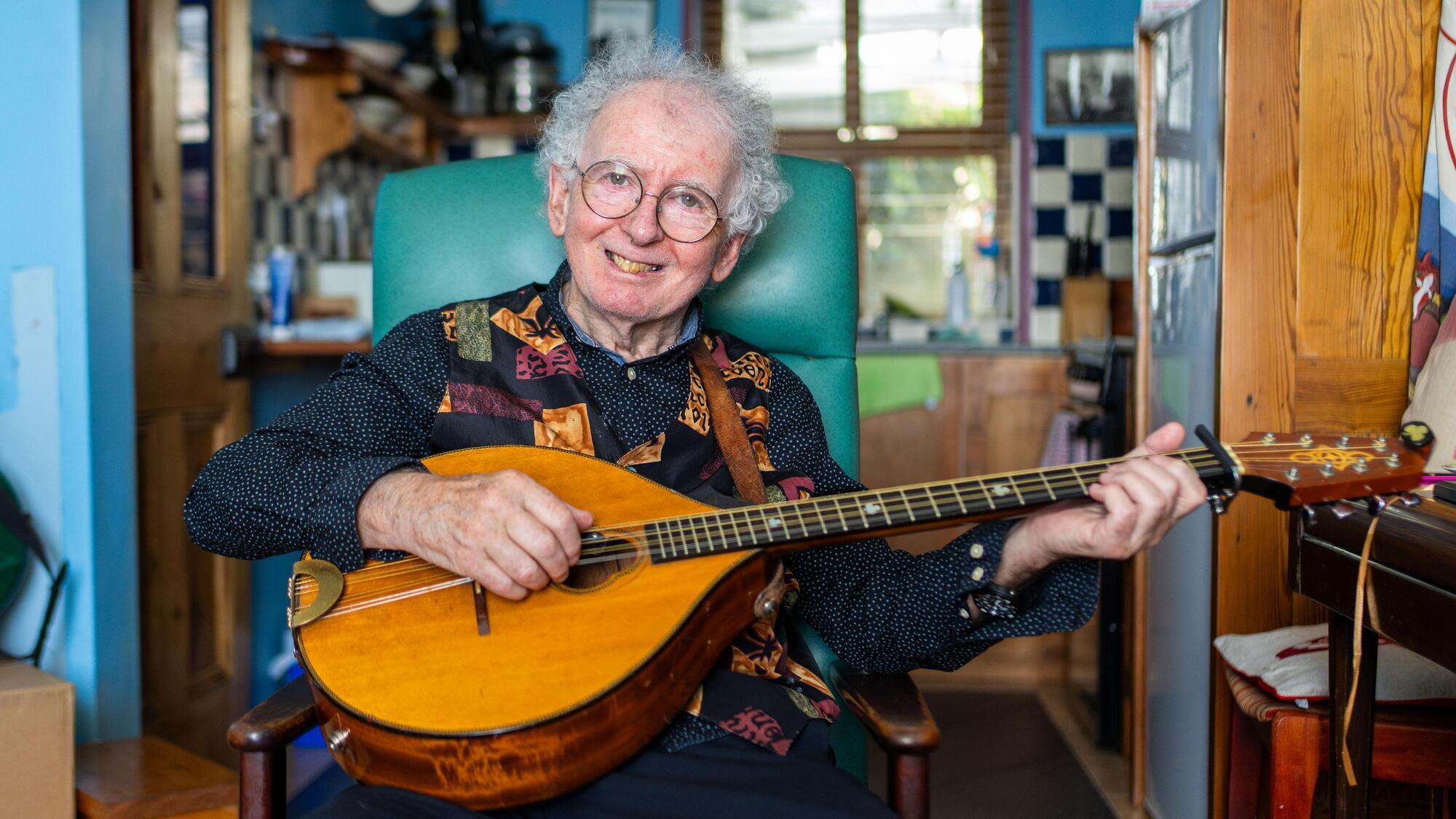
Jimmy Crowley is back at his home in Cobh, following long stints in hospital. Picture: Noel Sweeney
Stage three oesophageal cancer, a debilitating stroke, a fractured hip, all in one horrendous year. It was, reflects Jimmy Crowley, “a wicked thing to happen”. Even this devastating series of health blows, however, has failed to quench the creativity of the Cork singer-songwriter, who during his enforced absence from stage performance is now looking forward to the publication of his first novel.
Diagnosed with cancer last September, Crowley then suffered a stroke in December and spent more than five months in Cork University Hospital, where several falls necessitated hip surgery.
“It was too many things together,” says Crowley, who though largely wheelchair-bound has been able to return home to Cobh thanks to a GoFundMe campaign and fundraising concert which defrayed the costs of modifications to his house and the 24/7 care team his condition necessitates.
His health challenges continue, and in recent weeks Crowley was rushed back to hospital with aspiration pneumonia, returning after a week’s treatment to the comfort of the home he shares with partner Eve Telford and cat Smudge. “Thank God; you can’t believe it,” he says.
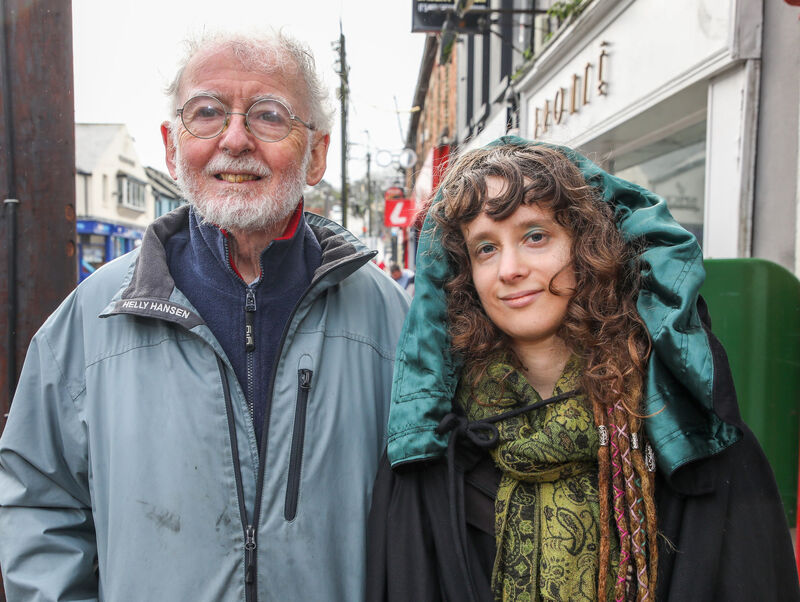
Walking is “hard work” but he is thankful the cancer is not causing him pain. “They found cancer in my oesophagus but I don’t feel it at all. It doesn’t bother me; it’s extraordinary,” he says. “I know I won’t get away with it for ever.
“It’s not good for a singer though,” admits the man who re-popularised Cork ballads and
“Sometimes I can sing. There’s a slight chance that I might be alright like, in some respects,” he adds.
And illustrating Telford’s observation that his voice is recovering since the stroke, both singers burst in harmony into a duet lauding the War of Independence deeds of Mary Bowles, one of the collected and published by Crowley in his 2014 anthology of Cork ballads.
“I fully intend to sing again,” he says. “I’m going to work on getting six or seven songs up to concert level.”
In the meantime, the 76-year-old is in little danger of becoming idle. Even his months in the CUH stroke unit were turned into a new creative avenue, writing 24 short stories while in hospital.
“They’re ghost stories, ‘Tales from the Haunted Hospital’. They’re my astral travel’,” he says. “Every night I was taken on a journey from my ward and brought back to the same place; different parts of Cork and under the city to an underground city; I was sleeping in a forest under the ground. It was dreadful but comforting too.” The stories are one of three literary projects in various stages of production, the first to reach fruition being his debut novel, to be published by Cork’s Mercier Press next spring.
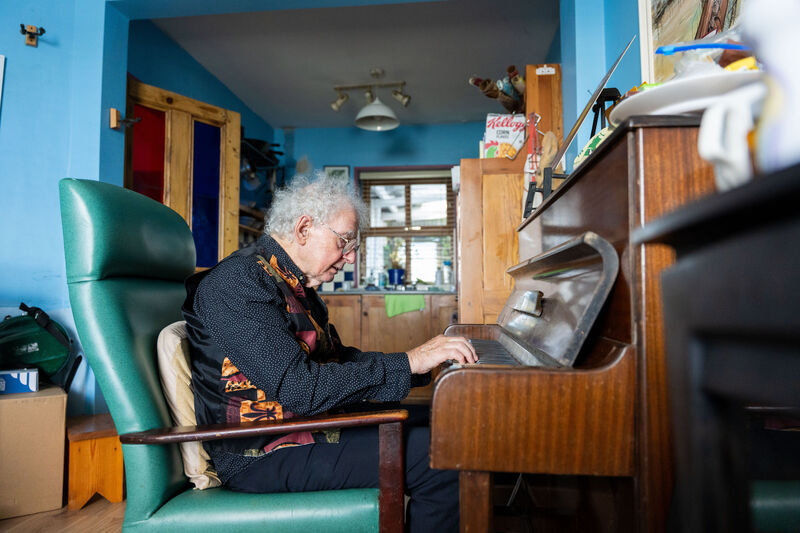
“I kind of switched over from music to literature and that’s been easier. It’s a blessing in disguise,” says Crowley.
“The book is a romantic novel, an Irish utopia called and I’m fierce excited about the way it turned out. I worked very hard on it for it must have been 30 years, and eventually Dee Collins in the Mercier Press said yes.”
Crowley’s while inspired by the mythical island reputed to rise into view every seven years, takes on a cosmic dimension as an Irish bard is lifted by starship to another planet where he finds a Gaelic utopia untainted by commercialism.
“I spent about 20 years thinking about how could I find a place that wasn’t affected by people or hadn’t been visited, on the Earth, but the nearest I could get was a little planet, so I wrote the book around that,” explains Crowley.
“A lot of people I’d say will be surprised by it. It professes an ideal. It has a didactic lesson in it, telling us we’re living wrong, and this is the way to live.”
It also has an indelible Cork stamp on its humour, people, and places.
Crowley’s travelling bard Rory McDaid is beamed into space from his cottage in Doirín Álainn, near Cúil Aodha, returning to Earth on a mission to save Ireland’s soul. The narrative moves to Cork city as McDaid and his friends, a professor of old Irish and a successful politician, meet in a café near Washington St courthouse, based on much-missed artists’ haunt, Café Lorca.
Cork is also the setting for Crowley’s next new literary venture: Writing a screenplay.
Telford, who is “helping; Jimmy’s doing the main work”, explains its premise: “This is about cruelty and injustice to a man from Cork called James Cotter who was hanged in 1720. He was accused of having his way with a young Quaker lady called Elizabeth Squibb, but he was innocent. He was the only Jacobite Catholic landlord at the time among a lot of Protestant landlords. When he died there were keens/laments written about him as Gaeilge.”
That the topic piqued Crowley’s interest will surprise few, given his penchant for Jacobite songs. That stretches back to the late 1960s when as a teenager he used to sneak into a folk club below-stairs at the Group Theatre on South Main St to listen to Irish and Scots songs of rebellion.
“A very important period in my life was when I was 16-17 there was a marvellous man called Jim O’Donnell, from Dublin, who was a ballad singer; he’s a film-maker in West Cork now. He used to have a ballad session every week and the songs were about Bonnie Prince Charlie, the pretender to the throne, and I got interested in all that,” he says.
The decision to tell Cotter’s story followed a conversation with ex-politician, journalist, and screenwriter Eoghan Harris, like Crowley, a native of Douglas.
“I talked to Eoghan Harris about it and he gave me a crash course in screenplay writing and thought I’d some hope. He was all for it,” says Crowley.
In addition to his burgeoning literary career Crowley has a bank of new songs written and at the time of his cancer diagnosis was working with Telford on an album of their own material, titled Ambrosia. Compositions by both singers are included, alongside the co-written Castletreasure, about Crowley’s childhood home – not far from the gatehouse after which he named his band, Stoker’s Lodge.
“I’m writing a few songs; not as many as I’d like though. I had a good few written before I got sick,” he says.
Compositions including are also yet to be recorded, but health recovery takes priority over the literary and musical to-do list.
Sustaining him is the knowledge that over half a century of singing, recording, writing, and song-collecting have earned Crowley the widespread respect and affection evident at this summer’s musical tribute in his honour at Cork City Hall.
More than 40 musicians and singers, all with personal connections to Crowley, participated in the fundraiser. “It was love,” he says. “I never thought people would love me as expansively. It was a fantastic thing to do and a great thing to be able to know.”