Tommy Tiernan Show: Niall Horan on humble beginnings in Mullingar, One Direction fame, and losing Liam Payne
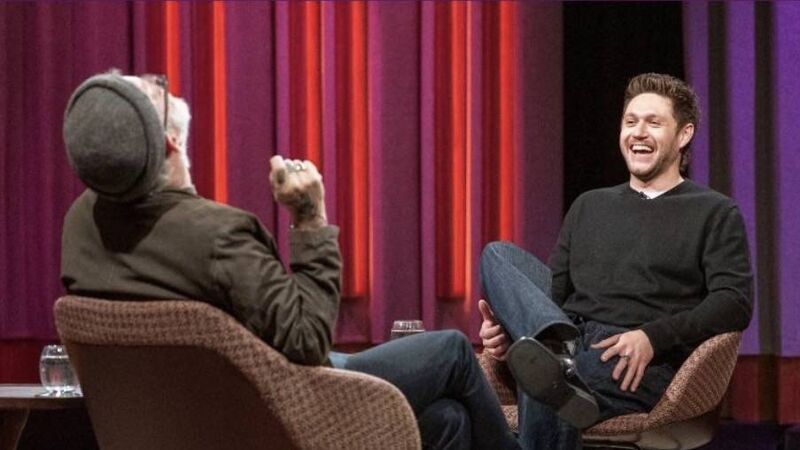
Niall Horan joined Tommy Tiernan, discussing his fame, humble upbringing, losing his friend and bandmate Liam Payne, and his future goals. Picture: The Tommy Tiernan Show/RTE One.
Singer-songwriter Niall Horan has opened up about his simple upbringing, being catapulted into a life of fame and losing his friend and former bandmate Liam Payne.
Horan was one of just two guests on the Tommy Tiernan Show on Saturday night, with viewers enjoying an extra-long interview with the Mullingar native.
The 32-year-old discussed his upbringing, family dynamics, and early musical interests, and shared his journey from taking part in at 16 to forming One Direction, the band's rapid rise to fame, their global tours, and the significant financial success they experienced.
He also touched on the emotional impact of his friend and bandmate Liam Payne's passing.
Describing his upbringing in a middle-class housing estate in Mullingar, and his parents’ separation when he was about four or five, he recalled the tight-knit community he grew up in and how his father worked for 30 years at Tesco.
He also touched on his father's support for Derby County Football Club, and the bonding experiences they shared watching football.
Speaking about the emotional awareness he had from a young age, Horan said: “As I got older, I felt like I was quite emotionally aware. I feel like I understood all right. Well, they just don't love each other. Like, I remember thinking that and being nearly all right with it.”
Speaking about his schooldays and discovering his singing talent through primary school carol services, he gave Tiernan a small rendition of
He said he credits his teacher, Anne Caulfield, for recognising his talent and giving him solo parts, playing Oliver in a school production. He spoke of how he went on to develop his singing skills in secondary school.
In fifth year of secondary school, he decided to audition for after being encouraged by his teacher Georgina Ainscough.
He described to Tiernan the audition process, including the long queues and multiple rounds before reaching the TV stage.
He spoke about how he was put into a band by Simon Cowell, which became known as One Direction, and the whirlwind of fame that followed.
Read More
He reflected on the surreal nature of his early success and the rapid transition from school to international fame, which meant he didn’t sit his Leaving Cert.
Horan spoke about the overwhelming response the band got to their initial promotional trip in various countries, and the success of their first single,
“It was just a great time. I mean, travelling the world, for two or three of those years we were playing to an average of about 65,000 people at night in every corner of the globe. I was just loving it, like I was just having the greatest time ever,” he said.
Horan touched on the challenges of maintaining a sense of normalcy while dealing with the intense fame of One Direction, and described the physical and emotional impact of performing in front of large crowds.
He also touched on his gradual realisation that One Direction was coming to an end and the bittersweet nature of that transition.
The band began an indefinite hiatus in January 2016, following the departure of Zayn Malik in March 2015.
Touching on the emotional toll of his friend and bandmate, Liam Payne's, passing, he told Tiernan: “I was playing a gig in Buenos Aires about two weeks previous, and he was in Buenos Aires for some reason, and we met up. We had a chat. He came around to my hotel room in the daytime, and we had a coffee, and then he came to the gig that night — he was in the dressing room before and then, yeah, came to the show. It was great to see Liam.
“Tour ends… Then I finished in Colombia. Then about a week later, went home. I was only home after a big, long stint on the road, ended the tour, and then I was just at home one night. Don't know what day of the week it was. I remember, and just looked down at my phone. I'd gotten a text. I was just about to go asleep, and, you know, and the phone lights up, and you have a look, one last look.
“And it was just pure shock and I knew he'd had a couple of issues, but because I wasn't around him like I was in previous years, all the time, I didn't realise to what extent or anything like that. I knew there was some stuff going on, but I wasn't aware of the depth.” Horan spoke of the stages of grief he experienced, admitting that he still hasn’t really “touched the sides on” his grief yet.
“I grew up with this fella, and all of a sudden, it’s just no more. It’s such a strange thing to go through. You go through, like, what could I have done if I'd known more? Should I have dug more into it? Like, could I talk to other people to get an angle on it?”
Sharing his thoughts on the media coverage and the judgmental nature of public reactions to Payne’s death, he said: “I have to say, after I made the mistake of turning it [the TV coverage] on the first time, because when I first turned it on, it was the shock the fans, you know, on the TV people work with us, doing interviews. I just remember going, No, I'm not doing that. I can't go any further than this because I've got a funeral to go to and things like that. I can't be worrying about what they're going to say next, because I have my own grief to deal with.”
Post-One Direction, Horan has released four solo albums, with his latest expected to be released in June.
Discussing his solo career and making music, he said: “When you graft so hard, and you write so many shite songs, and you have to go through the mincer on every album that you write, create sound, create feel, and create a mood, like when you when you get to the clear water and you start getting on a bit of a roll, it's a nice, feeling I also used to get I'm enjoying it more now than ever my solo stuff.”
Horan said he looks forward to his new album release in June and is looking forward to his three-night stint at Dublin’s 3Arena and two-nights at Belfast’s The SSE Arena in November.
Tiernan’s second guest of the night was poet, performer and playwright Felispeaks, who joined him for the second time on the show, having previously joined Tiernan some years ago.
Filling Tiernan in on how life has been since her last visit to the studio, she said: “I’ve been wintering, if that makes sense. In many ways, disintegrating into somebody else.”
“It’s become joyful now, but it’s been really hard becoming another version of yourself, or the next version of yourself,” she said.
She said she felt like she was spoiling and then becoming compost and that a new thing had to grow out of that. She said the process has felt “a lot like death”.
Touching on what led her to the desire of wanting this "disintegration" to happen, she said the housing crisis forced her to find how to be without a home base, explaining that she went from having everything at her fingertips, earning money as a performing artist, to no longer having that.
She spoke about her time living in Brussels, which she said allowed her to figure out who she was when not constantly performing, saying that in her twenties she had found so much of her identity and value in being “some sort of a successful artist”.
Felispeaks shared memories from her childhood and time in school, saying: “I think I grew up really quickly anyway. My primary school and secondary school, for example, was very multicultural. I didn’t start really experiencing the shock of being in a majority-white country until leaving Longford.
“I moved to Longford when I was like seven or eight, so it's all I've really known from my childhood, but the grit is familiar. I have two younger brothers. I'm the only girl child in my family. So I also grew up, in general, rough around the edges, but I also had a lot of joy as a child. There was so much community, I was in constant community.”
She spoke about how her favourite teacher drove her to her first poetry competition in Carrick-on-Shannon and drove her back home, because her mother was working in Dunnes.
“The ordinariness was very communal,” she explained.
She touched on her experience and the challenges of moving back into the family home in Longford at the age of 30.
“They’re doting on me, which is really sweet. I feel like I’ve been an adult for so long, even though I’m only 30. I feel now like I get to be their child again, which is nice,” she said.
Sharing some tears, she said: “I was like an assistant adult for a long time, in the house. I didn’t mind it. I find that I’m quite a capable person. And capability is often not a respecter of your age, especially when it’s recognised in you, and your vulnerabilities are not so much addressed or acknowledged.”
Felispeaks also touched on her long-form prose pieces and writing a book.
“I'm really excited about it because I’ve gone from spoken word poems, poetry in general, being my first kind of release, or my first pen, into writing plays. The past couple of years, I've been writing a lot of plays and now writing a book. I didn't think I was the type of person that would ever write a book. It just sounds like so much commitment, but it just dropped. I got the idea,” she said.
The show was closed out by The Scratch who performed the song