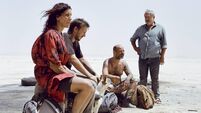
Tommy Tiernan Show recap: Pat Spillane on his love for football and his mother's influence

Pat Spillane spoke about early life, his teaching career and his passion for football on the Tommy Tiernan Show on Saturday night. Picture: Tommy Tiernan Show/RTE.
Fans of the Tommy Tiernan Show were treated on Saturday night to a show exploring everything from a career in football to a career in Hollywood.
Tiernan’s guests on Saturday night included former Gaelic football pundit and player Pat Spillane, specialist cleaner Alana Gillen, and actor and writer Andrew McCarthy.
Tiernan’s first guest of the night was Pat Spillane, whose league and championship career at senior level with the Kerry county team spanned seventeen years from 1974 to 1991.
Spillane, who is widely regarded as one of the greatest players in the history of the game, discussed his personal life and diverse career.
Spillane taught geography and PE for 35 years, wrote for the Sunday World and Irish Independent for 35 years, and worked behind the bar for 40 years.
“I retired from teaching at 55, so just 15 years ago. I still write, I write with the Sunday World. I started writing with them on October 1, 1991 and I haven’t missed a Sunday since then," he said.
“I write for the Irish Independent as well… do podcasts with the Independent and I watch sports all day long.”
Spillane discussed his teaching career, having taught in both Ballyvourney and Bantry, saying he loved his career in teaching.
He went on to speak about the “lots of careers” he had in his 70 years of life, alongside GAA which he described as his pastime, his “pursuit”.
“I've been writing for the Sunday World and the Irish Independent for 35 years. I was a teacher for 35 years. I was born and reared in a rural pub… I was behind the bar counter for 40-something years, and I worked on here in RTÉ for 30 years. If there's one thing about all those jobs, there was a sort of common denominator in the sense that every one of those jobs, you were on stage, if you know what I mean, you were performing.”
“It’s only since I retired and particularly in the last couple of years that I like my own company, I like being on my own watching sport, not talking to people, not performing, not having to be nice, just being myself.
“I was on that ‘stage’ for 55 years, and I like the company of myself a lot of the time with a newspaper, sport and TV. Sport is my vacuum. Sport is my escape from reality. I love watching sport. Tommy, on a bad day, I will watch eight to 10 hours of sport.”
He credited his mother, who raised four children while running a bar, as the person in his life who defined him.
“My father died when I was eight, and my mother was left to rear four kids. Not alone did she have to rear four kids, but she had to run a bar, run a grocery shop, and operate a petrol pump, and she did that on her own for 40 years and she reared us as well at the same time.
“And in those years, in the 60s and 70s, there were no widow pensions or nothing. She worked hard, she sacrificed her life for us, but the one thing she instilled into me was that value for hard work. I was never gifted as a footballer. I was never gifted in school, but I was a hard worker. I worked hard, I slogged. I got to the top of each profession that I was at through pure hard work.”
Spillane spoke about how close he was to his siblings growing up, and how they still have a close relationship to this day.
“We’re a very close family. Still to this day, we’re very close,” he said.
Spilane went on to talk about rupturing his ACL in 1982 and thinking “that was it” for his football career, after a consultant told him at 27 he would never play football again.
Speaking about his subsequent comeback, he said: “I’d five All Ireland medals in my pocket, I’d six All Stars. I didn’t need to achieve anything, but I wanted to achieve. I wanted to show I can come back playing football again. I can win All Irelands, I can deliver, even though no one thought I would.”
When asked by Tiernan if where in his life he thinks he might have failed, Spillane spoke about how he was “so focused” on football.
“When I met Rosarii, she couldn’t believe… I was the most driven, focused, selfish, self-centred person in the world because football was my life and everything revolved around the match next Sunday.
“I couldn’t go on dates, because I’m in the zone. I can't drink. I'm in the zone. I'm training.”
He shared the story of their engagement, the day after a Munster final between Cork and Kerry, which ended in a draw, and spoke about how he celebrated with 10 pints of Club Orange because the replay was the following Sunday.
He touched on having a fear of death in his younger years, because his father had died when he was so young, and spoke about his faith and how he is no longer afraid of what comes after death.
“I'm sort of thinking ahead now, and I'm thinking back as well at the same time. I've had a ball. I've had a blast. God forbid, if the man above beamed me up tomorrow morning, I'd be happy, I swear to God. My life is perfect at the moment.”
Tiernan’s second guest of the night was Alana Gillen who specialises in biohazard, crime scene and trauma cleaning.
“I would get a call out for perhaps a murder, and I would have to pack the van and travel and come and clean up and hand a house or an area back to families with all traces of traumatic events gone,” she explained.
She explained that her work often deals with blood, bodily fluids, and other biohazards, and that she handles about 50% death cleaning and 50% biohazard and trauma cleaning, including hoarding disorders.
Touching on some of the most difficult cases she’s worked on, she spoke about how she finds cases where an older person would have passed away alone particularly upsetting.
When asked if she would be told the full story of how a traumatic event took place before entering a home or area, she said: "I'll probably be given a brief. Sometimes, I think it's easier if you don't know the full story, because you might get attached, or, you know, it might make you a bit more aware of or emotional in places. But in other cases, it's good to know the story, because you're going to be looking for a specific thing here, or this is going to be in a certain area, or could be somewhere else.”
Gillen said, however, that she is always willing to listen to stories from family members of a person who has passed.
“I do cry with the people too. I give hugs and I cry, and I listen to the stories. Whenever you go to maybe meet a family member outside a house, and they go, ‘I haven't been in. I don't want to see it. Here's the keys’.
"And they want to tell you their story, and I want to listen. And I have cried, and I will cry, and I will certainly give hugs and I, you know, and it would be very brutal of me to turn up and go, ‘I don't want to know anything about this. I'm not going to comfort you in your time of need’.
“I'm here to clean and do your practical job but I'm human, I’m very soft, and I will definitely cry. I want to hear the stories. I want to know how much you loved your brother and how devastated you are that this has happened, and there's a thing in the house that you want to see and you want me to keep and look out for and I and I will go and I will get that, I'll keep that for you, and I'll meet up with you afterwards. I'll bring it to your house.”
Touching on cleaning extreme living conditions and self-neglect situations, she said there is not an ounce of her that has ever walked into someone's house and thought, ‘How could they live like this?’.
“People just get overwhelmed. If you have a cold or a cough, the last thing you want to do is clean your house, but if your brain gets sick, and it's sick for a very, very long time, those things mount up, and then inside you, something's telling you, ‘Sure you don't deserve to have a clean house, you don't deserve to have this, so we'll just keep building up and building up’.
“And then before you know it, you don't know where to start and you don't know how to, so you hide yourself away, you hide everybody else away, isolate yourself, and it's all because there's something going on in your house that you don't want anybody else to see.”
Tiernan described Gillen’s line of work as “amazing”, and thanked her for coming onto the show to talk about it.
The final guest of the night was actor and writer Andrew McCarthy, who spoke about his career, struggles with fame and addiction, and his transition to writing and directing.
Starting the conversation by delving into his rapid success in the 80s and 90s, McCarthy spoke of growing up in New Jersey, attending NYU at 17, and being kicked out for skipping classes.
He recounted auditioning for and landing the lead role in the movie Class, which was not successful, followed by and which catapulted his career.
Speaking about the effect of the term ‘Brat Pack’, a nickname coined in a 1985 article for a close-knit group of young actors who dominated 1980s teen coming-of-age movies, such as he said: “That altered how we were perceived.”
“It’s one of those things where a label was thrown on right away, and it altered the trajectory of my career, and I felt like when that happened, my hands were taken off the steering wheel, and I wasn't in control of what was going on, and I was sort of presented in a certain way, and I felt like, wait a minute, I'm a 22 year old kid, I'm just starting to be successful. This is really wonderful and exciting and now what just happened? Now I'm a part of this ‘thing’,” he said.
McCarthy spoke about the challenges of being pigeonholed and his struggle with alcohol addiction, describing how his addiction led to a period of self-destruction but ultimately became a source of strength.
“I fought against, for a long time, the notion of feeling pigeon holed in a certain way, and I struggled against that. I also drank too much when I was younger and people often say, ‘Oh, well, you're too young for success, and so you drank’. And I'm like, ‘No, success just let me drink better vodka but I would have drunk the vodka anyway’.
“That derailed me for several years and that took me several years to actually do something about. The worst thing that happened to me in diving down that drink hole turned out to be a real blessing to me.
“Not stopping drinking, of course, that was a blessing, but the act itself of drinking and losing myself to that, you know, it's like that the cracked vase lasts longest, that's turned to my greatest sense of strength in a certain way.”
He shared his experience of travelling the world alone after quitting drinking, including the realisation of his fears and how overcoming those fears led to a sense of self-awareness and a new direction in life, including becoming a travel writer and working with
He touched on his transition from acting to directing, which started with the show which streamed on Netflix, describing initial challenges and how his experience as an actor helped them connect with actors.
McCarthy went on to discuss preparing for the role of the judge in Andrew Flynn’s new production of Arthur Miller's Tony Award-winning classic which is running at Dublin’s Gaiety Theatre until March 21.
Closing out the show on Saturday night were Just Mustard performing ahead of their 3Olympia gig on May 1.