'You can only take a few financial risks': Getting the balance right at Cork Arts Theatre
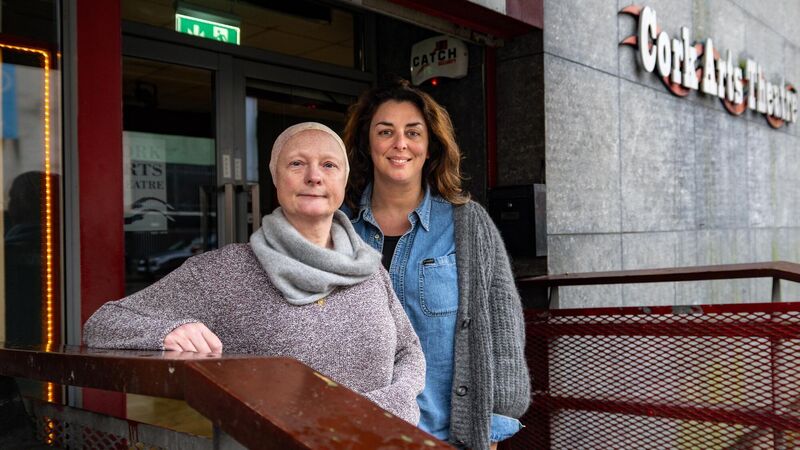
Fin Flynn of Cork Arts Theatre, and 'Infinity' director Julie Kelleher at the Carrolls Quay venue. Picture: Chani Anderson
Now in her roles as director and CEO of the Cork Arts Theatre for nearly four years, Fin Flynn says the main challenge is to ensure that the venue is economically viable. This year, the 100-seater venue formerly known as the CAT Club is celebrating 50 years with an ambitious programme. Under the banner Re: Directing, the theatre is producing three contemporary plays with the first one, directed by Julie Kelleher.
Thanks to Arts Council funding of €129,000 to produce the three plays, Flynn says this is the first time the theatre on Carrolls Quay has received “significant funding” from the organisation. The grant is specifically for the three shows.
“Therein lies the challenge,” says Flynn. “We really need to secure funding going into the future that will allow us to cover some of the overhead costs. That would take the pressure off in terms of having to make the bottom line. And it would allow us to give better terms to artists coming in to use the space.
"Currently, I have to make enough revenue from the rent and box office to support two full-time salaries and all of the overheads.” (Ideally, the Cork Arts Theatre would have three full-time positions, says Flynn. Most of its staff members are employed on CE schemes.)
Ongoing Arts Council funding would allow the Cork Arts Theatre to make more adventurous decisions in terms of programming. “What’s difficult for us is that I’d like to see more work from touring companies coming down from Dublin. But if they’re looking for a substantial guarantee [of income] I can’t offer that because currently, I need to make the revenue work. That’s what’s tricky.
"A touring production mightn’t be as well supported as a Cork production. You know that ticket revenue isn’t going to cover guarantees. It limits us. You can only take a few financial risks throughout the year. I’d like to be able to take more risks.”
Flynn’s hope is that in two to three years time the theatre will manage to get onto a ladder of funding. When she started working at the Cork Arts Theatre, following over 17 years as company manager of Corcadorca, Flynn says the venue was — and is — in a good state financially.
“It survived covid. A quite successful fundraising campaign was run which ensured the Cork Arts Theatre’s viability. The mortgage was paid off during covid times.
"Obviously that was a stretch when there was no income coming in but the fundraising that Dolores Mannion and the board ran during 2019/2020 ensured that the mortgage kept being paid. When I joined, there was a residual loan outstanding. I managed to pay that off.”
Flynn has put in an application to Cork City Council looking for significantly more funding than usual based on the fact that 2026 is an anniversary year and that the Cork Arts Theatre has received Arts Council funding. “I made the case to the arts office at City Council that an increase would allow us to plug in a bit more money to each of the three Re: Directing productions for the anniversary.”
On a very positive note for the Cork Arts Theatre, there is a big demand for the space. “Because of its size and its lean running costs, it is very much in demand from professional companies, semi-professional companies and am-dram companies, plus performing arts schools and festivals such as the Munster Literature Centre’s festivals and the Cork Midsummer Festival.
"There is plenty to keep us going. There’s a show on for 48 weeks a year. We close for two weeks of maintenance work and we also tend to close when the bilingual pantomime closes for Christmas.”
Covid cast a long shadow over live performance but Flynn says that audience numbers have revived. “Certainly, any of the local companies do very well at the Cork Arts Theatre in terms of support. We run a platform for early career artists, a lot of whom would be recent graduates of the MTU Cork School of Music. Their shows tend to sell out.”
But working away without funding, there are a number of theatre companies in Cork staging sometimes impressive productions. Flynn cites ALSA Productions’ staging of Enda Walsh’s last year as well as two Brian Friel plays, produced by Longstory Theatre and Lee Promotions. “Thankfully, they were very well supported audience-wise,” she recalls.
But is theatre losing its appeal as a career? After all, there are far more lucrative opportunities in film, TV, the online space and other related areas.
“I still think there are a lot of actors who have a grá for live performance," says Flynn. "Obviously, film pays way more. But even if you look at very established actors, they still like to do theatre when they can. There’s a buzz there.”
- directed by Julie Kelleher is at the Cork Arts Theatre from February 5-14.
- directed by Al Dalton is at the Cork Arts Theatre from June 17- 21 in partnership with the Cork Midsummer Festival.
- , directed by Katrina Foley is at the Cork Arts Theatre from November 11-21
Former artistic director of the Everyman in Cork and former CEO and director of the Mermaid Arts Centre in Bray, Julie Kelleher is directing at the Cork Arts Theatre. She is excited about this contemporary play written by award-winning Canadian playwright, Hannah Moscovitch.
The brief from Fin Flynn was to stage a contemporary work that hadn’t had an Irish production as of yet. It also had to have a small cast. “I was conscious that the other directors had chosen plays by British playwrights,” says Kelleher, who was delighted to discover recently that Moscovitch had a grandparent from Cork.
“I read plays that had been translated into English and work from other Anglophone countries. Fin wanted to show something that’s a bit new and different, that audiences wouldn’t normally have access to. I was using an online library, reading plays written in the last 10 years. I was also looking at what was hot in New York and London.”
has a cast of three, comprising a mathematician, a musician and a theoretical physicist. The mathematician is trying to solve the problem of love while the physicist and the musician must work out how to make a life and family together. The play is a non-linear drama about time and love. It is inspired by scientific concepts of time while remaining grounded in the very human predicaments of its characters.
“There’s a parallel thread in the play, how physics thinks about time. There’s the idea that time is an illusion and also, one of the characters doesn’t really believe love to be real. Those two theories get tested in the course of events that happen in the play.”
If that sounds heavy-going, Kelleher says the play is not overly cerebral. There is comedy in it but it goes to unexpected places.
There is also music in While the original script has violin music in it, Kelleher has hired Belfast’s Córas Trio, an avant-garde trad/folk group, to create the soundscape. She saw them in Paris and was “blown away” by them.
Another major project coming up for Kelleher is directing Cork musician Mick Flannery’s new musical which will be staged in the Pavilion in Dun Laoghaire in April and at the Everyman in May. Kelleher produced Flannery’s first musical, in 2019.
This will be her first time directing a musical. “I love working with Mick. He can be quiet and he’s a thoughtful person. But he can be mischievous in spirit as well. He’s a very curious person interested in a lot of things.”