'I couldn't touch materials': Daphne Wright on how having a child changed her art
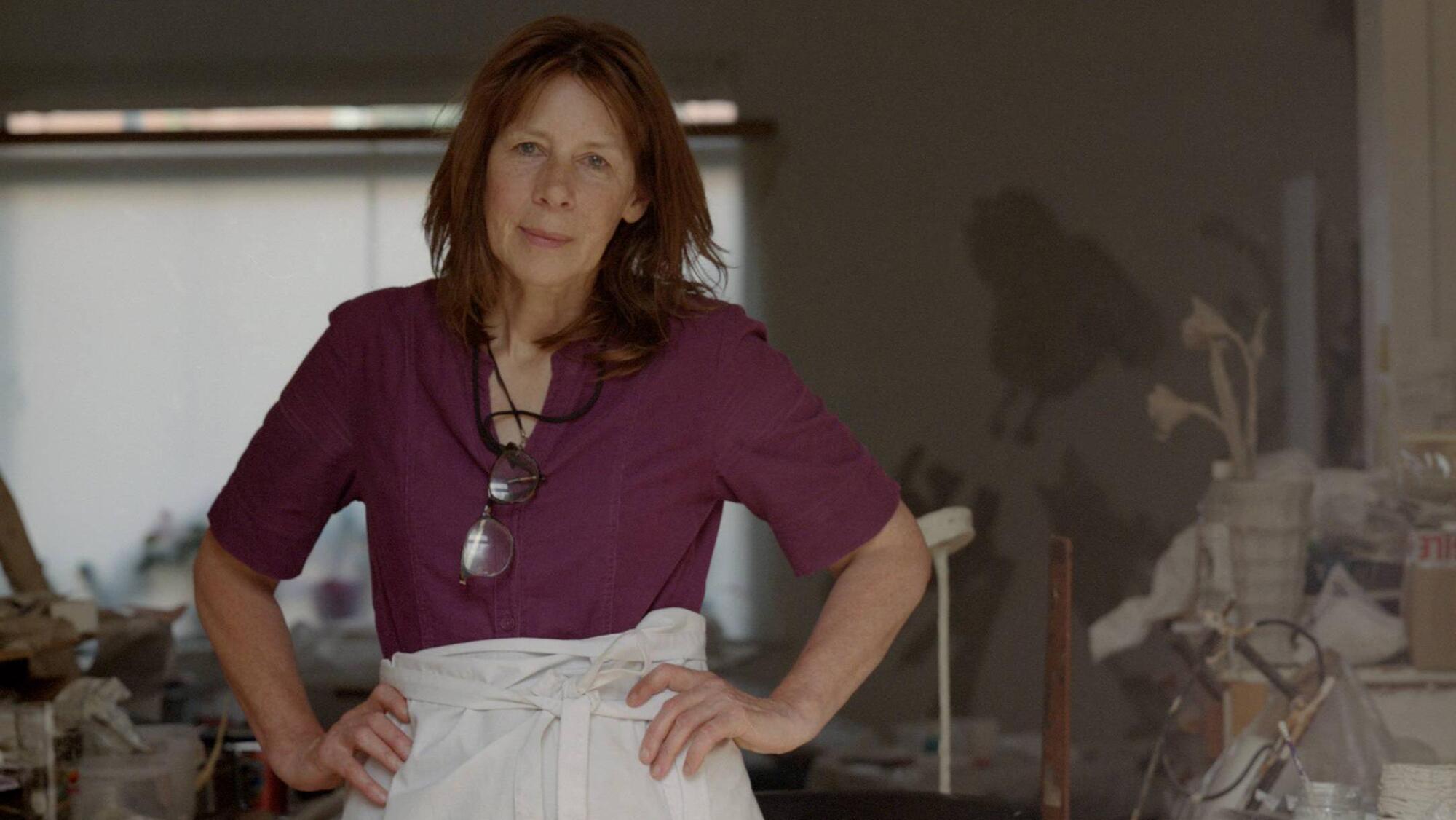
After temporarily turning away from sculpture following the arrival of her first child, the artist's sons are now central to her work  
'I couldn't touch materials': Daphne Wright on how having a child changed her art

Daphne Wright has a new exhibition in London in February. 

Few artists maintain as low a profile as Daphne Wright, and yet she is one of the most prestigious Irish artists working today. Based in Dublin, Wright is a member of Aosdána in Ireland and a Fellow of the Royal Society of Sculptors in Britain, and exhibits regularly in both countries. 

One exhibition, Deep-Rooted Things, will no sooner finish at the Ashmolean Museum in Oxford on February 8 than her next, Expectations, will open at the Frith Street Gallery in London on February 19.


Central to each is an installation called Sons and Couch, which features sculptures of her two children. This is the latest in a series of sculptures that began in 2011 with Sons, when they were boys, continued with Kitchen Table in 2014, when they were entering adolescence, and concludes – for now, at least – with this latest iteration, which finds them on the cusp of adulthood.

Sons and Couch, by Daphne Wright. 

Wright remembers how Sons, for which she cast the two boys’ heads and upper torsos in jesmonite, was inspired by the sight of them playing with a friend’s children when they were infants. “It was in somebody’s living room,” she says. 

“And the parents had casts of their children’s hands and feet. There’s this huge growth at that age, and it was almost as if everybody in the room was nostalgic for a time that was literally only six months or a year before.

“I was interested in that ordinary domestic grief those parents were experiencing, and in linking that into the history of art. I was wondering what would happen if you put that grief into a museum language. That’s where it came from. But I had to wait until they were a little older to establish that it was okay to make the pieces.” 

Wright made Kitchen Table in 2014, when one of the boys was eight and the other was 10 or 11. One sits bored at a table, and the other is cross-legged on top of it, as if testing boundaries.

“I would have loved to do them again when they were 15 or 16,” she says. “That’s when parents and teenagers are really renegotiating their relationship. They find parents a huge embarrassment, which I think we are. That whole thing, the physical closeness you have with your parents… they have to grow and redefine themselves. And that means separating in all sorts of ways. Not just with ideas, but with the usual rebellion and all that.” 

It was not until the boys were in their late teens that Wright felt she could approach them about making a third sculpture. “I felt that things had shifted, and I could ask. But we did a lot of negotiation, a lot of talking about it. One thing they agreed on was that the boys would not be depicted at the table again, but on the couch in the living room. The couch is definitely their wild space, their place of rebellion.” 

In each of the three pieces, Wright has made the figures life-sized. An interest in working at scale is something she attributes to her upbringing on a dairy farm in Co Longford. “I think I was really lucky to have that experience,” she says. “You see farmers take on massive workloads, just because they have to. I think you bring that with you, that sense of being able to achieve things physically.”

Beginnings

She was always creative as a child. “I was always surrounded by people who were making things. So it wasn't unusual. I think at that age, most artists are doing it without even knowing they're doing it.” 

On finishing school, she studied at Sligo RTC for four years, before going on to NCAD in Dublin. After graduating in 1987, she stayed on in the city for another two years. 

“I had a bedsit on Leinster Road,” she says. “It was tiny, and full of the sculptures I was making in wax and plaster. That was a very pivotal time for me. I worked in Bewley’s as a waitress. I read every book I could find, I really educated myself in literature. But back then, nearly everybody from my age group emigrated. And I left myself in ’89, to go to Newcastle Poly.”

Another piece by Daphne Wright.

She spent two years studying for her Masters, before going on to survive on a series of fellowships, in Cheltenham, Manchester and Rome. She made all sorts of work, in video and sound, as well as sculptures in materials as diverse as unfired clay and tinfoil. By her own account, she was never focused on commercial success.

“My work is very much based on research and inquiry and curiosity,” she says. “It's not about the market. And anyway, there wasn't a market at that time. That whole idea of the selling and the sales, that just didn't exist. 

"From my experience, that all kicked in with the Brit Pack and Charles Saatchi and all that. Art became a commodity. That was my experience of it. And I didn't know how to answer that because my work was made from very fragile materials that didn't fit. My sculptures are not commodities.”

Motherhood

Becoming a mother would have a profound effect on her art-making. “For a long time, I couldn’t touch materials,” she says. “It was a physical revulsion, almost to the point of vomiting. I don't know, I suppose there's several reasons why that was. For one, you're consumed by your child, your baby. I think it is such a physical thing that it is overwhelming. So there was just no room for material.” 

One positive aspect of her situation was how having a child 'rewired' her brain. "There's a lot research on that now; the mother’s brain actually does totally rewire, and its capability increases,” she says.

Another was that it forced her to collaborate with others. "People who could touch material. That's the point where, working with other makers, I made Home Ornaments, a public art piece in the Gorbals area of Glasgow.” 

Public art

Wright’s Home Ornaments, which she worked on between 2002 and 2005 in association with CWZ Architects and the Artworks Programme, saw her present public art in a new and innovative way. “I did a lot of interviewing and talking with the local communities,” she says. 

“There’s a lot of Irish in the Gorbals, of different political backgrounds. There’s a lot of conflict there as well, but also there was an aspiration to rebuild the area.”

Wright worked with a handful of other makers to create a series of small objects, in wool, ceramic and polyurethane resin, each of which was placed on a specially built shelf in each apartment in the new Gorbals housing estate.

“The ornaments were a gift to the residents. I did that rather than put a large public art piece outside on the lawn. They were based on historical stories, so the whole narrative around them was important. I placed an edition of each into GOMA, the Glasgow Museum for Modern Art.

"They’re shown regularly, so the people from the apartments have an investment in it. At the time, it was kind of a radical project. And I do think that major changes and shifts in your life do sometimes make for radical work.” 

Exhibitions

For all her disinterest in the art market, Wright’s work has found its way into many other collections, such as those of the Irish Museum of Modern Art, the Rhode Island School of Design in Providence, USA, and the Bucerius Kunst Forum in Hamburg, Germany, where, even now – as Sons and Couch is being displayed in London – its predecessor, Sons, is being shown alongside work by Titian and Anthony van Dyck in an exhibition called Kids!.

“All these years later,” she says, “it’s in a dialogue with these historical artists who’ve looked at the subject of the child in art. I couldn’t have foreseen that at the time I made the piece. When you have children, you think you’ve disappeared as an artist, so it’s really ironic that it’s ended up where it is now.” 

  • Daphne Wright, Expectations opens at Frith Street Gallery, London on February 19 and runs until April 18. Further information: frithstreetgallery.com

More in this section

Scene & Heard

Newsletter

Music, film art, culture, books and more from Munster and beyond.......curated weekly by the Irish Examiner Arts Editor.

Cookie Policy Privacy Policy Brand Safety FAQ Help Contact Us Terms and Conditions

© Examiner Echo Group Limited