Tom Dunne: Mark Kermode is spot-on about the brilliance of the Gang Of Four
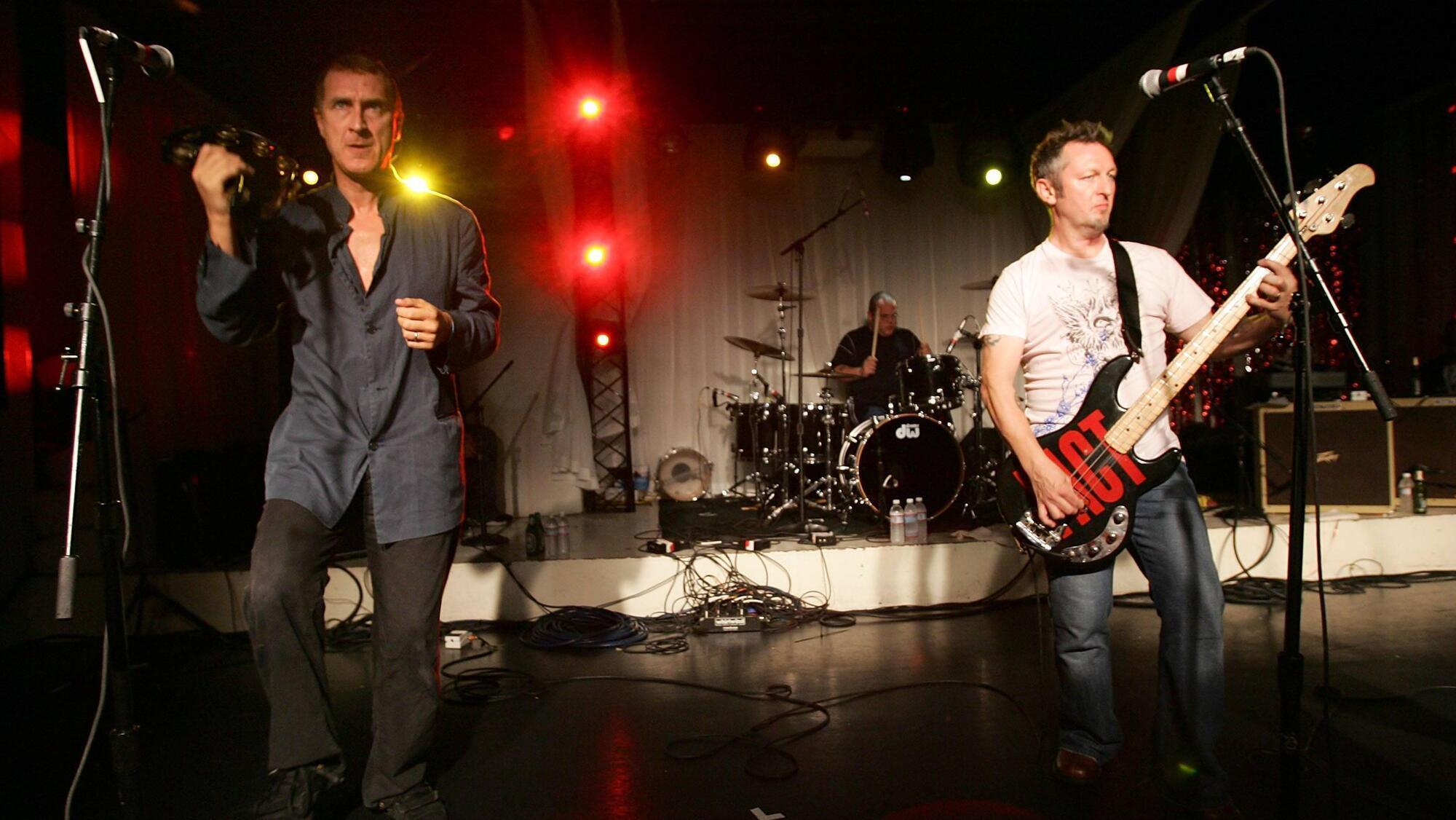
Jon King, Hugo Burnham and Dave Allen of the Gang of Four during one of their reunions in 2005. Photo: Frazer Harrison/Getty Images

A lot of the bands that I love reside in the “if you know you know” realm. I name check them and people look blankly into the distance. Gang Of Four would be one of them. Understandable too. Not many bands reference the Frankfurt School of social criticism as an influence.
Mark Kermode, the much-beloved BBC film critic, is not one of those who look blankly away. And it’s not just love. It is devotion. He is in, essentially, a Gang of Four covers band. Being a man short, they are called, naturally, Gang of Three.
May I say from the outset that “covers band” is an offensive, convenient moniker that while conveying the essence of what is at play here manages to devalue and reduce it at the same time. They are not a wedding band. And if they were it wouldn’t be a wedding for the faint hearted.
But how can this be you ask? Gang of Four were brilliant, but even in 1979 stood out as “a little bit out there” in a post punk world where being a little bit out there was the absolute norm. You could see the ones that would eventually get semi absorbed, people like Weller and Costello, but GOF weren’t one of them.
The debut single, Damaged Goods was a mission statement. Peel loved it, it topped the indie charts. A deal with EMI followed but when their debut single at that label, At Home He’s a Tourist, charted and they were invited onto trouble followed.
It seems innocuous now, but when it was suggested that they change the word “Rubbers” to “Rubbish” they simply refused and walked off. That’s what bands did then. They had principles. A later single, I Love a Man in Uniform, was banned by the BBC during the Falklands War.
The BBC probably thought they were just dealing with some oiks from Leeds in a post-punk band. They didn’t realised the oiks were schooled in Frankfurt School and were wise to how capitalism justifies and legitimises the domination of people. What fools the BBC really were.
A teenage Mark Kermode was blown away by all this and particularly the Gang of Four’s album 1979 Entertainment. He and his band mates tried to play it but despite its minimalistic inspiration it is wickedly complicated musically. The parts are simple, but the way they are combined is anything but.

And there it might have stayed where it not for Mark’s 60th birthday. At which, with musical accomplices Simon Booth and Stephen Hiscock, he resolved to give it one more go. After a lifetime in music, but not without difficulty, Entertainment, in full and in order, was mastered. The response was joyous and gigs followed.
That Entertainment should now sound quite contemporary should surprise no one. Bands that have openly discussed the influence on them of Gang of Four include the Red-Hot Chili Peppers (who hired Andy Gill to produce their debut), Nirvana, R.E.M., Franz Ferdinand, The Jesus Lizard, Fugazi, Idles, St Vincent, The Afghan Whigs, Sleater-Kinney, The Rapture and the Yeah Yeah Yeahs. And lyrically, questioning the alienating effect on the individual of modern society, well, has that ever been more relevant?
It does of course present an issue for Mark. The position of bass player has been filled by many gifted individuals since Dave Allen left the fold in the 1980s. One of the was Gail Ann Dorsey. I could list the bands she has played in, although it would take time, but let’s just leave it at Bowie, 1995 to 2004.
Mark is philosophical. “When I became the film critic at the I took over from Phillip French, the then ‘doyen of British Film critics’.”
After he left, the printed a two-page tribute to him during which Martin Scorsese described French as simply “irreplaceable.” “You’d imagine I’d have learned something, i.e. in future try and step into the shoes of someone who isn’t that smart. But no.”
Gang of Three play Whelans this Thursday night. Strangely since Gang of Three started to do this, Gang of Four have also started to tour and play the album. Watch this space for future announcements. A Gang of Seven supergroup cannot be ruled out.
Meanwhile if you are unfamiliar with what the Frankfurt School was all about now might be a good time to change that. They were worried about the socio-economic system of the 1930s Germany. Hmmm.
- Mark Kermode and the Gang of Three play Whelan's Dublin on Thursday, January 21