Seán Ó Sé obituary: A remarkable singer best known for An Poc Ar Buile
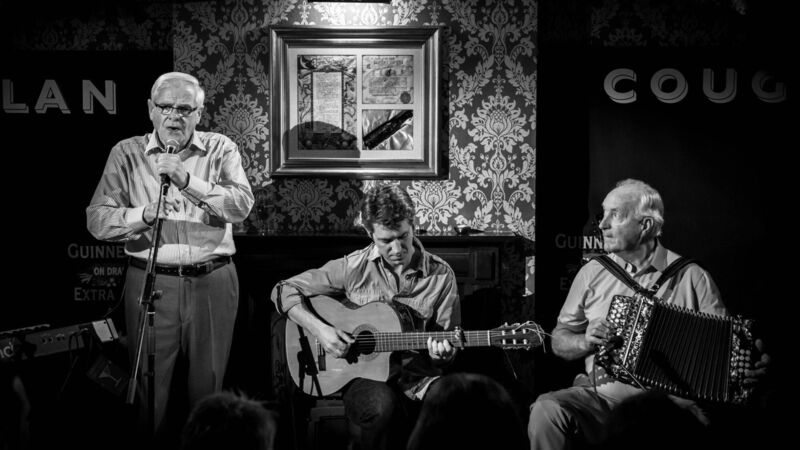
Sean Ó Sé performing with friends during a special concert in Coughlan's pub in Cork city for a TG4 documentary in 2013. Picture: Richie Tyndall
Seán Ó Sé, the Cork singer who passed away on Tuesday, January 13, aged 89, once recalled: “I went to Coláiste Íosagáin between 1949 and 1953 and every Oíche Shamhna, local people would come in to entertain us.”
It was on one such Halloween occasion at the Baile Mhúirne boarding school that he first heard the song that would catapult him to fame with Seán Ó Riada’s Ceoltóirí Chualann in 1962 and become synonymous with Ó Sé’s rich tenor voice.

Dónall Ó Mulláin of Screathan, near Cúil Aodha, who composed charting the exploits of a mad puck goat, was the performer, and Ó Sé was hooked. “I heard Dónall Ó Mulláin sing it and the verse and chorus stayed with me forever,” he said. “That was the first time I ever heard It’s a very catchy song and it remained in my mind.”
Though his birthplace on January 16, 1936, was Cork’s South Terrace, Ó Sé’s home for many years was Laharn, near Ballylickey Bridge, close to where his parents taught at Coomhola Boys’ School, near Bantry.
Cork city called him back in 1980 when he was appointed principal of the newly-opened St Mary’s on the Hill NS in Knocknaheeny, where he remained until retiring in 1993. In recent decades, he lived in Ballinlough, with his wife Eileen (who passed away in August 2025), and their three children, Áine, Con and Íde.
After his first public singing appearance in 1959 yielded Feis na Mumhan success and a radio appearance, Ó Sé began performing with Cabaret Gael Linn.
“We used to travel around to all the Great Southern hotels and we’d be entertaining all these up-market yanks,” he told the “There was an office of Gael Linn in Cork at the time and the man who was at the head of it was called Paddy Tyers, famous because he played in goal for Cork in 1956.”
It was Tyers, later of UCC, who suggested he make a demo for Gael Linn and Ó Sé recalled: “I was wondering what song I would sing and then it suddenly occurred to me. Why not
“I went out to Cúil Aodha, to Dónal Ó Liatháin, who was a pupil in Coláiste Íosagáin two years ahead of me, and he got me the words of five verses of it and I went about learning it and recorded it.” His demo found favour with Gael Linn, whose co-founder invited Ó Sé to meet Ó Riada, acclaimed as composer for George Morrison’s 1959 film and musical director at Dublin’s Abbey Theatre.
“The manager of Gael Linn at the time, the recording part of it, was a man called Roibard Mac Góráin, and we went out to his house in Stillorgan for the audition,” said Ó Sé.
After hearing only a handful of songs, Ó Riada made a spur-of-the-moment decision which sparked a seven-year musical collaboration with Ó Sé and a close personal friendship.
“Straight away he liked the voice and he decided there and then that we would go into a small studio at the corner of Stephen’s Green… and we recorded a voice and piano version of An Poc ar Buile,” recalled Ó Sé. “He rang Mac Góráin and on that very day Gael Linn decided they would release it as an EP.”

with and became Gael Linn’s second EP record.
“The minute it came out it became a hit,” said Ó Sé. “There was no official top 10 on any of the radio stations but it was certainly the first hit in the Irish language.”
Though Darach Ó Catháin and Seán Ó Siocháin sang with Ceoltóirí Chualann in its early days, it was Ó Sé who became most closely associated with the band throughout concerts, 1960s series Fleadh Cheoil an Raidió, and recordings, culminating in 1969’s
Ó Sé, who credited his vocal training by St Fin Barre’s Cathedral organist John T Horne for extending his range to two octaves, recalled Ó Riada’s remarks upon his successful audition. “He said ‘thanks be to God, now we have a Corkman who will be able to sing
Indeed in 1965 Ó Sé recorded with Ó Riada and the Radio Éireann Symphony Orchestra, for Louis Marcus’s film
Though will be forever associated with Ó Sé, inspiring his nickname ‘An Pocar/The Pucker’, he told this newspaper, “strangely enough, it wasn’t my favourite recording”.
he said, “was a fantastic recording because Ó Riada’s arrangement was spectacular and I’d be proud of the fact that it’s played at big Cork occasions even up to the present day”.

Both songs remained staples of Ó Sé’s repertoire long after Ó Riada’s premature death, aged 40, in 1971, Ó Sé going on to perform worldwide over the next half-century, raising the roof at venues from Shanghai to Cuba, Canada to Moscow, touring with Comhaltas, and recording extensively.
Most recently, his stirring rendition of brought the crowd to its feet in Cúil Aodha this August at an outdoor Aeríocht commemorating Ó Riada’s birthday during Féile na Laoch, founded by Ó Riada’s son Peadar.
Despite the passage of 50 years, Ó Sé said in 2021 of the friend who was best man at his 1967 wedding to Castlemartyr woman Eileen Tangney: “There isn’t a day since Seán Ó Riada died that he doesn’t enter my consciousness at least once.”
Ó Sé continued the family connection, singing with a reconfigured Ceoltóirí Chualann under the stewardship of Peadar, with whom he recorded albums and which linked their respective home-places.
Not even the intensive chemotherapy that accompanied a colon cancer diagnosis in 2011 would induce Ó Sé to retire from singing though, declaring following his recovery: “As long as I have a voice that will last, I will keep singing,” a maxim that served him well, right until the final verse, age 89.
Seán Ó Sé, January 1936 - January 2026. Ar dheis Dé go raibh a anam