Tommy Tiernan Show recap: Jane Seymour on near-death experience that changed her perspective on life
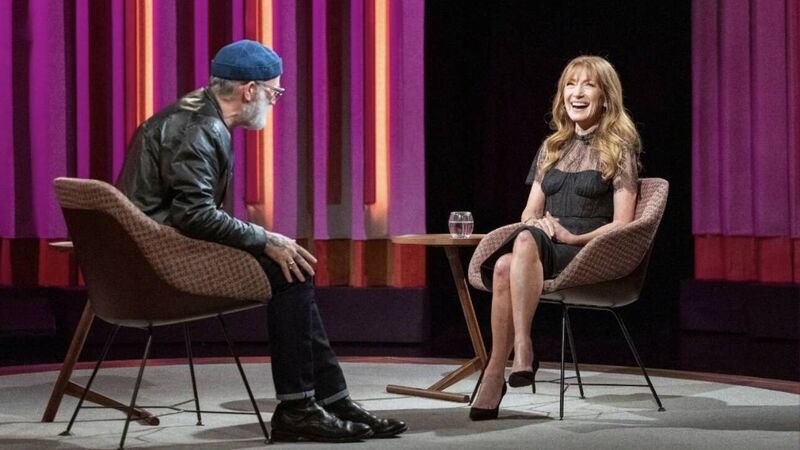
Jane Seymour joined Tommy Tiernan on Saturday night. Picture: Tommy Tiernan Show/RTE One.
The Tommy Tiernan show has returned to our screens, marking a decade of unscripted, surprise interviews where host Tommy Tiernan meets his guests for the first time on air.
This week, Tiernan welcomed actor Jane Seymour, spiritual director and author Soline Humbert and musician, and award-winning storyteller Aindrias de Staic.
The first guest of the night was actor Jane Seymour, known for her roles in and
Seymour said she has been in Ireland for the past three months, filming for a series where Seymour plays a retired literature professor with a knack for solving mysteries.
She spoke of her professional background, opening up about her first professional gig as a dancer at just 13 years old and how an injury eventually led her to move into acting.
She spoke about her time as a ‘Bond girl’, having played the role of a Bond girl in
She also shared her experience working in America, including winning a Best Actress award for and starring in
Seymour became emotional when talking about her deep connection to her role in which was of particular significance to her because of her parents’ backgrounds.
“So if you were to ask me about War and Remembrance, where I play Natalie Jastrow, who went through Auschwitz and Theresienstadt and went through World War II and was tortured and all of that, I did that for nine months with Sir John Gielgud.
“I mean, I still haven't really shed that experience completely from my spirit, that character, you know. If I watch it, or even talk about it, because I, for nine months, was Natalie Jastrow, and felt it very deeply, and felt that it was like a mission too, that I had to tell this story so that kind of atrocity that happened in World War II wouldn't happen again.
“And see it gets he gets me every time, and part of that is because they didn't realise it, but I was perfectly cast for it, because my mother had survived a Japanese prison of war camp for three and a half years in Indonesia.
"She was a Dutch national living there, and my father, who she met after the war, had been in the RAF, and he'd opened the gates of Bergen-Belsen, and had lost a lot of relatives there.
“And although nobody would ever talk about it, or could talk about it, I think the DNA of that was somehow in me, and it was almost like I had to tell the story."
Seymour went on to open up about her near-death experience, where she had an anaphylactic shock and a vision of her own body.
“I’ve also had the privilege of dying,” she said.
“I had bronchitis. I was playing Maria Callas. They needed me to work on Monday, I was sick on Saturday, so they decided to shoot me up with an antibiotic. They missed, the guy missed, the muscle and hit a vein or an artery, and I had full anaphylactic shock, which means everything shuts down.
“I left my body, saw the white light, had a vision, was able to have a view of me lying there half naked with a guy screaming and yelling for an ambulance trying to resuscitate me, which he, at that time, couldn't, and very calmly, I'm watching all of this going, ‘Well that's curious, because you know, that's me, I'm me, but that looks like me’.
“And no fear, no pain, no trauma, no attachment to any of it. And this amazing white light, it's like very beckoning. And I remember kind of looking down, going, No, I want, I want to get back in that body.
“And of course, they shot me up with whatever, cortisone, adrenaline, whatever, and I came back to tell the tale. The only reason I'm telling this story is that my perspective on life is very similar to other people I know who have been through that and survived, which is, now is it, right now, this moment with you. This is it. Not five minutes ago, and not five from now.”
She described the profound impact the experience had on her perspective on life, saying: “The only thing you take with you when you die is the love you've shared in your life and the difference you've made."
The conversation ended with Seymour touching on her hobbies and how she feels her best in her 70s and described an “amazing freedom”
Tiernan’s second guest of the night was spiritual director and author Soline Humbert — a woman with a 50-year vocation to the priesthood in the Catholic Church.
Humbert discussed her activism and the challenges she faces, how she has celebrated Eucharist in various settings, including private homes and hotel rooms, due to the official church's closed door to women in the priesthood, and how, despite receiving threats and opposition, including from devout men and women, she remains committed to her calling.
“An agent of the impossible, causing trouble. I suppose that sums it up,” she said when asked to describe herself.
She explained that the Catholic Church is the people, including herself, and expressed frustration with the official leadership's closed door to women in the priesthood.
She went on to speak about the official church's attitude that women with a vocation to the priesthood do not exist and her long-standing desire to meet the Pope to convey the message that women have a calling to the priesthood.
“The attitude of the official church is that we don't exist. There's no such thing as a woman with according to priesthood, that has been the official attitude,” she said.
“Still to this day, one of the things I've wanted and tried for 35 years was to meet the Pope, because I felt the Pope needed to know that women had a calling to the priesthood.”
Tiernan questioned why she has remained in the Catholic church, which he said can be “so full of blinder, power and corruption”, and if she ever thought about going elsewhere.
Explaining her decision to remain within the Catholic Church, acknowledging its flaws but believing that starting a new church might also lead to corruption, she said: “As it happens, I was baptised in the Catholic Church, and I have remained, I've discerned, you know, as I say, I've been tempted over the years to go elsewhere, to do something else, and but I have discerned that my own path is within the Catholic Church.
“That's where it's at, but I can understand fully, and I'm certainly not going to disagree with you in terms of corruption, and, yeah, a lot of things have been done. And as a woman, I would know firsthand, very abusive.
"And I've not been silent about the level of abuse, spiritual abuse as well. And as a woman, I've been at the receiving end of it. So I know exactly.”
She spoke about some of the threats she has received because of her views, which included what she described as threats of a sexual nature that were often quite violent, from men.
She also spoke about the threats she has received from some women, but also spoke to the men and women in her life who have been very supportive of her path.
Looking to the future of the Catholic Church, she emphasised the need for courage, encouraging truth-telling, truth-listening, and responding in freedom.
Actor, musician, and award-winning storyteller Aindrias de Staic was the third and final guest of the night.
The conversation revolved around de Staic’s journey as a storyteller and musician, influenced by Irish traditions and personal experiences.
He discussed the evolution of his storytelling style, incorporating music and rhythm, and the impact of his father, a writer and storyteller.
“My father was a writer, storyteller. He wrote so many stories about Ennis time and the west of Ireland and about the Irish in America, because he lived in San Francisco," he said.
"And I thought when my time would come, I'd sit down and type up the stories, but I just could never get down on the laptop.
“I just have this anxiety in the body, it's like school or homework, you know. So that was going on for a while, and I kind of repeated the formula in But what was happening was, Can I show you?,” he said before playing some examples of different tunes on his violin.
de Staic also touched on the emotional impact of his father's death and the deep connection he had with music.
“There was always such a deep connection with me and the music and my father, like it was kind of like, why I'm even shaking thinking about it. Because I remember after he died, there was a moment where I thought, ‘Oh, I don't have to do music anymore, now I can do comedy’," he said.
“I think on a subconscious level, I maybe worked at music or stories because I wanted to impress him, you know, maybe. When I was young, maybe secretly, you know the way, often say, you're looking for approval from the father.
“I would have upset him so many times, you know, like when I went drinking, like in my 20s. We fell out so much. But then when I got sober, you know, and I had the show. I came home from Australia that year, I was clean and sober, and I had the show.
"And I remember I was backstage at Glór after the show, and I was wondering, ‘Did I say too many ‘f’ words?’ Because, you know, with storytelling, I wouldn't have a script; I’d just be letting off, and he came backstage, and he gave me a big hug and yeah, it kind of flattened me.”
Tiernan wrapped up the conversation by saying: “It’s important to be sad and to allow ourselves to be sad. I’m very, very fond of you, Aindrias and stay in touch.”
Finishing out the show with a musical performance was Belfast and Donegal-based Huartan with their song