Book review: Dublin’s street traders come alive, alive-O
Susan Marie Martin’s fascinating new book charts the resilience and determination of generations of street traders
Book review: Dublin’s street traders come alive, alive-O

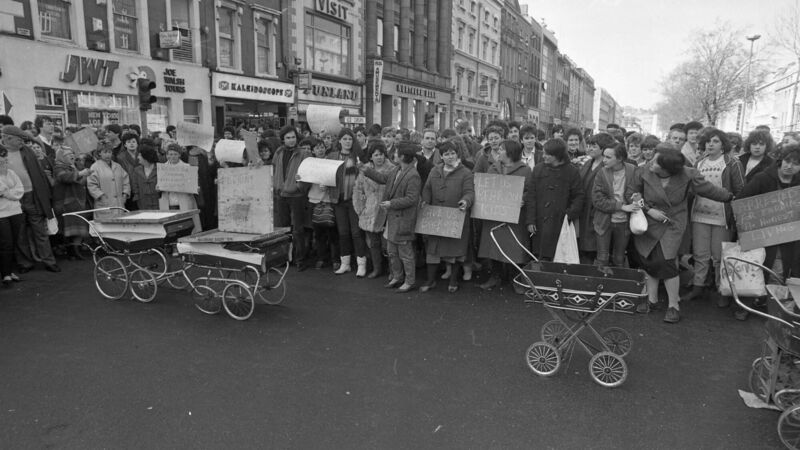
TD's Tony Gregory and Christy Burke at the protest in O'Connell Street to support the Dublin Street Traders in 1985. File picture: Independent News and Media/Getty

  • Dublin’s women street traders, 1882-1932
  • Susan Marie Martin 
  • Four Courts Press, €11.65

For all the recent uproar about the “groping” of the Molly Malone statue in Dublin, it is striking how little attention we have paid to the street traders she represents.

How ironic, for instance, that the bronze statue by sculptor Jeanne Rynhart was erected in 1988, just a few short years after a heavy-handed crackdown on Dublin’s casual traders. 

They fought back — with the memorable anthem, Stand by your pram — but with limited success.

Susan Marie Martin makes that point in a fascinating new book which charts the resilience and determination of generations of street traders who faced similar struggles as they tried to make an honest living while being moved on, fined, or sometimes jailed in a city that considered them a blight on the cityscape.

Her new book, Dublin’s women street traders, 1882-1932, focuses on that time period, in particular on the devastating effect of the Street Trading Act of 1926, but it opens with a brief history of trading that stretches back centuries.

There’s an evocative description of the dozens of “oyster-wenches, poultry, and herb-women” who lined out with the dignities to see King James II on a visit to Dublin in 1689, and danced at his side until he reached Dublin Castle.

The author, as she did in her 2017 book on the shawlies in Cork, keeps the focus on the women themselves, winkling out the few traces of their lives and struggles that remain in the historical record.

The records, for example, give us a telling outline of Ellen Preston, a mother-of-12 who traded for 43 years “out in rain and snow” and returned to her pitch within days of giving birth. 

She endured waves of police action in that time and once, when in court, told the magistrate she went out selling so she could keep her children in school as long as possible.

There are several such vignettes in a book that outlines the forgotten sweep of stall holders that once stretched right across the city from O’Connell St to Wicklow St. 

Given what happened later, it is not too surprising to see how reviled those women were in some quarters.

They “disfigured” the capital’s streets, according to an Irish Times editorial, which compared the noise, dirt, and disruption to “an oriental bazaar or continental ghetto”. 

Then, as in more recent years, there was concern the traders were taking sales from brick-and-mortar establishments, not to mention lowering the tone.

Rather encouragingly, they had support, too. And the women themselves showed incredible strength and resistance, in one case throwing fish and fruit at gardaí during a raid on their stalls on George’s St, which led to headlines in the local papers.

This is a rigorously researched history book, yet it has something of a cat-and-mouse quality to it as Susan Marie Martin skilfully sums up the attempts by the Street Traders Act to corral and regulate traders, and how those affected fought back to protect their livelihood.

Among those firmly on their side were Sarah Cecilia Harrison, artist and first female councillor of Dublin; Robert Biscoe, TD; Alfie Bryne, future lord mayor of Dublin; and future president Sean T O’ Kelly, who described them as “honest, industrious, hard-working people” who paid rates indirectly.

They also had a friend in James Brady, solicitor and city councillor, as well as Magistrate Collins. When the judge died in April 1930, the street traders of Camden St gathered to pay their respect and left “three beautiful wreaths”.

Now, in Suffolk St not far away, the touch-for-luck tourists are still reaching out for Molly Malone’s bosom despite the flowerbed that surrounds her.

Perhaps we should put in a QR code link to this book to give visitors a truer picture of the women who wheeled their wheelbarrows through the streets broad and narrow.

x

BOOKS & MORE

Check out our Books Hub where you will find the latest news, reviews, features, opinions and analysis on all things books from the Irish Examiner's team of specialist writers, columnists and contributors.


More in this section

Scene & Heard

Newsletter

Music, film art, culture, books and more from Munster and beyond.......curated weekly by the Irish Examiner Arts Editor.

Cookie Policy Privacy Policy Brand Safety FAQ Help Contact Us Terms and Conditions

© Examiner Echo Group Limited