Books of the year: 2025’s best offerings that highlight political strife, pain, and injustice
JP O’Malley reveals his picks for books that tell true stories of those who lived in difficult and challenging times, both in the present day and the past
Books of the year: 2025’s best offerings that highlight political strife, pain, and injustice

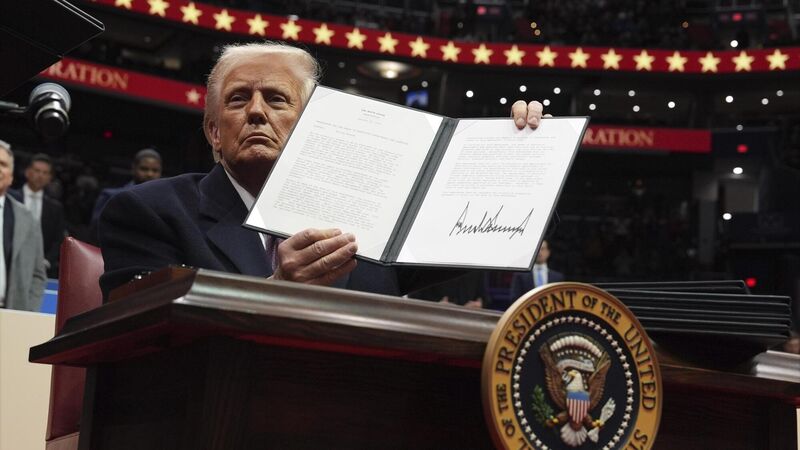
Donald Trump declared ‘a national emergency at our southern border’ at his inauguration in January. File picture: Evan Vucci/ AP

The third Monday of January is officially the most depressing day of the year. It was fitting that Donald Trump’s inauguration fell on Blue Monday 2025. 

The pleasantries inside the US Capitol rotunda in Washington DC didn’t last long.

“I will declare a national emergency at our southern border,” the 47th president of the US told dignitaries who gathered to watch him being sworn in for a second non-consecutive four-year term.

By early summer, the US Immigration and Customs Enforcement (ICE) raids began in Los Angeles, the city with the highest Latino population in the US. 

These so-called ICE raids have since moved nationwide. The American Civil Liberties Union have questioned their legalities and claim ICE officials are deporting children, many of whom are US citizens.

Trump’s ruthless, aggressive stance on immigration is based on similar historical examples.

In Banished Citizens (Harvard, €29.99) Marla Andrea Ramírez points to one. 

The book documents how between 1921 and 1944 more than 1m Mexican Americans were forcibly removed from the US — 60% of whom were US citizens.

Most banished Mexican Americans were later denied re-entry at the US-Mexico border, even though many kept records of their US citizenship.

Reading Ramírez’s book, I was reminded of a conversation I had three years ago with Paul Auster, who has since died of lung cancer.

“Fear coupled with violence, with bullets as the weapon of first resort, is a combination that runs through every chapter of American history,” the American novelist told me.

It’s a sentiment I suspect Eric Foner shares. Our Fragile Freedoms (WW Norton, €29.99) is an insightful collection of journalism from the 82-year-old American liberal historian.

They’re mainly book reviews and opinion pieces Foner has published over the last 25 years about the Civil War (1861-1865) and the Reconstruction era (1865-1877).

The latter period brought in constitutional and democratic reforms for former slaves. But they turned out to be disappointing in the south — where the majority of African Americans were subjected to apartheid-segregation from the 1870s until the 1960s. 

Foner teaches us why this history matters. Especially when injustice rears its ugly head.

Amanda Knox’s decades-long battle with injustice began in the winter of 2007.

Then a 20-year-old student studying Italian in Perugia, a small city north of Rome, her life turned into a living nightmare after her flat mate, a fellow student, and British national, Meredith Kercher, was found stabbed to death. 

In Free: My Search for Meaning (Headline, €19.99) the 38-year-old American provides a detailed account of where she was the night of the murder. 

Knox claims she was at the home of Raffaele Sollecito: A 23-year-old Italian she had then recently become romantically involved with. The Italian police didn’t believe her. 

We read about their brutal interrogation methods, the subsequent trials, and controversial global tabloid circus that followed.

In December 2009, Knox and Sollecito were sentenced to 26 and 25 years in prison respectively for Kercher’s murder. 

Knox was released in October 2011, when independent experts concluded that the minuscule trace of DNA allegedly linking her to Kercher’s murder were not sufficient and possibly contaminated.

Two years later, prosecutors appealed Knox’s acquittal, arguing the verdict was lacked logic, and it was overturned. 

Retried in absentia, Knox was then reconvicted of the same crime and resentenced to 28 and a half years. 

But in March 2015, the Court of Cassation, Italy’s highest court, acquitted Knox and Sollecito of Kercher’s murder.

Today, Knox is still convicted of slandering Patrick Lumumba, her former boss, who she initially implicated to the scene of the crime. 

Presently, Knox is exploring the possibility of appealing this conviction in the European Court of Human Rights (ECHR).

In 2019, the ECHR ordered Italy to pay Knox €18,400 for police failures to provide her access to a lawyer and a translator during her interrogations in 2007.

Two years ago, the ECHR ordered Azerbaijan’s government to protect the health of Dr Gubad Ibadoghlu. 

The economist and founder and chair of the opposition Azerbaijan Democracy and Prosperity Party had been working as a research fellow at the London School of Economics, when he was arrested, in late July 2023, outside Baku. 

Numerous human rights organisations describe the charges as politically motivated.

This spring, I interviewed Ibadoghlu’s daughter, Zhala Bayramova, who agreed. 

She told me: “My dad is under police surveillance 24 hours a day in Sumgait, 31km away from Baku, where he remains today under house arrest.”

I’m scared the authorities in [my country] are going to kill him.

Azerbaijan is a former Soviet republic bounded by the Caspian Sea and Caucasus Mountains, and a member of the Council of Europe since 2001. 

The oil rich nation has an appalling record implementing ECHR judgments. Europe, though, is turning a blind eye in exchange for cheap oil and gas, as Gabriel Gavin explains in Ashes of Our Fathers: Inside the Fall of Nagorno-Karabakh (Hurst, €18.99). 

The book begins with a brief introduction to the complex, bloody history between Azerbaijan and Armenia. 

Largely, it’s over the status of Nagorno-Karabakh: A landlocked mountainous region at the southern end of the Karabakh mountain range, within Azerbaijan. Gavin is mostly concerned with the recent conflict.

The Second Nagorno-Karabakh War started in September 2020, during the covid pandemic. Over 44 days, an estimated seven thousand soldiers were killed on both sides.

Azerbaijan claimed victory. Nagorno-Karabakh was subsequently cut off by Russian peacekeepers, who blocked most foreign citizens and journalists from entering. 

Gavin spent more than three years in the South Caucasus region reporting on the conflict.

The young British reporter was there when fighting flared up, again, in September 2023, as Azerbaijan launched a so-called “anti-terrorist” offensive.

It lasted less than 48 hours and concluded with more than 100,000 ethnic Armenians fleeing their homes in what was, in essence, a carefully planned ethnic cleansing project by Baku. 

In Reporters Without Borders’ 2024 World Press Freedom Index, Azerbaijan ranked 164 out of 180 countries.

In that same index, in 172nd place, is China: Where there are currently 118 authors-writers-journalists behind bars, the highest number in any country in the world. 

Jung Chang fears she may join them if she returns to her country of birth. The 73-year-old Chinese-born British author writes about her troubled relationship with Beijing’s State Security in Fly, Wild Swans (William Collins, €17.99).

The personal-political memoir documents how Chang came to write her two bestselling books — Wild Swans (1991), which recalled a century of Chinese history, told through the lives of three women, and Mao: The Unknown Story (2005), which Chang co-wrote with her husband, the Irish historian Jon Halliday. 

Chang has not visited her homeland since 2018. That year, Chinese president Xi Jinping made himself supreme leader of China, declaring that any insults made to Chinese revolutionary heroes were a crime punishable by imprisonment. A charge that Chang would almost certainly qualify for.

2025 was a rough year for the fourth estate, worldwide; 103 journalists and media affiliated workers have been killed on duty, according to the International Federation of Journalists. 

Statistics from Pen America’s Freedom to Write Index claims the number of writers jailed around the world has increased, annually, over the past six years. 

But with repression comes resistance, as the late Czeslaw Milosz reminds us in his poem Incantation:

“Human reason is beautiful and invincible/

No bars, no barbed wire, no pulping of books,/

No sentence of banishment can prevail against it./

It establishes the universal ideas in language,/

And guides our hand so we write Truth and Justice/

With capital letters, lie and oppression with small.”

Wise words from the Polish Nobel prize winning poet, and worth keeping in mind as 2026 looms.

BOOKS & MORE

Check out our Books Hub where you will find the latest news, reviews, features, opinions and analysis on all things books from the Irish Examiner's team of specialist writers, columnists and contributors.
More in this section

Scene & Heard

Newsletter

Music, film art, culture, books and more from Munster and beyond.......curated weekly by the Irish Examiner Arts Editor.

Cookie Policy Privacy Policy Brand Safety FAQ Help Contact Us Terms and Conditions

© Examiner Echo Group Limited