Tommy Tiernan Show recap: Mat Fraser on Fair City acting opportunity
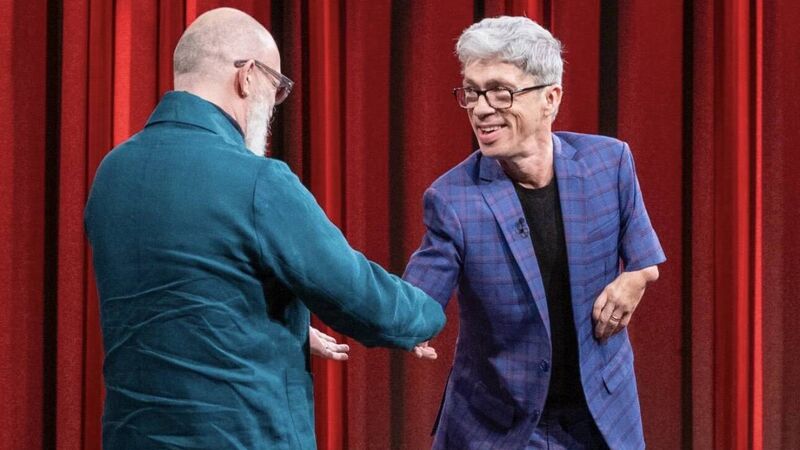
Mat Fraser spoke about how grateful he was to be offered a role in Fair City at a time when nobody else included him in their world. Picture: RTE One/Instagram.
The most recent episode of the Tommy Tiernan Show discussed the pressures of athletic performance and the challenges of being a closeted LGBTQ+ person, the importance of inclusion of disabled people in the world of acting, and giving closure to families by recovering and identifying remains.
Tiernan’s guests on Saturday included Olympic gold medallist Kelly Holmes, humanitarian forensic specialist Oran Finegan, and musician and actor Mat Fraser.
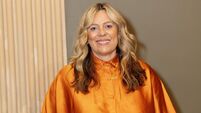
Dame Kelly Holmes discussed her journey from a 10-year military career, where she faced challenges as a closeted LGBTQ+ person, to winning two Olympic golds in 2004.
Holmes began her conversation with Tiernan by explaining that she became the first British athlete to win two gold medals at the Olympic Games in Athens 2004, in the 800 metres and 1500 metres, for which she was awarded damehood.
Holmes spoke about her complex relationship with the military, her struggles with mental health, and the impact of her identity on her career.
Discussing her background in the British Army, where she served for 10 years and received an MBE for her services, she highlighted the challenges she faced as a gay person in the army at a time when there was a ban on LGBT+ people in the military.
While she appreciates the discipline and strength it instilled, Holmes, who only came out as gay two years ago at the age of 52, also noted the impact that her military service had on her personal growth and mental health, including the long-lasting effects of suppression.
She recounted the psychological consequences of winning two gold medals at the age of 34, after a long period of injuries and mental health issues and went on to describe the depression she experienced after retiring from athletics, losing her identity and support system.
Speaking about growing up as a mixed race child in a predominantly white neighbourhood, she said:
“I literally can see it in my head. The moment one kid at school said to me, why are you brown and your brother’s white? And I was like ‘oh’. It literally didn’t even come to my head that Kevin was white. Literally didn’t even occur to me because everyone I see is white so how would I think differently?” She said it was later when she approached her mother about it, that her mother explained that she had a different dad and that things began to make sense then.
Holmes reflected on her driven nature and the importance of having a purpose in life and emphasised the importance of living authentically and the importance of mental health awareness, noting the support she received from psychologists in her journey of self-discovery.
Tiernan’s second guest of the night was Oran Finegan, a humanitarian forensic specialist, who discussed his 25-year career, which began with investigating war crimes in Bosnia.
He shared his journey, which started 25 years ago at the University of Bradford, and how he was influenced by his advisor to work on war crimes in Bosnia, where Bosnian Serb forces had massacred 8,000 men and boys.
He spoke of the subsequent efforts to recover and identify remains, explaining to Tiernan the emotional toll of his work and sharing a vivid memory of examining a baby's body in a morgue in Kosovo.
He reflected on the balance between witnessing the worst of humanity and the goodness of forensic practitioners who dedicate their lives to giving names and identities back to the dead.
Over the years, Finegan has worked in various conflict zones and disasters, including Iraq, Syria, North Korea, and the MH17 crash site.
He discussed his decision 18 months ago to advocate for the dead and missing and emphasised the importance of forensics in providing closure to families and the emotional toll of his work.
Finegan shared details about his family, including his close relationship with his identical twin brother, who became a primary school teacher after a career in acting, and recounted a poignant story about finding his uncle in London, who had been living a difficult life and was eventually identified through an ID card.
He spoke about the cruelty of not knowing the fate of loved ones and the importance of certainty in providing closure to families and the impact of his work on his personal life.
He reflected on the importance of scientific rigour and transparency in his work, and the emotional journey of understanding the fate of missing persons.
Finegan also discussed his current role, focusing on excavating a mass grave and ensuring dignified burials, aiming to provide closure to families.
When asked by Tiernan what he thinks happened in Tuam, he said: “I always approach this from the scientist’s perspective. I have to look at the facts and I can’t guess what has happened. What I do know is that there were test excavations carried out around 2017.
“There are human remains that have been located in a chamber structure in a disused sewer tank and we are mandated under the relevant legislation to recover it, to excavate the whole site, to recover any remains that are present and to provide them with a dignified burial, first and foremost.” Tiernan’s final guest of the night was rock musician, actor, and writer Mat Fraser who discussed his experiences as a Thalidomide survivor.
Detailing his mother's use of the drug, given to her by her doctor to alleviate morning sickness during pregnancy, he spoke about how it led to his limb deformities.
He said the drug was initially marketed as a wonder drug but had severe side effects, including limb deformities in children.
The drug was heavily promoted as a painkiller and sedative, but its side effects were not fully understood at the time.
He recounted his realisation of his disability during puberty and the societal challenges he faced.
He spoke about his experience in school, where disabled individuals were at the bottom, and the emotional pain it caused him.
Fraser touched on how his career evolved from being a punk rock drummer to an actor, highlighting his roles in on Netflix and
He spoke about his time as a drummer in punk rock bands, which he found more accessible than other music genres, and described the challenges of reconfiguring his drum set to accommodate his disability and the determination it took to succeed.
He spoke about how punk rock gave him freedom as a disabled musician.
Discussing his transition from music to acting, he said he was inspired by a theater company called Graeae Theatre Company that featured disabled performers.
He described the epiphany of seeing disabled individuals on stage, realising he could also pursue a career in acting.
Fraser spoke about being cast in roles that were significant for disabled representation, such as his role in Chaos and reflected on the challenges of auditions and the importance of diverse representation in media.
He expressed gratitude for the opportunities he has had, despite the challenges, and the importance of being included in the industry, touching specifically on his role in Fair City.
“I’m of the age where I was usually the first to do a thing, in terms of the disabled thing. So, back in 2011 I was not getting any work at all. I was very desperate and I got offered six weeks on your favourite show, Fair City. And I took it,” he said.
“I was so grateful to be included. No one else included me in their world. But I became a part of Carrickstown for a bit.”
Speaking about the importance of disability rights and representation and sharing personal anecdotes about his activism and the impact of his work on changing public perceptions, Fraser discussed the emotional toll of fighting for social justice and the importance of self-care.
He touched on the future of Thalidomide survivors, acknowledging the sadness of being a small blip in history but also the importance of preserving their stories.
The show closed out by Niamh Bury who performed