Film Review: Wicked Little Letters is a wickedly funny commentary on middle-class mores
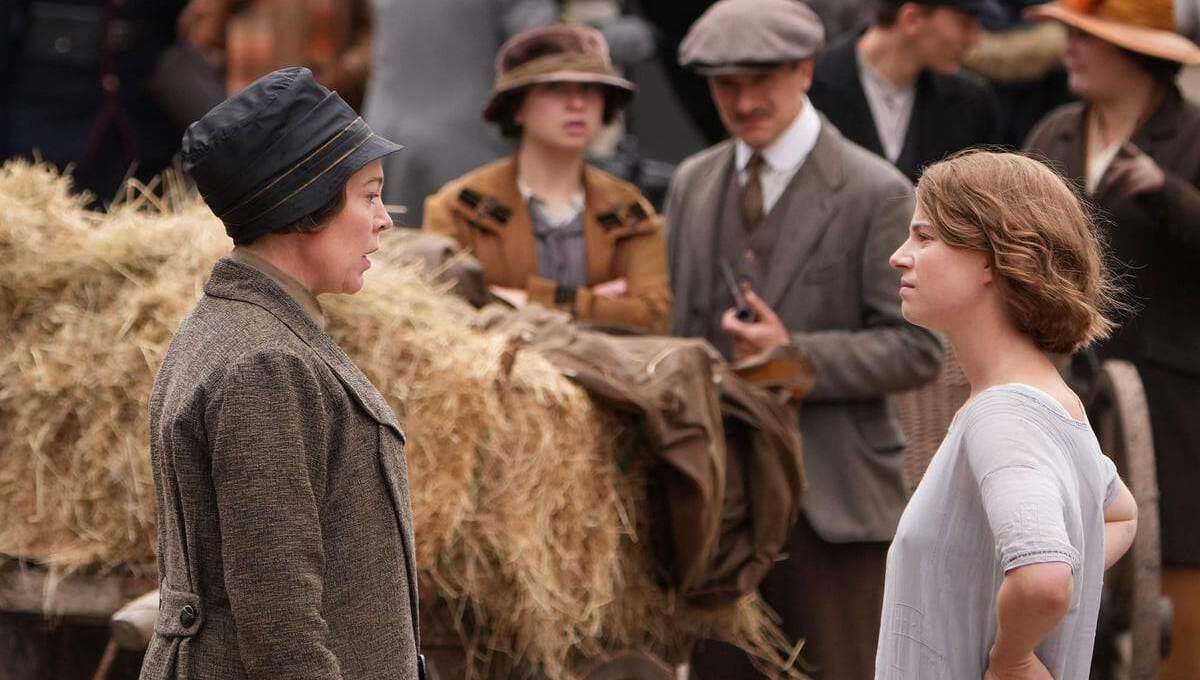
Wicked Little Letters stars our own Jessie Buckley and Oscar winner Olivia Colman
- Wicked Little Letters
- ★★★★☆
- Cinema release
Bile-fuelled anonymous abuse is one of the downsides to living an online life these days, but Wicked Little Letters (15A) suggests that the phenomenon is nothing new.
Set in the coastal English town of Littlehampton in the 1920s, Thea Sharrock’s film opens with Edith Swan (Olivia Colman) — ‘a pretty young Christian woman’, as the press describes her — receiving poison-pen letters of inventively crude language.
Suspicion immediately falls on Rose Gooding (Jessie Buckley), an Irish immigrant recently arrived in Littlehampton with her young daughter Nancy (Alisha Weir), and largely because Rose is a foul-mouthed free spirit who doesn’t suffer fools gladly.
But why would Rose, formerly a friend of Edith’s, choose to target her next-door neighbour in such a coarse and underhand way?
Based on a true story, Wicked Little Letters is a black comedy that seems on the surface to be a rather frivolous affair, but which employs the poison-pen letters as a wedge to break open the ostensibly prim and proper world of middle-class mores, then and now.
Littlehampton, which serves as English society in a microcosm, is very quick to turn on Rose, in the process revealing its bigotry and intolerance when it comes to outsiders and those who refuse to toe the socially approved line.
Olivia Colman is in terrific form as the repressed, performatively Christian Edith, while Jessie Buckley brews up the proverbial storm as the iconoclastic Rose, and both get strong support from Anjana Vasan, playing a young policewoman battling her colleagues’ institutionalised sexism, and Timothy Spall as Edith’s patriarchal father.