Book Review: The Turning Tide charts a course through the Irish Sea
"The Irish Sea was created by a huge glacier that scraped its way from Scotland and Ireland 700km south to St George’s Channel, sculpting the land on either side."
Book Review: The Turning Tide charts a course through the Irish Sea

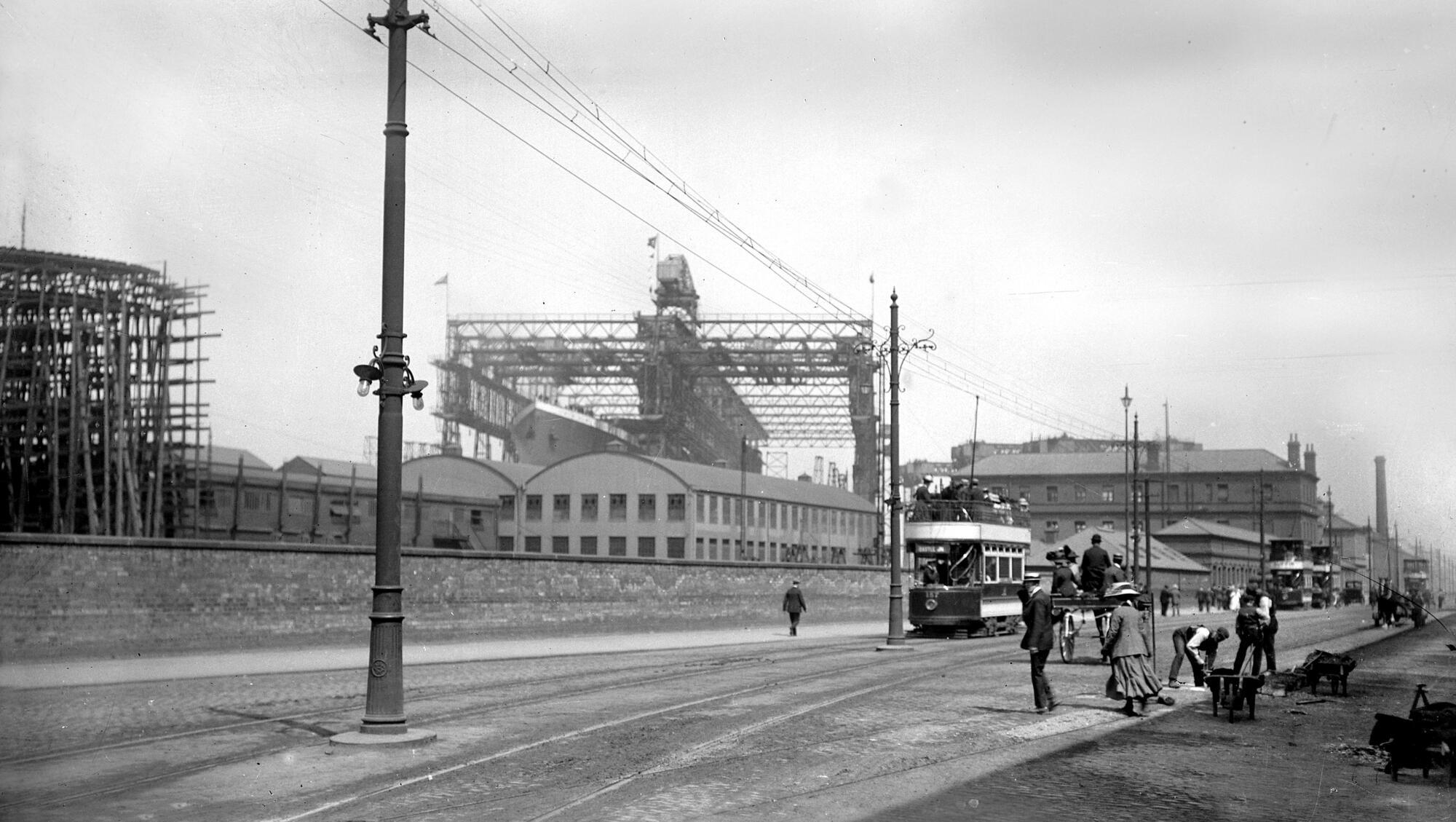
The Harland and Wolf shipyards in Belfast when the liner RMS Titanic was under construction.

  • The Turning Tide: A Biography of the Irish Sea 
  • Jon Gower
  • HarperCollins, €23.99 

Dublin dockers’ imaginative nicknames for their colleagues — based on their habits or looks — included Spit in Pint, Fatser Curry and Baldo McAuley. One who moonlighted as an undertaker was known as Chase the Corpse.

In Liverpool, the name Diesel Fitter was given to a kleptomaniacal docker who’d steal some cargo for his wife with the justification “Diesel fitter”.

Such epithets also extended to the cargoes that dockers handled.

In Dublin, the most memorable was a ‘Dana’ for a boat carrying a miscellany of shipments — a moniker inspired by the singer’s Eurovision-winning 'All Kinds of Everything'.

Dockers are a vital thread of The Turning Tide, a kaleidoscopic portrait of the Irish Sea that blends history, travelogue and nature-writing into a sparkling, widescreen synthesis.

The author is Jon Gower, a documentarian and former BBC Wales journalist who, writing in English and Welsh, has produced more than 30 books.

The Irish Sea was created by a huge glacier that scraped its way from Scotland and Ireland 700km south to St George’s Channel, sculpting the land on either side.

Epitomising Gower’s lyrical prose, the Celtic connections that emerged between Ireland and Wales were “like swirling fans and fronds of kelp, drifting together but also discernibly separate in themselves”.

The Turning Tide: A Biography of the Irish Sea Jon Gower

The most significant crossing of the Irish Sea occurred in May 1170.

At the invitation of the King of Leinster, Dermot MacMurrough, a small band of Normans, led by the knight Raymond Le Gros, sailed from the Welsh county of Pembrokeshire to Wexford.

The landmark Norman conquest inaugurated 800 years of conflict.

In the 20th century, the Irish Sea still served as a conduit for those hostilities.

In July 1914, the crew of the Asgard yacht, including Erskine Childers and Sir Roger Casement, evaded British authorities to transport 1,500 rifles from Holyhead to Howth for the Irish Volunteers.

After the 1916 Rising, about 1,800 republicans were transported in the opposite direction for internment in Frongoch, Wales.

Later, Cork’s Frank O’Connor pithily articulated the freedom promised to emigrants escaping the censorial fledgling Irish State: “An Irishman’s private life begins at Holyhead.” 

Gower emphasises the importance of shipbuilding on the Irish Sea’s facing coasts.

From 1814 to 1922, more than 260 ships — many royal navy commissions — were built in Pembroke Dock in Wales.

During the Titanic’s construction, the workforce in Belfast’s Harland & Wolff swelled to 14,000. When the ship was completed, it was the largest man-made object ever built.

The greatest single loss of life on the Irish Sea occurred in October 1918 when a German submarine torpedoed the RMS Leinster. More than 500 Allied soldiers were drowned when the ship sank, dispersing “a tragic harvest of bodies” to both sides of the sea.

The Turning Tide is a real cabinet of curiosities.

In 1988 on Wales’s Harlech beach, the largest and heaviest ever recorded turtle — measuring nearly 3 metres and weighing more than 900kg — washed ashore.

Meanwhile, the 1934 documentary The Private Life of the Gannets about the gannet colony on the tiny Welsh island of Grassholm was the first wildlife film to ever win an Oscar.

Structured into succinct chapters, The Turning Tide is elegantly expressed while retaining a light, informative tone.

Gower’s exemplary scope, the engine of the book, imbues the text with a properly panoramic feel.

At the start, he tells us that because the sea is unpredictable the narrative won’t be linear.

“We will thither and hither, sometimes … veer around sharp rocks, or lose sight of the lighthouse. But we will get there. I know where we’re going.” Despite being a self-confessed “landlubber”, Gower steers The Turning Tide ship with grace and panache.

x

More in this section

Scene & Heard

Newsletter

From music and film to books and visual art, explore the best of culture in Munster and beyond. Selected by our Arts Editor and delivered weekly.

Cookie Policy Privacy Policy Brand Safety FAQ Help Contact Us Terms and Conditions

© Examiner Echo Group Limited