Pat Talbot recounts a historic evening with Mo Mowlam at the Everyman
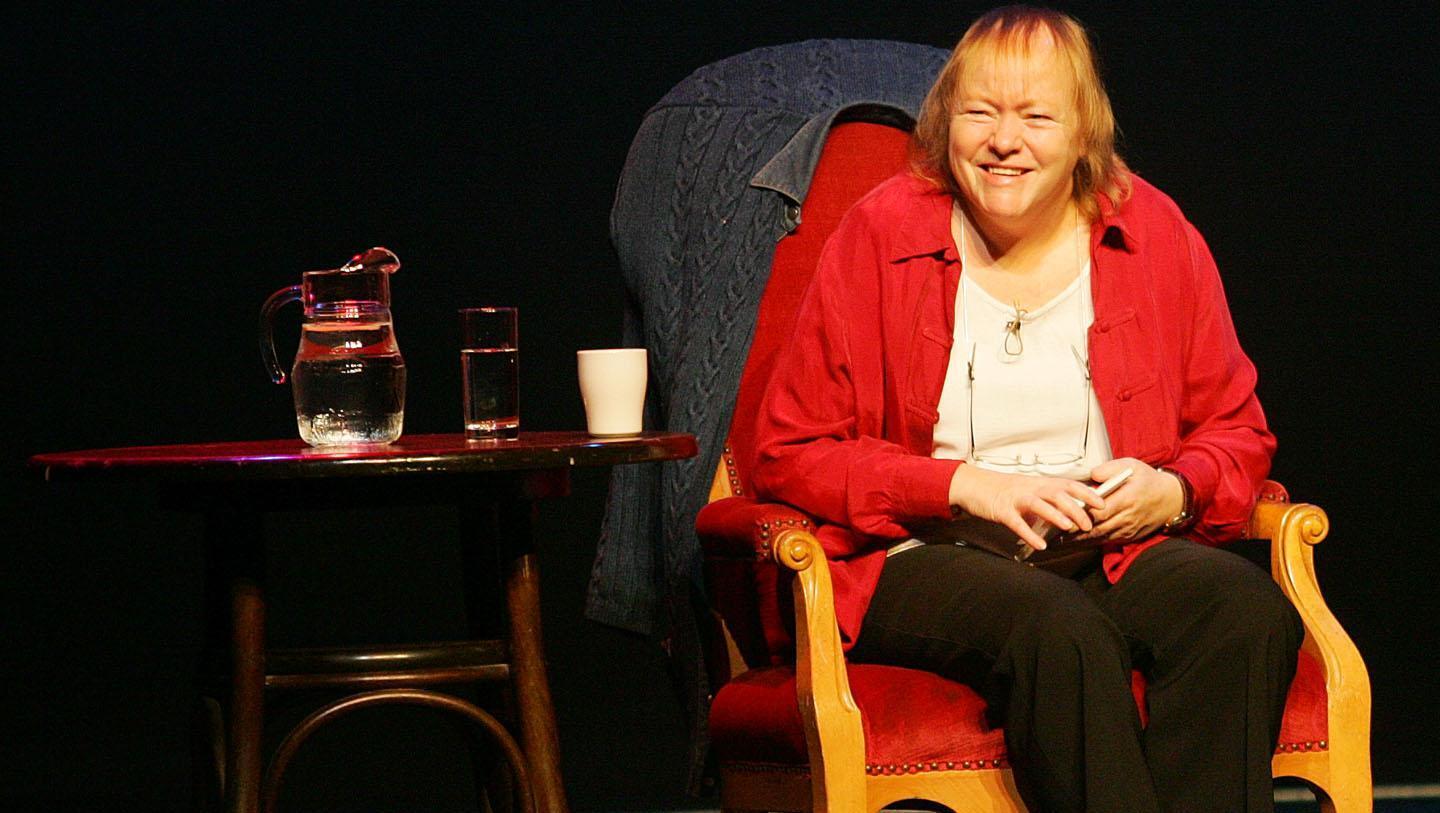
Mo Mowlam during her show at the Everyman Palace in 2005.
I got the call just after 5pm. Mo Mowlam, the former Secretary of State for Northern Ireland, had fallen in her hotel room, would I go to the hotel immediately?

It was February 9, 2005. I was the director/CEO of the Everyman Theatre Cork and that evening we had an event entitled An Audience with Mowlam. It had sold out weeks in advance.
Cork was the European Capital of Culture that year. I was looking forward to a bumper programme of events for the city and for our theatre.Â
When I had become aware that Mo Mowlam had put this solo presentation together, I instantly contacted her agent in London and secured it for Cork. I was not to know that this would prove to be Mo Mowlam’s last public appearance on the island of Ireland.
I knocked on the hotel room door. “Who is it?”, the unmistakeable voice asked from inside. I introduced myself through the closed door. She opened it. And there she was. Arguably one of the most controversial but also most effective secretaries of state for Northern Ireland ever and a close friend of then Prime Minister Tony Blair, whose campaign for the leadership of the Labour Party she managed in 1994.Â
And she was of course diminutive in stature. Despite me, at 6ft 5, towering over her, she grabbed my hand, pulled me into the room, and assured me she was fine. She had lost her balance and tumbled over but all was OK. The show could go on. Emergency over.
In 1997, the year Tony Blair became prime minister after his landslide general election victory, Mo Mowlam had been diagnosed with a brain tumour. She had managed to keep it quiet initially, but it became very public when, because of her treatment, she lost her hair and began to wear a wig.Â
She would defuse many a tense meeting by dramatically removing her wig and dismissing it as being “such a bother”. After retiring from politics in 2001, her condition deteriorated and she developed serious problems with her balance, hence her unfortunate falls.
As we left the hotel, she continued to hang on to me as I brought her to the theatre across the street. She did her soundcheck and she was now totally focused on the evening ahead.
A no-frills approach
In introducing Mo to the capacity audience I made the point that Cork was well versed when it came to popular politicians.Â
The legendary Cork-born Jack Lynch was the most popular politician in the Republic for many years during his heyday in the 1970s as Taoiseach.Â
But without question the most popular non-Irish politician in Ireland in the period immediately before and after the signing of the Good Friday Agreement was Mo Mowlam. Her irreverence and directness, her common touch, and her refusal to indulge in the usual politician-like evasions and dodges, endeared her enormously to ordinary people - and this sell-out evening was testimony to that popularity.
Having introduced Mo, I then walked over to the wing where she sat. She stood up, I took her arm and we walked out on stage together to deafening applause and cheering. We had placed a large throne-like armchair on the stage for her to sit on. She had asked that I allow her walk the last few feet to the chair on her own: “I don’t want the audience thinking I am a complete cripple,” she had said to me.
Once she was comfortable in her chair and began speaking to the audience, she hit her stride quite rapidly. She delivered a typically no-nonsense, no-frills account of events leading up to the signing of the Good Friday Agreement. She stressed that once people were in the room, no matter who they were, or how they had got there, she treated them equally. This was reminiscent of her hugely controversial visit to the Maze Prison in January 1998 to speak to both loyalist and republican prisoners in what was a first for a secretary of state for Northern Ireland.
In a very self-effacing way she recalled how, in a meeting she and Tony Blair had with then-American President Bill Clinton, Blair had basically ignored her in making a point to Clinton.Â
Mo cut across the prime minister and remarked to Clinton: “Didn’t you know I’m the tea lady here?” Mo had requested a few bars of DairyMilk chocolate to eat at the interval in order to replenish her energy. While she consumed these, she recounted to me a discussion she once had with Tony Blair about terrorism. “I told Tony he would have to negotiate with Al Qaeda.”Â
She smiled at me and quipped: “That didn’t make me very popular with Tony that day either.”Â
In the second half of the evening the audience could ask Mo questions. That week then President Mary McAleese had made a comment that was deemed to be critical of Ian Paisley. A gentleman in the audience asked Mo if she thought the President was a little out of line in what she said.
“Oh shut up you silly man!” bellowed Mo from the stage to rapturous laughter from the rest of the audience. “Mary McAleese is a wonderful President and I will not entertain any criticism of her.” This prompted enthusiastic applause and underlined that Mo’s feel for an audience was as sharp as it ever had been.
An applause and a goodbye
If you run a busy theatre for 10 years, you will experience many standing ovations for many different types of actors and performers, etc. But no standing ovation I had experienced to that point compared to that which the audience in Cork that night delivered for Mo Mowlam. And to make it more extraordinary from my point of view, was that I was standing beside Mo on stage while it happened.
She had told me when exactly she would finish the evening. So I knew when to walk out onto the stage, take her arm and accompany her off. When the audience saw me walk on they knew that was it: The show, so to speak, was over. The audience was on its feet instantly. They were not simply applauding a stage appearance, but they were saying goodbye. It was more than likely they would not be seeing Mo Mowlam in person again. The emotion was very real and tangible.
Mo had risen from her chair and taken my arm and I very deliberately took as much time as I could walking off the stage so that Mo could soak in the respect and affection washing over the stage. It was truly an extraordinary few moments.
In the foyer afterwards that outpouring of emotion continued, for it seemed as if over half the audience had stayed on in an attempt to get an autograph and a photo with Mo. And that was absolutely fine with Mo. “Just give me some whisky,” she told me, “and it will keep me going.” And keep going she did until well after 1am when the last of the audience departed.
Mo Mowlam’s bluntness caused her a lot of problems. Unionists like David Trimble for instance had enormous difficulties with how she completely ignored the conventional ways of doing things. But for the general public, in both the UK and Ireland, the Good Friday Agreement was virtually synonymous with her. It was a defining event in her life.
As we walked back to the hotel, arm in arm at nearly 2am, back to the room where I had first encountered her almost nine hours earlier, Mo’s concern was that I was happy with the evening and that the audience would remember it fondly.
When Mo died a few months later, on August 19, 2005, at the age of 55, I would remember that evening in Cork with extraordinary fondness indeed.

Subscribe to access all of the Irish Examiner.
Try unlimited access from only €1.50 a week
Already a subscriber? Sign in