George Bolster: From art in West Cork to aliens in outer space 
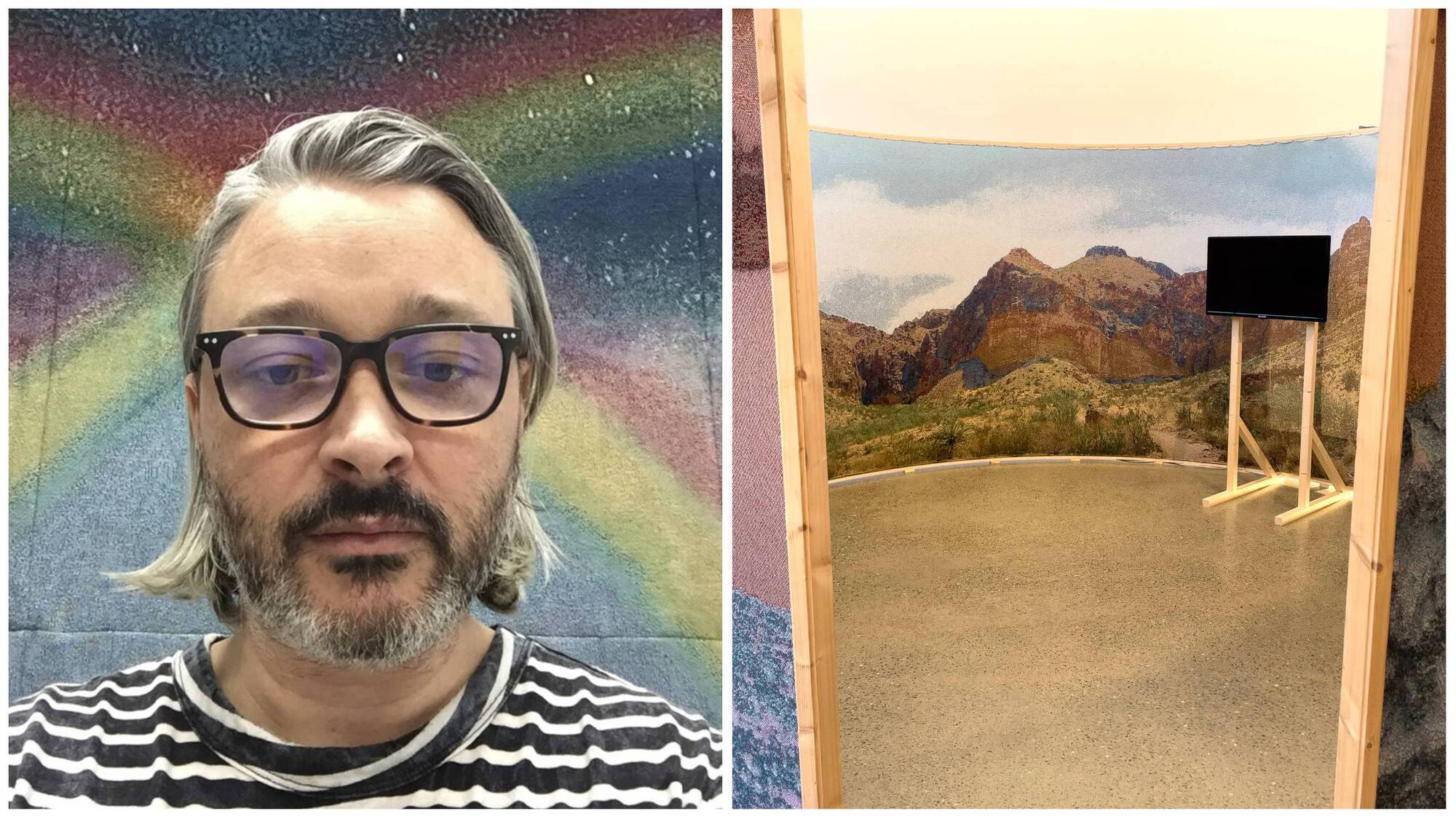
Cork-born artist George Bolster's association with the SETI Institute in California feeds into his current exhibition at Uillinn 
George Bolster: From art in West Cork to aliens in outer space 

Bolster’s fascination with the search for extra-terrestrial life is behind much of the work in Communication: We Are Not The Only Ones Talking… , his solo exhibition at Uillinn, the West Cork Arts Centre in Skibbereen.

George Bolster does not doubt the existence of extra-terrestrial beings. The Cork-born artist has lived in America for many years, enjoying a long association with the SETI Institute at Mountain View, California, where more than 100 scientists are engaged in the search for other life forms in the universe.


“Given how many stars there are in our galaxy alone, it would be hard to believe that there cannot be some kind of life out there,” he says. “SETI searches for signals outside the bandwidth of nature. They’re looking outside the usual frequencies for an artificially made sound or signal. They don’t believe aliens have visited here or anything like that, but they do think there is every possibility that some form of life, even at the level of microbes, will be discovered on some other planet in our lifetime.”

Bolster’s fascination with the search for extra-terrestrial life is behind much of the work in Communication: We Are Not The Only Ones Talking… , his solo exhibition at Uillinn, the West Cork Arts Centre in Skibbereen. The show includes works on film and elaborate tapestries based on digital photographic images of American wildernesses.

A graduate of Chelsea College of Art and Design, where he completed his degree in Painting in 1997, and Central Saint Martin’s, London, where he studied Film and Video for his MA in Film and Video in 1999, Bolster began his career exhibiting paintings and drawings. He still works in both disciplines, but the tapestries and films seem best suited to his current extra-terrestrial interests.

“The first film I made was about the Moon Museum, a project by a group called Experiments in Art and Technology that put the first art object on the moon. They worked with Bell Laboratories in New Jersey, using nano-technology to produce six tiny drawings by Andy Warhol, Robert Rauschenberg, David Novros, John Chamberlain, Claes Oldenburg and Forrest Myers on a sort of wafer, which they attached to the leg of the Apollo 12 spacecraft and left on the moon in 1969.

“This has never been confirmed by NASA. But working on the film led me to working at NASA and talking to their scientists.”

The Cobh native was first awarded a residency at SETI in 2015. “I’m the resident that never left,” he says. “It was supposed to be for just one year, in 2015, but I’ve ignored that. These days, I turn up regularly in California and interview the scientists on their current areas of research. They’re always very helpful. When you’re walking down the corridor at SETI, it’s insane what you’ll read on the door labels.

“Margaret Race, for instance, was someone I interviewed for a fifteen-minute talking heads style video. She’s the Planetary Protector for NASA. That’s her title, and that’s what she does. She takes care of all the legislation for everything leaving or returning to earth. It was all very ad hoc during the 1960s and 70s missions, but she governs all that now.”

Bolster’s research led to his discovery that the early digital images sent back from the moon were processed by a computer system inspired by the mechanical looms that came into use in the Industrial Revolution.

“The Jacquard loom worked on a card system with ones and zeroes. Alan Turing looked at that while developing code breaking technology in World War, and that in turn evolved into computational language as it’s known today.”

George Bolster: A Fable of Anti-Nature, from his exhibition in Skibbereen. 

Bolster has not yet had the opportunity to work in space, but he began photographing the vast, almost lunar wilderness landscapes of the American Southwest, focusing in particular on the Big Bend National Park along the border between Texas and Mexico.

For all the strangeness of their topography, “these landscapes are familiar to us as the backdrops to science fiction films,” he says. “When you visit, you feel like you know them already.”

Using computer software, he has converted the digital images into patterns for weaving tapestries, which he then works into with embroidery and paints.

“The process of making these tapestries is quite arduous,” he says. “I think of them as conversations between me and the machine. The larger works – there’s one in the Uillinn exhibition that’s 47 feet long and 14 feet high – when I make those, it’s more like I’m fighting with the machine. The machine doesn’t know how to calibrate multiple images; it’s the human and the technology having a face-off in a way.

“So, I’ve highlighted these different colour possibilities through using a machine that can’t handle what I’m asking it to do. I’m also highlighting how human beings are still more effective than machines. The machines are not essentially creative, as we are… not this week anyway.”

George Bolster: Reality is more than we can comprehend

Bolster’s next project is his first book, When Will We Recognize Us, a collection of essays on his work by Irish writers such as Sarah Kelleher, Seán Kissane and Claire Walsh, along with contributions by Denise Markonish of the Massachusetts Museum of Contemporary Art, Ian Alden Russell, an American curator and anthropologist, and the French curator Leanne Sacramone. When Will We Recognize Us is edited by Miranda Driscoll of Solas Nua in Washington DC, and Bolster expects it will be published in May.

Bolster is based in New York these days, and will, he says, remain in America for the foreseeable future. “It’s very expensive to live here,” he says. “But I’ve been very lucky to have had support from the Arts Council of Ireland; I couldn’t have made my installations without them. And Culture Ireland have been a great support as well.”

Bolster’s parents live in Glengarriff in West Cork, so he has spent a great deal of time in the area, and he was delighted when Uillinn invited him to exhibit in Skibbereen. “The Uillinn team have been fantastic to work with,” he says. “It’s so inspiring to walk into a gallery in West Cork that has the same standards as a gallery in New York.”

  • George Bolster’s exhibition Communication: We Are Not The Only Ones Talking… runs at Uillinn: West Cork Arts Centre in Skibbereen until February 11. Further information: westcorkartscentre.com

More in this section

Scene & Heard

Newsletter

Music, film art, culture, books and more from Munster and beyond.......curated weekly by the Irish Examiner Arts Editor.

Cookie Policy Privacy Policy Brand Safety FAQ Help Contact Us Terms and Conditions

© Examiner Echo Group Limited