Munster in 30 Artworks, No 14: Roger Casement at Ballyheigue, Co Kerry, by Óisín Kelly
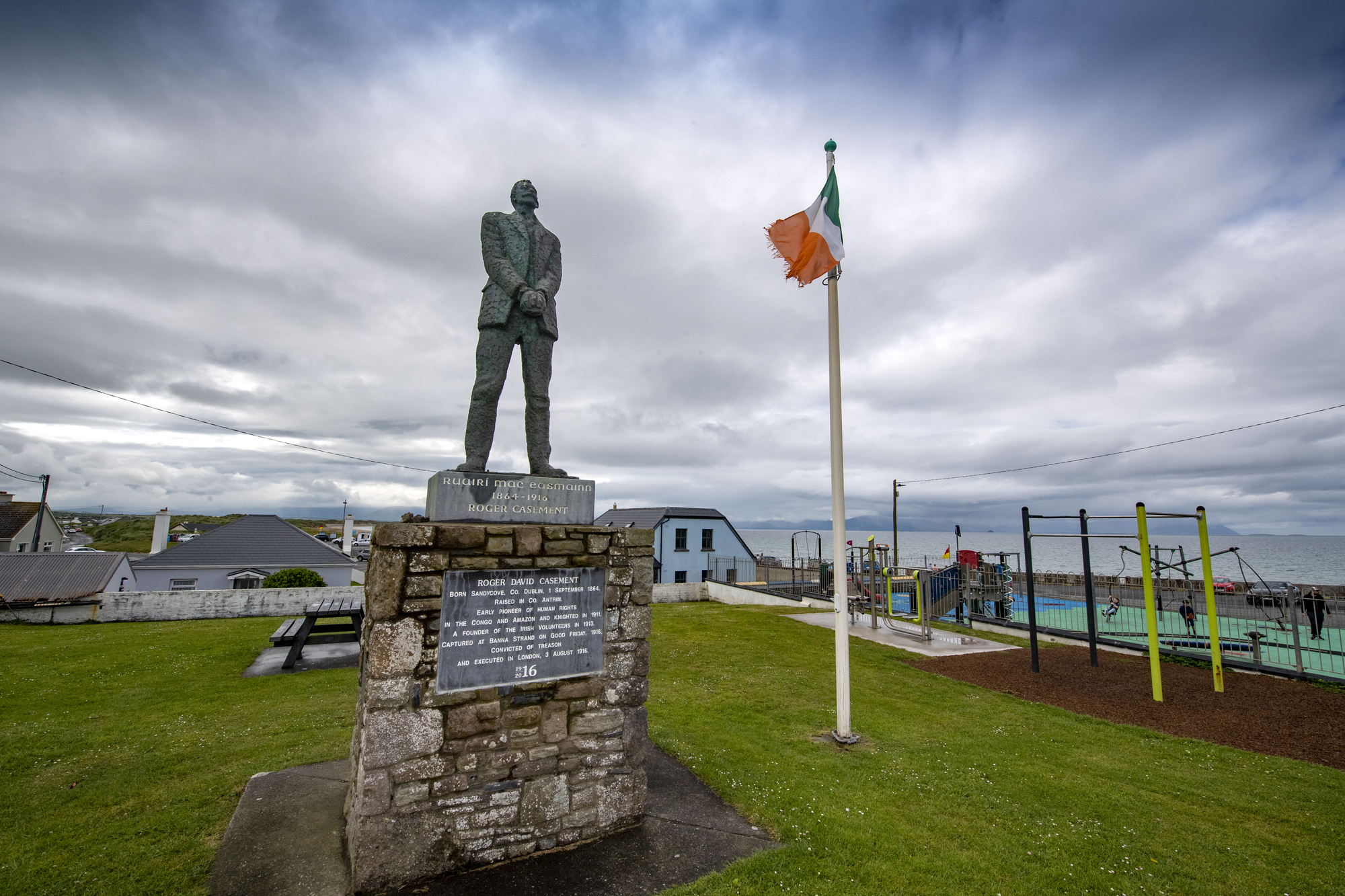
Roger Casement statue by Oisín Kelly at Ballyheigue in Co Kerry. Picture: Domnick Walsh
No one could have predicted the circumstances surrounding the unveiling by Tánaiste Dick Spring of Óisín Kelly’s bronze statue of the executed Irish nationalist Roger Casement in the village of Ballyheigue, Co Kerry on September 30, 1984.
Ballyheigue overlooks Banna Strand, where Casement was landed from a German U-boat on Good Friday 1916, the same day the British Navy intercepted a massive arms shipment he’d arranged to be delivered to Fenit pier, less than ten miles away. Bizarrely, the day before the unveiling of Casement’s statue, the Irish Navy intercepted a trawler called the Marita Ann off Fenit, importing arms from the US for the Provisional IRA.
“It was a remarkable coincidence,” explains Prof Michael Cronin, Academic Director of Boston College in Ireland, whose essay 'Roger Casement’s Long Journey to Ballyheigue' was published in in April 2016. “But that’s all it was, a coincidence. It’s not as if the men on the Marita Ann were thinking of the unveiling of Casement’s statue when they organised their own shipment of arms from America.”
Casement was an unlikely rebel. Born into an Anglo-Irish family in Dublin in 1864, he became a career diplomat, and first found fame in 1904 as the author of a British Foreign Office report into human rights abuses in the Congo Free State, which was at that time the personal fiefdom of King Leopold Il of Belgium.
He later exposed similar abuses in South America, and was knighted for his campaigning humanitarian efforts in 1911. By that time, however, he had already been active in Sinn Féin for some time. A few years later, on retiring from the British consular service, he helped found the militant Irish Volunteers, travelling to America to help raise funds for the organisation.
By the spring of 1916, Casement was in Germany, lobbying the authorities for support for the rebels in Ireland. He secured a consignment of weapons — including 20,000 rifles and 1,000,000 rounds of ammunition — and arranged their transportation to Fenit on a vessel called the Aud. At Fenit, after its captain failed to make contact with the Volunteers, the Aud was intercepted by the British Navy and taken to Cork harbour, where it was scuttled by its crew. That same day, Casement was arrested at a ring fort in Ardfert, and taken to Brixton Prison.
After the outcry that attended the executions in Dublin of Padraig Pearse, Thomas McDonagh, James Connolly and the other leaders of the Rising, it was decided that Casement should be tried in London. He was charged with high treason. Ironically, he is believed to have travelled to Ireland in an effort to call off the Rising, believing the Volunteers were not well enough prepared to bring it off.
Casement’s trial was a sensation. “By the time of his arrest,” says Cronin, “Casement had been a very public figure for more than twenty years, whereas the rebel leaders in Dublin were largely unknown before the Rising. His background was Anglo-Irish, and the fact that he had been knighted for his humanitarian work meant he was known as ‘Sir Roger Casement’. He was tried at the Old Bailey on Bow Street, the most famous court in the world, and all the leading newspapers were there to report on the proceedings.”
Ahead of his trial, Casement’s enemies circulated entries from what were purported to be his personal diaries, detailing his sexual encounters with other men. There continues to be argument over whether the Black Diaries, as they came to be called, were real or forged, but there is no doubt they helped turn public opinion against Casement, and affected the outcome of his trial.
“I’ve never read the diaries, or done research on them myself,” says Cronin. “Casement was a homosexual, but was he active to the extent suggested by the diaries? Who knows. What we do know is that he was involved in a very murky world of spies and intrigue. England was at war with Germany, and he had spent the previous year in Berlin, so it was easy to paint him as a traitor.”
Casement’s defence was based on admission of his involvement in running guns, while arguing that it had not occurred under British jurisdiction. When this tactic failed, he was sentenced to death. His defence team appealed, and when, again, this failed, they remained hopeful of a reprieve. But the Crown pressed ahead with his execution. On August 3, 1916, he was hanged at Pentonville Prison in London, where his remains were buried in quicklime.
Ahead of the 50th anniversary of the Rising in 1966, the Irish Government negotiated the repatriation of Casement’s remains. “Casement had spent his youth at Murlough, Co Antrim, and had expressed a wish to be buried there,” says Cronin. “But it would have been too controversial to bury him in Northern Ireland. Instead, he was laid to rest in the Republican Plot at Glasnevin Cemetery in Dublin.”
In many ways, this was the ultimate acknowledgement of Casement’s importance in Irish nationalist history. Among those buried in the Republican Plot are Michael Collins, Harry Boland, Cathal Brugha, Maud Gonne and Constance Markiewicz.
Kelly, the most prominent public artist of the day, won the commission for the sculpture to be placed on Casement’s grave. He completed the project in 1971. But by then, the Troubles in the North had escalated to the point where erecting a statue of Casement, even in the Republic, could be considered inflammatory. Instead, it was removed quietly to an OPW storage yard in Ladd Lane, off Baggot St.
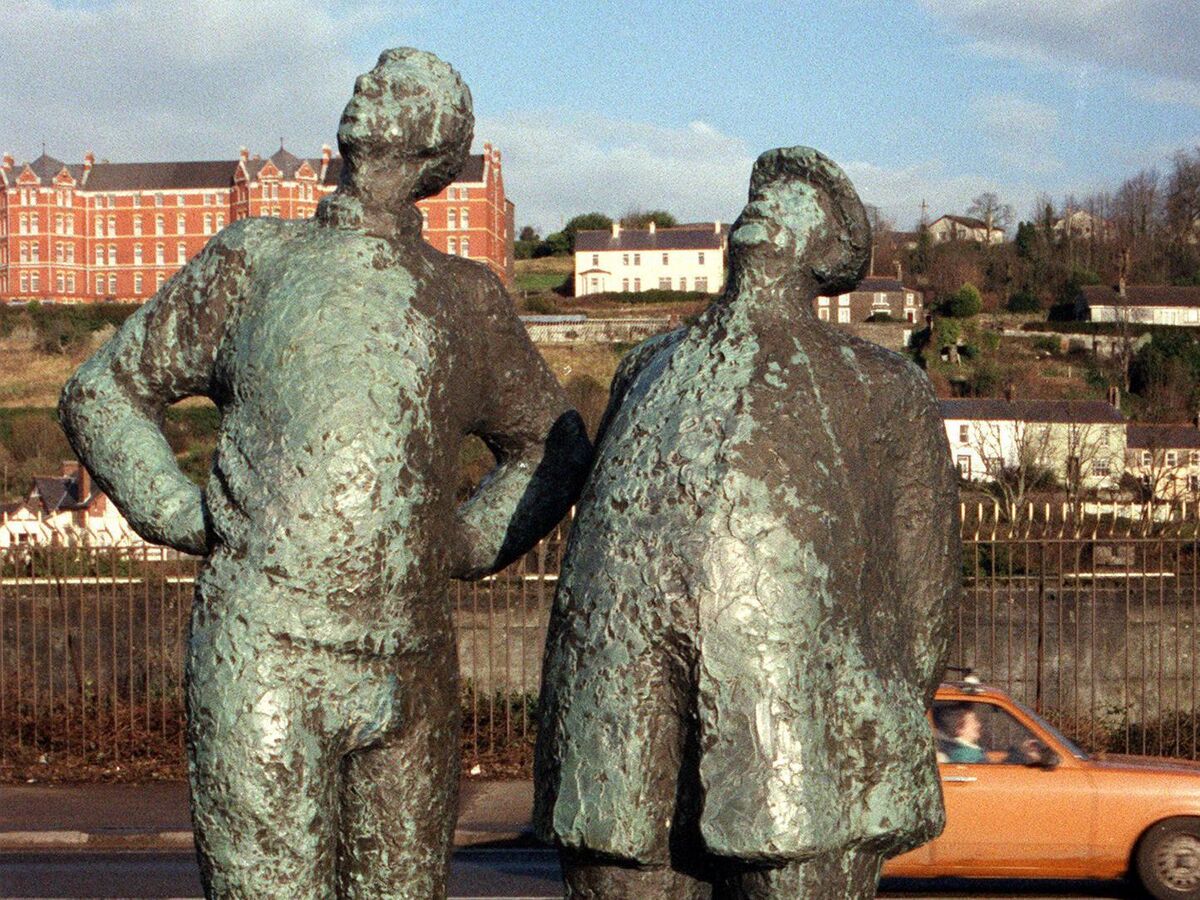
Among Kelly's other works was another that changed location through the years. Two Working Men — also known as 'Cha and Mia' — is now located at Cork County Hall, after originally being designed for Liberty Hall in Dublin.
Over the years, different sites were proposed for the Casement statue. At one point, it looked like it might go to Dun Laoghaire, on the basis that Casement was born in the area. “But that fell through when the local Council couldn’t agree on a site,” says Cronin. “Eventually, Ballyheigue Development Company offered to take it, citing the village’s proximity to Banna Strand.”
The seizure of IRA weapons at Fenit on 29th September ensured that the unveiling of the statue attracted a number of protestors. It was, after all, the very next day. They carried placards with slogans such as: “1916 The Aud. 1984 Marita Ann. What has changed?”
And as the Tánaiste spoke, some among them shouted “Traitor!” Afterwards, asked by the press to comment on the coincidence of the unveiling coming so soon after the arrest of the Marita Ann, he stated: “Other people may see it as ironic, but I see no irony in it at all. In 1916, the wishes of the vast majority of people in this country gave validity to what was happening, but that is not the case in 1984, when people here have rejected violence.”
One of those arrested for gun running on the Marita Ann was Tralee man Martin Ferris, who was jailed for ten years for his involvement. In the General Election of 2002, Ferris stood for election as a Sinn Féin candidate for Kerry North, taking Spring’s seat in the Dáil.
Kelly’s statue of Casement is twelve feet tall. He is handcuffed, and faces inland, away from the sea. Cronin believes the artist based his sculpture on a Daily Mirror photograph of Casement being led out of court after his failed appeal in July 1916.
“There’s something very defiant about this image,” says Cronin. “Casement knew for sure he was facing execution, but he stood tall, and kept his head held high.”