Book Review: War Hotels charts the infamous inns that provided refuge in war 
You can be sure there is now a hotel in Kyiv that is serving as an 'island of refuge and operational headquarters' for the international press covering the war in Ukraine, a hotel that is sure to be included in any new edition of this book
Book Review: War Hotels charts the infamous inns that provided refuge in war 

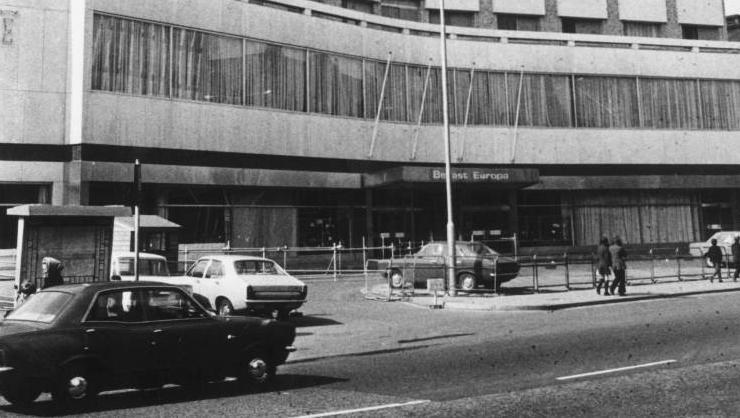
The Europa Hotel in Belfast, in 1972, which has the distinction of being the most bombed hotel in the world. Picture: James Jackson/Evening Standard/Getty Images
I never stayed in the Europa Hotel in Belfast, though I spent time in its bar on a number of occasions. Together with McGlade’s Bar behind the offices of the Belfast Telegraph, it was one of the great “listening posts” for journalists during the Troubles.

The last time I was in the Europa was in October 2006, and that was to meet the late Rev Ian Paisley’s daughter, Rhonda. We didn’t talk much about the past violence; we talked instead about her paintings.

Earlier this year the Europa was featured as part of Al Jazeera’s series War Hotels. This book builds on the research undertaken for that documentary series. The Europa has the dubious distinction of being “the most bombed hotel in the world”. In the period from 1971 to 1987 (the last IRA ceasefire), it was bombed 33 times.

Even as I write this you can be sure there is now a hotel in Kyiv that is serving as an “island of refuge and operational headquarters” for the international press covering the war in Ukraine, a hotel that is sure to be included in any new edition of this book.

Early on in his novel The Quiet American (set in Vietnam in the closing days of the French occupation), Graham Greene’s central character, a reporter, goes to the Continental Palace in Saigon to meet other reporters.

The authors tell us that it “was in Room 214 of the hotel that Greene penned his novel while allegedly working on an informal basis for the British intelligence agency MI6”.

The Europa Hotel in Belfast, in 1972, which has the distinction of being the most bombed hotel in the world. Picture: James Jackson/Evening Standard/Getty Images

The Continental, along with the Caravelle, was a safe location for reporters working in Saigon. It “became one of the key places to meet fellow journalists, military personnel, politicians and spies, and gather intelligence”.

Walter Cronkite, one of the most trusted and reputable journalists (he was the anchor of the CBS News primetime slot), preferred to stay at the Caravelle. “It would be his sobering assessment of the course of the conflict that would sow the seeds of doubt about whether the war in Vietnam could be won.” 

In Hanoi, the capital of North Vietnam, it was the actress Jane Fonda who gave one of its hotels celebratory status. In July 1972 she visited Hanoi to see for herself the impact of the US bombing of the city. She stayed at the Metropole Hotel, and it was from there that she made a series of controversial broadcasts on Radio Hanoi. Some months after Fonda’s visit the singer-songwriter Joan Baez also stayed in the Metropole.

In Sarajevo, during the 1992-1996 siege of the Bosnian capital, the “Holiday Inn was the only functioning hotel large enough to cater for the needs of the small army of foreign correspondents, aid workers and diplomats that came to the city during the siege”.

In Beirut, the Commodore Hotel was used by many correspondents, among them the late Robert Fisk. “If a journalist has good story and cannot send it, they might as well go home,” Fisk once said. “In the Commodore, you had three working telex machines and they could get you a call to London.”

Today, though Ukraine may be an exception, the “war hotel” doesn’t play the role it once did. “A hotel that could provide the means to establish a temporary press centre was no longer a necessity. Text, images and footage could be sent using Wi-Fi or through mobile phone networks, and from almost any location equipped with these.” Time and communications technology have changed.

“Though war hotels, as we have conceptualised them in this book, have become less commonplace as the nature of foreign reporting has changed, they were long a crucial part of, and vital nodes in, the reporting infrastructure, and thus are part of the history of journalism.”

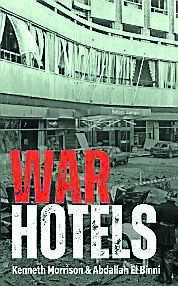
  • War Hotels
  • Kenneth Morrison & Abdallah El Binni
  • Merrion Press, €16.95

More in this section

Scene & Heard

Newsletter

Music, film art, culture, books and more from Munster and beyond.......curated weekly by the Irish Examiner Arts Editor.

Cookie Policy Privacy Policy Brand Safety FAQ Help Contact Us Terms and Conditions

© Examiner Echo Group Limited