Book Review: Danny Morrison draws ties between the 'old' and 'new' IRA
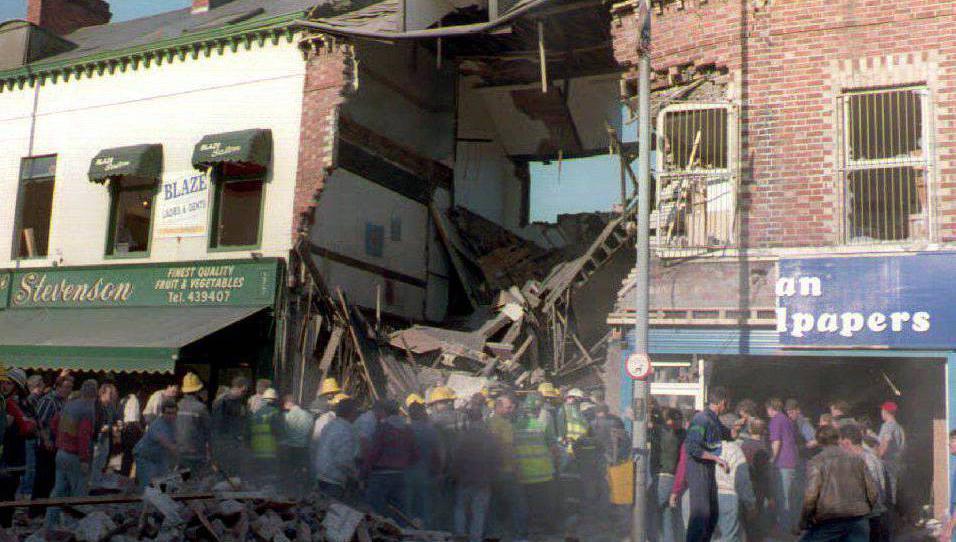
Police and rescue workers try to uncover victims trapped under the debris of a building that partially collapsed when a powerfull bomb exploded in the protestant Shankhill road of Belfast 23 October 1993. The explosion claimed by the IRA in a coded message to a radio station left at least seven people dead and many injured.
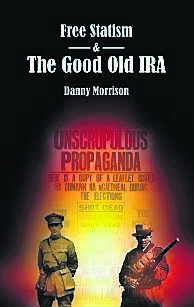
- Free Statism & The Good Old IRA
- Danny Morrison
- Greenisland Press, €17
The purpose of this book can be simply stated — it is an attempt (a rather desperate one) to conjure up the memories of an earlier murderous campaign (1919-1921) and to use these as a precedent to justify a more recent murderous campaign (1971-1997).
This is yet another phase in the obsessive promotion of a Sinn Féin narrative that would have us believe that the 30 years of murder and mayhem in Northern Ireland, commonly referred to now as “the Troubles”, was a legitimate “armed struggle”.
Morrison, a former director of publicity for Sinn Féin/IRA, sets out to challenge the view held by Fianna Fáil and Fine Gael — the two parties to emerge from the split in the original Sinn Fein and the Civil War (1922-23) — that “our violence was good, yours bad”.
Morrison is a good propagandist and a seasoned apologist for the Provisional IRA and its “armed struggle”, but it is hard to shake the feeling that this book was written for himself as much as anyone else.
The assumption that there is a widespread desire for a United Ireland in the Republic is not how I read things. Personally (though this won’t matter one whit to Morrison) I’m lukewarm bordering on indifference on the question of a United Ireland. I am much more animated by a desire to see a just society in both jurisdictions.
In mid-February, the editor of the Belfast Telegraph, Sam McBride, speaking on the Today programme on BBC Radio 4, said a United Ireland was much further off than some claimed, and added that among those in the middle in the North — “people who are persuadable” — there was no great desire for it.
There is no mention in this book of John Hume, Austin Currie, Ivan Cooper or Seamus Mallon. No mention of course because they represented the “other way”, the non-violent way, the road less taken. They stood in contradistinction to the way of the gun and the bomb.
I once heard the late John Kelly (our foremost constitutional scholar) say that we would be just as far on today (he was talking in the 1970s) in terms of independence without a shot being fired.
The arc of history was bending in the direction of social justice, the recognition of civil rights and “parity of esteem”, and the ending of colonialism. Events in both the USA and South Africa support this. Neither the civil rights movement in the US nor the struggle to end apartheid in South Africa descended into insurrectionist violence.
“Advocates of ‘armed struggle’, as well as their ideological fellow-travellers, tend to be resistant to information that might undermine their heartfelt convictions and, conversely, will be eager to embrace ideas and experiences that serve to confirm their preexisting beliefs. Attitudinal change of a fundamental kind is not easily brought about,” according to Liam Kennedy, emeritus professor of history at QUB, in his 2020 book Who Was Responsible for the Troubles?.
For me nothing illustrated the senselessness of the “armed struggle” more than the murder in Derry in April 1981 of Joanna Mathers, a 25-year-old married woman with one child. She was a Protestant, an honours graduate, and her husband was a farmer. She had given up her work in town planning to raise her son and had taken a part-time census job to earn some money.
In his book Ten Men Dead, David Beresford described what happened: “She had just gone up to a house in Anderson Crescent when a masked man dashed up to her, snatched the clipboard she was holding with one hand, put a gun to her head and fired.”
In the entry on her death in Lost Lives, we read this: “Her husband later told BBC reporter Peter Taylor: ‘I see it as the complete waste of a good life ... I don’t think the troubles are worth one single person’s life’.”
When I first learned of her murder, I remember thinking — would Connolly or Pearse have sanctioned such a cowardly and wasteful act?
I dwell on this because Morrison’s book — a tirade — is really an extended exercise in what Liam Kennedy has called “the coarse art form known as whataboutery”. This takes the form, he said, of the well-practised response, on both sides of the divide, of avoiding dealing directly with an atrocity perpetrated by those on one’s own side of the communal divide.
So if someone says: “Wasn’t Bloody Sunday in Derry an appalling massacre of innocent lives?”, the response from the other side will be: “What about the La Mon massacre in Belfast?” And so the
bitter exchanges go round and round.
Morrison’s whataboutery involves using the War of Independence (which he claims had no democratic mandate) against those (especially in Fine Gael and Fianna Fáil) who deplore the Provisional IRA’s “armed struggle” and say it had no mandate.
So the second half of Morrison’s book consists of a catalogue of grisly murders carried out by the original IRA in 1919-1921 which he uses to justify the murderous campaign of the modern IRA between 1971 and the last IRA ceasefire of 1997.
He quotes a statement by the then Taoiseach Jack Lynch and uses this to make his central point. “In November 1972 the Taoiseach Jack Lynch said that Fianna Fail was ‘the direct descendant of the old IRA, the true IRA, which would have nothing to do with those who now claim to be the IRA’.
“In publishing a selection of IRA operations from the Tan War period I knew that I risked unsettling romantic assumptions about the ‘Good Old IRA’ which Fianna Fáil and Fine Gael self-servingly perpetuate and rely upon to demonise the IRA of contemporary mainstream republicanism. But I deemed it a worthwhile exercise.
“To recognise similarities between the War of Independence period and the post-1968 ‘Troubles’ era does not infer support for the modern IRA. What it does is facilitate an understanding of the raison d’être of the IRA from the early 1970s, how and why it flourished, endured, and came to be recognised as integral to any peace process.” Perhaps, but to what end? I echo the words of Joanne Mathers’ husband — The Troubles were not worth a single life.
And where is Northern Ireland now? In his recently published book, The Partition, Charles Townsend reminded readers that “awkward realities” remain. “The ‘peace walls’ in Belfast are still doing their work, and have, if anything, grown in number and size. Most analysts find that polarisation has not receded during the peace process. Some, indeed, suggest it is sharper than ever, and more visible.”
It has always seemed oddly perverse to me that an organisation so committed to achieving a United Ireland should set about that task by killing the very people its members desired to be unified with.
Liam Kennedy’s verdict stands: “What NICRA (The Northern Ireland Civil Rights Association) or the People’s Democracy, or other militant groups, could not deliver was a united Ireland. Neither, for that matter, could the Provisional IRA. Even after a 30-year campaign of violence it had to accept, not publicly of course, that its primary objective remained unfulfilled. The former deputy leader of the SDLP, Seamus Mallon, put it more bluntly: the IRA had suffered ‘total failure’. And to boot, it had left in its wake a society more deeply divided along ethnonational lines than was the case before 1969 (though it is not clear if this was a cause for much concern within its ranks).”