Theatre review: Starry cast of Endgame includes Robert Sheehan and Frankie Boyle
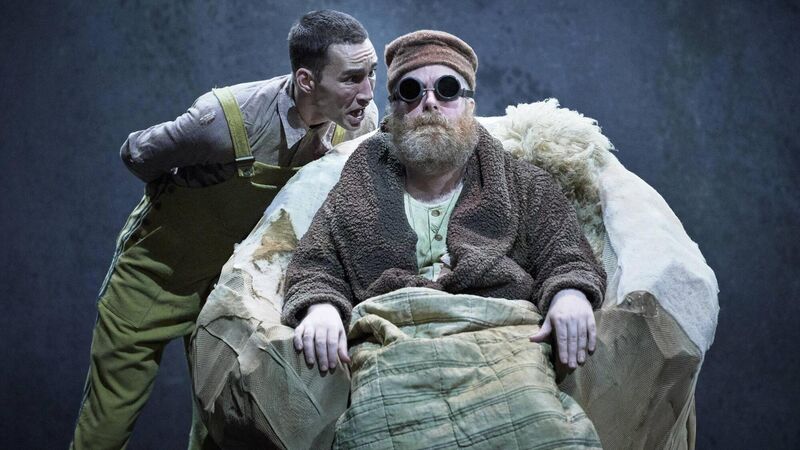
Robert Sheehan and Frankie Boyle in Endgame at the Gate Theatre, Dublin. Picture: Ros Kavanagh
- Endgame
- The Gate Theatre
- ★★★☆☆
Here they are then: Hamm and Clov. The isolators par excellence. Have they, or their plight, become more familiar to us after the last two years? Inevitably. If in 1957 the world outside their windows was, in the mind of the audience, more readily imagined a post-nuclear-apocalypse wasteland, we now think, based on recent all-too-first-hand experience, and the certain knowledge of worse things to come, of nature, pushed too far, exploited too much, wreaking havoc. And Endgame is happy to oblige this context. “There’s no more nature,” as Clov has it.
That scenario raises the fundamental Beckettian question: why go on? If in Waiting for Godot it was because something, an arrival, might happen (though of course it doesn’t), in Endgame it’s because, well, something might stop happening. We might get some release, some definitive, meaningful closure.
Yeah right. Closure, of course, is asking too much. This is Beckett after all. But Danya Taymor’s production does offer release. It’s palpable on opening night: a first full house in years is determined to have fun, determined to laugh at the jokes, quips and asides, many of them poking fun at the very idea of theatre, the very idea that we would watch this stuff. And that raises an odd question: is an Endgame this enjoyable, this, well, fun, a betrayal in some way of the text?
This strange feeling is not helped by Frankie Boyle’s Hamm. He’s a sardonic so-and-so, but under it all a bit of a softie, too. He’s not the monstrous Hamm one is accustomed to, the irascible egotist who exerts such a gravitational pull on the others in this little world. And without that threat of anger, that mood of resentment, the play loses something. It becomes too easily digestible, a bit too knockabout for its own good.
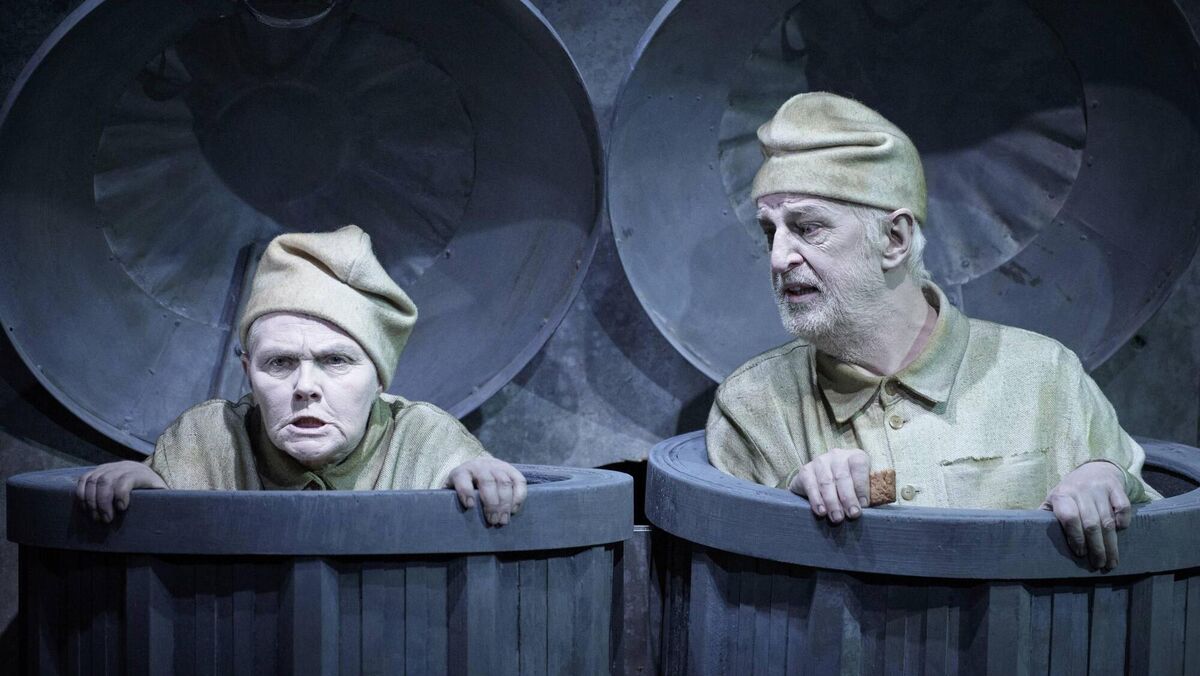
A brilliant turn from Sean McGinley as Nagg (alongside, in the dustbins, Gina Moxley’s Nell) reminds us of what’s missing. His long speech to Hamm is a wake-up call almost, suddenly touching the true bleakness of the text.
Robert Sheehan’s Clov is another highlight, reminding us of his past incarnation of the Playboy, finding the echoes of Synge that were always there in Beckett’s text, while also nodding towards the worlds of Enda Walsh and Martin McDonagh. The design is strong, too, with Isabella Byrd’s subtle, shifting lighting, and Sabine Dargent’s set.
There is, then, much to enjoy in this production, which Taymor never lets flag. And to sit and wrestle with why some of this might be problematic makes for an engrossing night of theatre.