Teilifís: Cathal Coughlan and Jacknife Lee mix old Ireland into a surreal brew
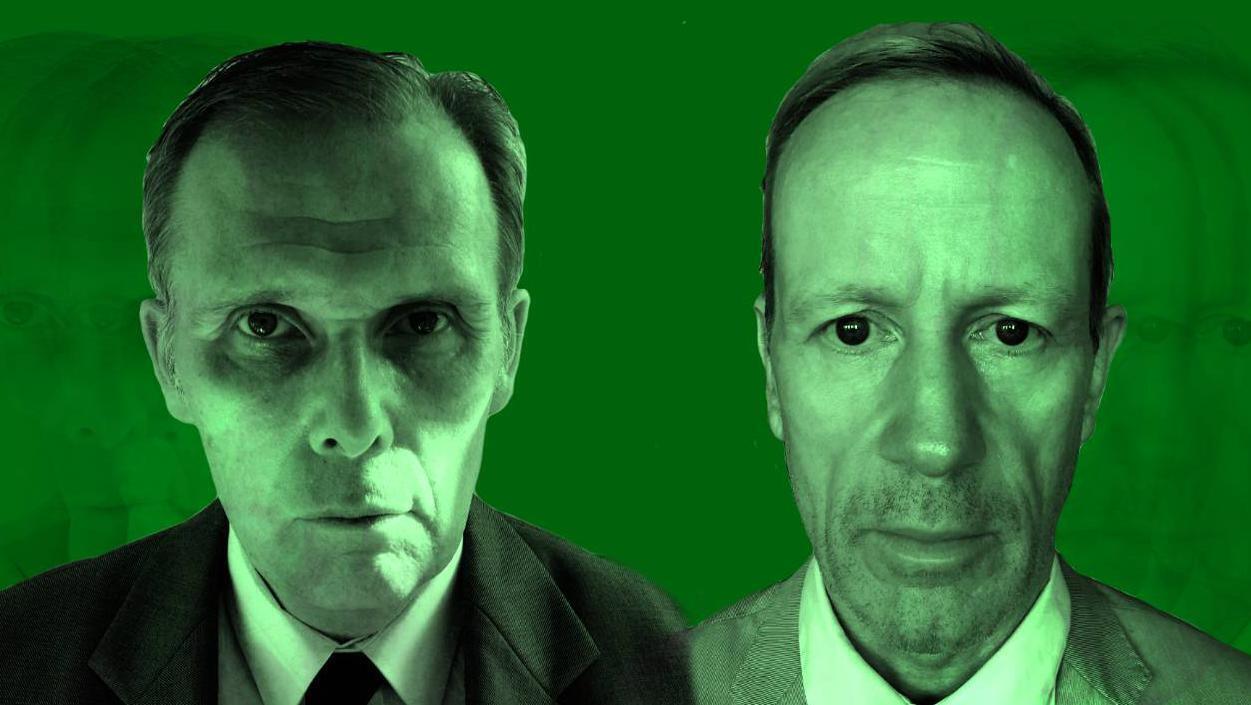
Teilifís: Cathal Coughlan and Garret Jacknife Lee.
Éamon de Valera, Kraftwerk, Danny La Rue. There’s a lot going on in the debut album from Teilifís, an unlikely but sublime collaboration between songwriter and former enfant terrible Cathal Coughlan and a-list producer Garret 'Jacknife' Lee.
“The Ireland of the 1960s was so different to where anywhere is like now, including Ireland. It’s almost exotic to investigate it,” says Coughlan, who cut a red-eyed swathe through Irish rock as frontman of Microdisney and Fatima Mansions before releasing a series of acclaimed, largely piano-based solo records. “It was quite monochrome. But, as with a lot of monochrome imagery, it’s hiding a multitude.”
The sheer strangeness of Ireland from the 1960s through to the 1980s is spun into a subject of unending fascination by Teilifís – Irish for 'television' obviously – and their debut album A hÁon, a project Coughlan and Lee worked from their respective bases in the UK and Los Angeles.
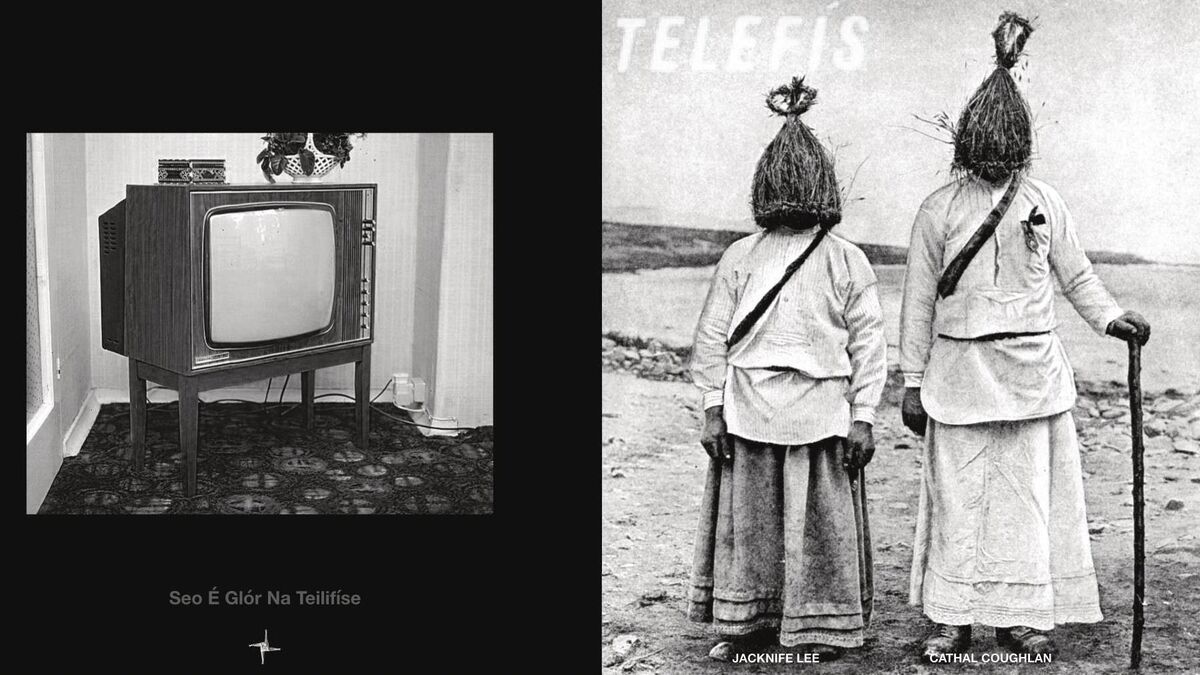
Having both grown up in the Ireland of Charles Haughey, Bunny Carr’s Quicksilver and Gay Byrne’s Late Late Show – of bishops on the airwaves and of the Angeles bells echoing out as a call to prayer – they have clear memories of how cut off the country felt. And how that isolation was reflected back to us through RTÉ, a dystopian single channel until 1978. It is not by coincidence that the cover of the record is a monochrome recreation of the early RTÉ logo of the Brigid’s Cross.
“I started travelling around [the world] and I realised that it was kind of unusual…[for]The Late Late Show, for instance, to be such an important thing,” says Lee from his studio in Topango Canyon, in LA’s glamorous hinterlands. “Having the one channel was such a strange idea and I never really thought of it that way.”
Teilifís is a musical project but it is also something else. Combining their gifts for melody, astute lyrics and gleaming production, Coughlan and Lee have blended vintage synth-pop and Irish surrealism. At moments they sound like 1970s electronic pioneers Throbbing Gristle possessed by the ghost of Flann O’Brien. Elsewhere, with Coughlan singing in his dolorous baritone, Teilifís suggests New York no-wave groups such as Suicide forced to spend a wet weekend in Knock circa 1985. It is uncanny and exhilarating – moving beats meeting moving statues.
But Teilifís has a powerful visual component, too. The video to We Need features a who’s who of Irish broadcasters through the 1970s and 1980s: Brian Farrell, Don Cockburn, Anne Doyle. For those of a certain age it’s like seeing your childhood flash before you.
It is, as Lee points out, reminiscent of the work of documentation Adam Curtis, who cuts and splices old newsreel footage to make a deeper point about the psychological condition of the world. Something similar is at play with Teilifís. Amidst Coughlan’s lyrics about Cork-born drag artist Danny La Rue, Lee’s analogue beats and footage of 1960e dance-hall slow sets they capture the darkly wonky essence of post de Valera, pre-Celtic Tiger Ireland.
They also tip their hat to Düsseldorf electronic pioneers Kraftwerk. The monochrome cover of A hÁon is a wink to the sleeve of Kraftwerk’s 1975 masterpiece Radio-Activity. And the very first thing the listener hears is a synthesised voice that seems to be reprising the ‘Ohm Sweet Ohm’ refrain with which Radio-Activity ends.
“The reference is pretty deliberate,” says Lee. “I’m not comparing RTÉ, the Catholic Church, with the Nazi party at all. But there was a similar land-grab of media that occurred early by people that wanted to control the people. It happened in the Soviet Union. It happens everywhere. There was a certain monochromatic aesthetic… We were listening to Éamon de Valera’s speech on New Year’s Eve 1960, when RTÉ started. And he compared television to nuclear power, saying it can be used for good, it can be used for bad."
Kraftwerk were exploring parallel themes in a German context. “That’s what Radio-Activity is about. It’s about music on the radio. And it’s about the emergence of nuclear power,” says Lee. “And the aesthetic they used was very similar. It’s a Nazi radio on the cover. So it’s about the propaganda. And obviously it’s on a completely different level in Ireland – I’m not suggesting any similarities. Music, entertainment and then the Angelus, and the news. Who’s delivering these things? The Nazis were very astute in jumping on to new technological platforms to deliver their message. And [Archbishop John Charles] McQuaid and people like that did the same thing with radio. And de Valera was saying it was a dangerous new idea.”
Lee is much in demand as a producer, having helped mastermind Snow Patrol’s Final Straw in 2003 and later worked with everyone from REM to The Killers. Over the past 12 months he has divided his time between Teilifís and part-producing Taylor Swift’s re-recording of her Red LP and U2’s contribution to the Sing 2 soundtrack.
He might spend a morning collaborating with Swift and then connect with Coughlan to discuss Teilifís. They were introduced via their mutual friend, Luke Haines of The Auteurs, though Lee vividly remembers seeing Coughlan’s Microdisney supporting Siouxsie and the Banshees in The Grand in Dublin in 1980.
For Coughlan, Teilifís represents the latest step in a remarkable purple patch. Microdisney reformed for a number of acclaimed concerts in 2018 while the Fatima Mansions back catalogue – which variously foreshadows Rage Against the Machine and casts Coughlan as a Leeside Scott Walker – is finally available on streaming services. And last year he put out the acclaimed solo project Song of Co-Aklan, which The Wire acclaimed as the “perfect companion” for getting through “a bruised and confused new spring” and which Mojo hailed as affirming his place “among Ireland’s poetic pantheon”.
In the 1980s and 1990s, inchoate fury was one of Coughlan’s reflexive gears as a songwriter. He feels he has mellowed. There is, it is true, some anger in Teilifís – it bubbles and seethes through We Need and Falun Gong Dancer, which has been re-recorded with a haunting bassline from former Public Image Ltd member Jah Wobble. But there is lots of wistfulness too. It’s a stark change from Fatima Mansions’s vicious 1991 deconstruction of REM’s Shiny Happy People, which didn’t parody the song so much as vaporise it.
“I certainly don’t want to be making the same mistakes I made in the past of often taking potshots at the most superficial aspects – and often the most undeserving targets – rather than focussing on what endures through life,” he says. “You can’t speak for what is going to endure past your lifetime. You try to get a bit more circumspect about what the recurring themes actually are in your own lifetime.”
Coughlan and Lee left Ireland decades ago. Coughlan relocated to the UK, where he still lives, Lee initially moving to London with his band Compulsion. They got out of Ireland at a time when the country was oppressive and dysfunctional. The dark joke at the heart ofTeilifís is that, from a certain angle, now it is Ireland that looks rational while it is the post-Trump United States’ and Boris Johnson’s Britain which teeter.
“The situation has changed. I don't think I ever felt fearful of living in Ireland,” says Lee. “I was kind of disappointed and I wasn't sure of my future. But I'm actually fearful of living here. Because it's so dysfunctional, so chaotic, and so violent.”
“The thing I used to say [about the UK] was, well, they're not dealing with their post-imperial problem very well,” adds Coughlan. “They're turning on the working people, blaming them for everything. But at least they make stuff just about run. Whereas in the 1980s in Ireland that was not a virtue that the place had. But that has completely turned around. They're not making stuff around here anymore, very well. Yes, there is a good health system. That’s about the extent of it. Britain is still having its post-Suez meltdown.”
- Due to vinyl delays, Teilifís album 'A hAon' has been pushed on to March 4. The group's EP, Falun Gong Dancer, featuring Jah Wobble, is out now