Cork In 50 Artworks, No 10: Fr Mathew statue on St Patrick's Street
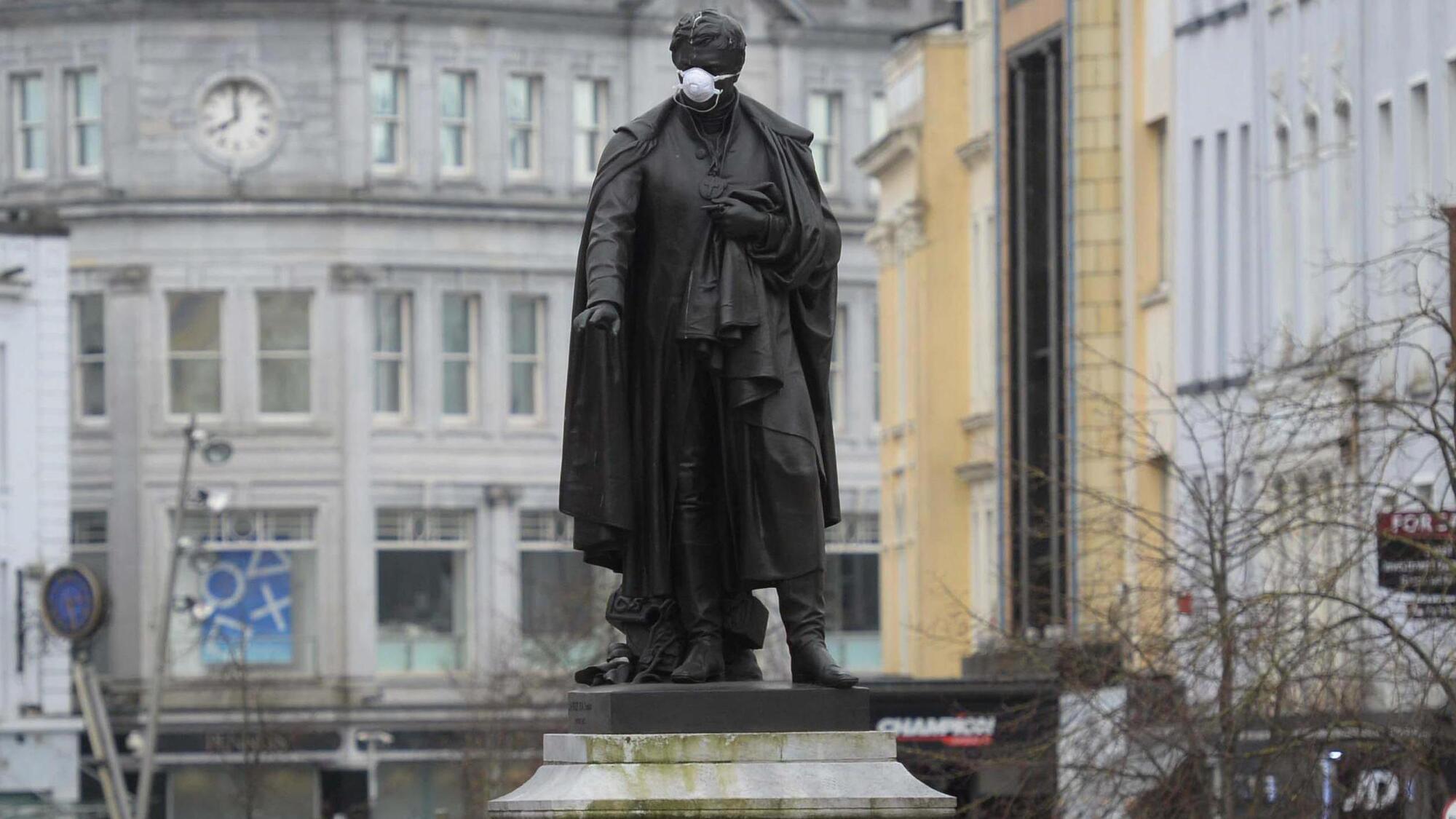
The statue of Fr Mathew with a mask during the pandemic. Picture: Denis Minihane
There are any number of public artworks in Cork city, but only one is so fondly regarded that it is known to all and sundry as ‘the Statue’: John Foley’s bronze sculpture of the temperance campaigner Fr Theobald Mathew, at the northern end of St Patrick's St.
In the early 19th century, chronic alcoholism was prevalent among the Irish people. In response, the Total Abstinence Society was formed in Dublin in 1836. It invited people to sign a pledge, stating they would henceforth abstain “from all intoxicating drinks.”
Fr Mathew - a native of Thomastown, Co Tipperary – was asked to promote the movement in Cork, where he served as Provincial of the Capuchin Order and was already well known for his charisma and industry. Crowds flocked to his meetings to sign the pledge, and he was soon invited to travel the country, converting hundreds of thousands to the cause.
Not everyone was happy with his success. Archbishop John McHale of Tuam suspected him of profiting from his endeavours and labelled him a “vagabond Friar”. But the reality was that Fr Mathew personally underwrote his whole campaign, and soon owed as much as £7,000. Friends helped pay off the debt, but his reputation was damaged by his profligacy.
And then, from 1846, when the potato crop failed, it was the absence of food rather than the ubiquity of drink that caused most concern. From September 1846 to May 1847, at least 10,000 were buried in St Joseph’s cemetery.
Fr Mathew was typically dynamic in his response, feeding thousands every day from a depot at Cove Street. But he buckled under the strain, suffering an incident of temporary paralysis, and finally accepted an invitation to tour America.
Fr Mathew left Cork in May 1848, and spent more than two years administering the pledge around the United States. His time there coincided with the burgeoning abolitionist movement, and though he had previously voiced his opposition to slavery, he avoided doing so now, insisting it would distract from his temperance mission. He even went so far as to observe that there was no objection to slavery in the scriptures. It was a stance which drew the ire of Frederick Douglass, the anti-slavery campaigner who had been befriended by Mathew on a visit to Cork.
On his return to Cork, Fr Mathew suffered a series of strokes. He died, aged 67, on 8th December 1856, and was buried at St Joseph’s cemetery, his funeral being the largest ever held in the city, attracting a crowd of 50,000 mourners.
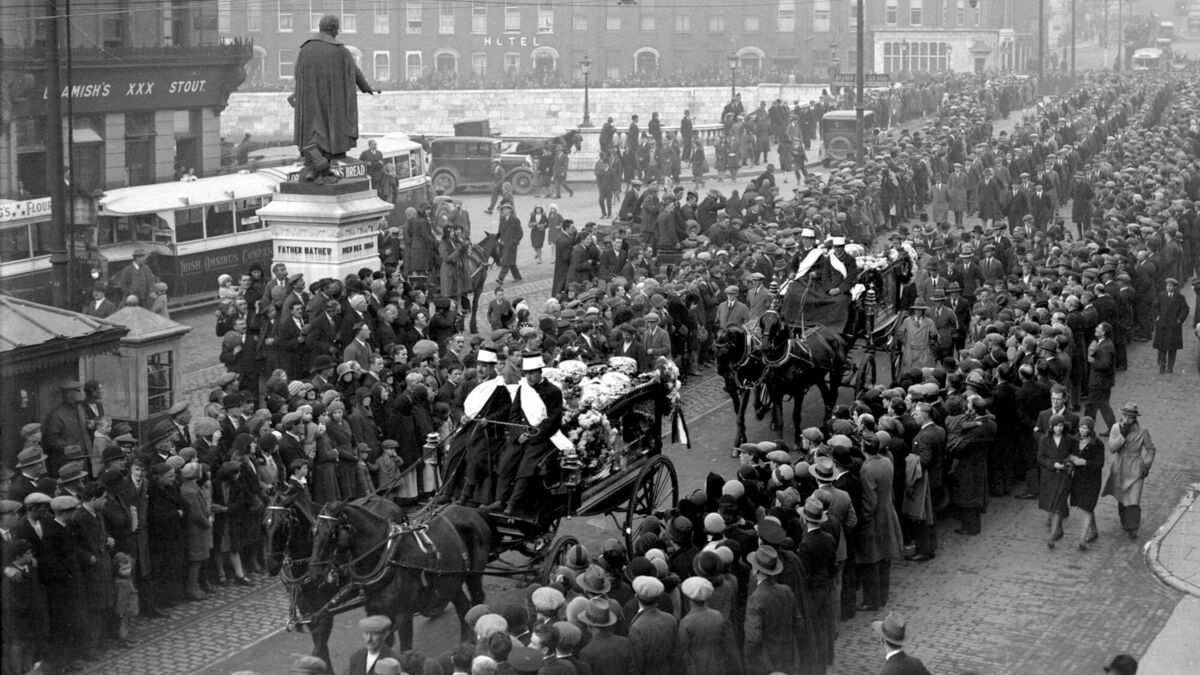
Fr Mathew had no sooner passed than a committee was formed to commemorate him. Funds were raised by subscription, and the sculptor John Hogan was commissioned to create an eight foot high bronze statue of Fr Mathew, on a ten foot limestone plinth. Hogan’s sudden death in March 1858 delayed the project; the commission passed to his son John Valentine, who proved unable to agree terms with the committee, and the task was eventually given to another sculptor, John Foley.
The unveiling of Foley’s statue, on what would have been Fr Mathew’s 74th birthday on October 10, 1864, drew a crowd of at least 100,000. A procession of dignitaries wound its way from Albert Quay to the top of Patrick’s Street, where the Lord Mayor (and Cork Examiner owner) John Francis Maguire delivered an eloquent tribute to the man he remembered as Cork’s finest. The Statue was at last revealed, to tumultuous cheers, and the city had its icon.
Fr Mathew’s legacy is open to debate, but his memorial seems unassailable. It has survived floods and fire, most famously the burning of Cork city centre by British forces in December 1920. Indeed, the only serious threat to the Statue’s standing came in 2002, when the Catalan architect Beth Gali, tasked with reimagining Patrick’s Street (on a budget of €13 million), suggested transposing Fr Mathew to the junction of Winthrop St. There was uproar, and the plan was shelved.
The Statue has been the subject of more mischievous intercessions, of course. Pranksters have balanced traffic cones on Fr Mathew’s head, draped football scarves around his neck, positioned beer bottles at his feet, and hung a yoyo from the fingers of his outstretched hand.
In the spring of 2020, as the first Covid lockdown commenced, someone memorably gave Fr Mathew a facemask. The Apostle of Temperance may never have looked so of-the-moment, and it would surely have astonished him to learn that every pub in the country had at last been forced to shut its doors, albeit temporarily, and by a pandemic rather than the pledge.