B-Side the Leeside: Interference - Live In Dingle
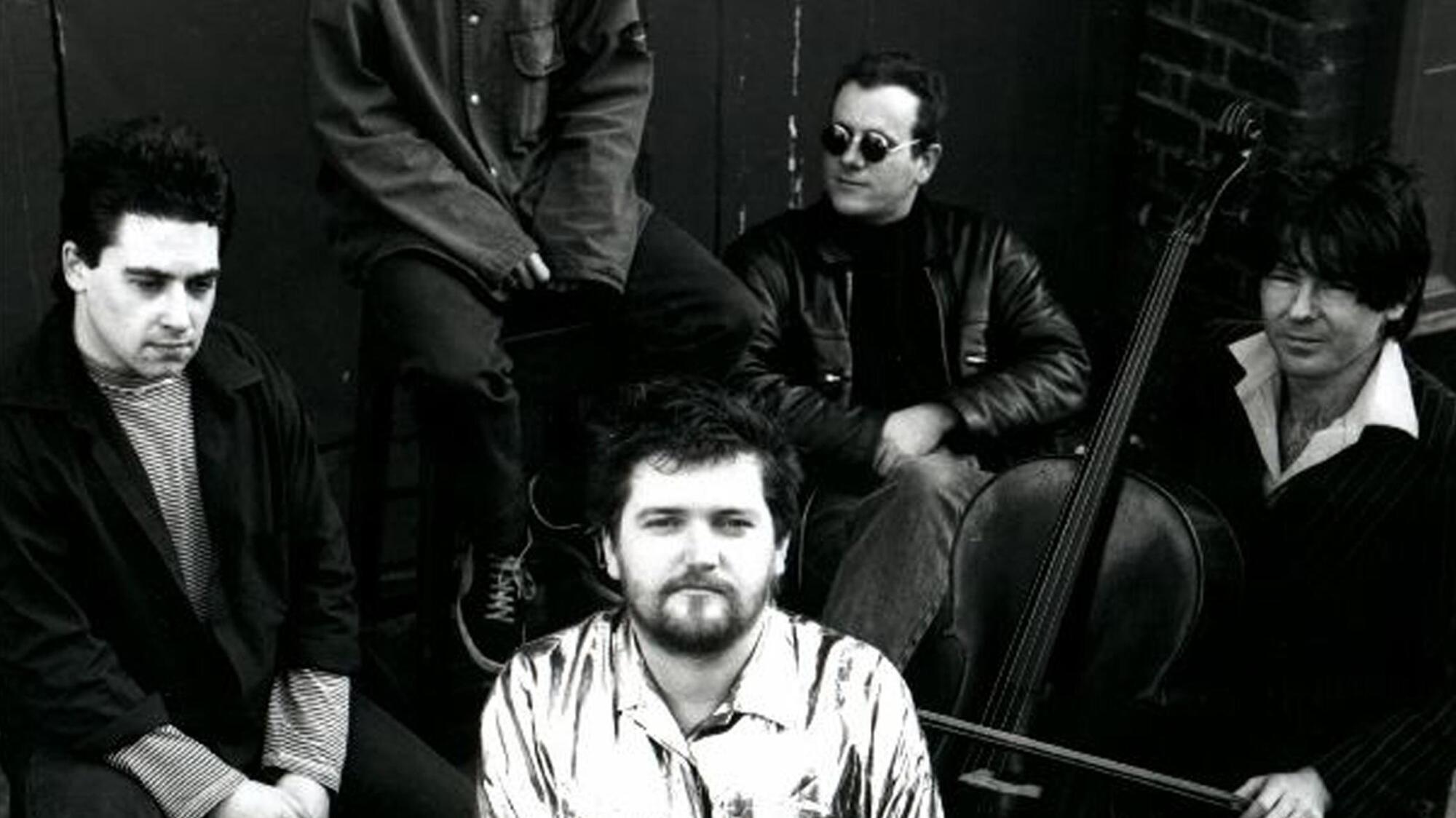
Fergus O'Farrell, centre, with an early incarnation of Interference.
The story of Fergus O’Farrell is one of tragedy, triumph and of a relatively short life lived to maximum potential. It is also one of incredible music – of haunting, storm-wracked songs that arrived like a gale gusting in from the sea.
To those in on the secret, Schull-born O’Farrell was among the most important Irish artists of his generation. Regarded by fans as one of the greatest ever songwriters to come out of Cork, O’Farrell and his group, Interference, never entirely received the recognition they deserved. Yet their following has, if anything, grown more devoted since the passing in February 2016 of the singer, who had lived nearly all his life with muscular dystrophy.

As sort of Irish Jeff Buckley, O’Farrell sang from the depths of his soul. His ballads brimmed with emotion and melancholy. And sometimes anger. And, incredibly, for much his career they were performed from a wheel-chair by a vocalist whose lungs were operating at one third of regular capacity. Health issues did little to detain O’Farrell up to his passing at age 48 in his native West Cork.
He was worshiped by a young Glen Hansard and by Mic Christopher, another protean Irish talent taken before his time. And in the years immediately prior to his death, he received some overdue acknowledgement when Interference’s elemental dirge Gold was featured, at Hansard’s insistence, on the soundtrack to John Carney’s Once and in its Broadway spin-off.
It was just one of several audacious comebacks by O’Farrell. In 2002, he had put Interference back together and blown off the shutters at Other Voices in Dingle, which, in its very first season, dedicated an entire evening to the band. The following year, that concert was released as an album, Interference Live In Dingle. It capture O’Farrell at his very peak and is fitting testament to one of Cork’s outstanding troubadours. Here is the story of the record – of how it came to be and of its legacy.

O’Farrell was born in Schull in 1967. His family were comfortably off, father Vincent a businessman who owned the Eldon Hotel in Skibbereen. At age seven, Fergus was diagnosed with muscular dystrophy: his parents were told he would be lucky to make it to his twenties. A fighter from the start, O’Farrell refused to let his health get in the way of his ambitions.
“He didn’t really want to talk about it -– he didn’t want to be, as he would say, the cripple in the wheelchair. He wanted to be the singer on the stage.” recalls Paul Tiernan, the guitarist who played with Interference in the early 2000s and is part of the ensemble on Live in Dingle.
“It was amazing – people would forget about the wheelchair. The only time we’d remember was when there were issues with him getting on stage. And then we’d have to lift the fecker up. But he was very stoic about it.”
O’Farrell attended Clongowes Wood in Co Kildare. Clongowes is a rugby and cricket school but owing to his muscular dystrophy, Fergus received a dispensation. He found a soulmate in James O’Leary, with whom he would form Interference.
“Obviously with his disability he didn’t play rugby,” says O’Leary, who recalls that the fledgling ensemble’s first percussionist was a Casio keyboard drum machine. “I didn’t play rugby because I was myopic. And when you’re not playing rugby, there’s not much else to do. We were both mad into music and started to play together. That’s where the band came from.” Those who encountered him at Clongowes remember his magnetism – and determination.
“Although tiny in stature he was a giant inside and a powerhouse of talent bursting to transcend his physical disabilities and soar with the eagles,” is how Farrell is described by Clongowes head of communication Declan O’Keeffe in a tribute posted on the school’s website following the singer’s death.
“As soon as he got up on stage, O’Farrell knew music was his destiny,” agrees O’Leary, today a successful architect in Dublin. “Fergus was very very driven. And he was a star.”
The rest of the Cork contingent in Interference featured Kevin Murphy from Monkstown on bass and cello, and Cal McCarthy from Rochestown on drums.
Based at the old Winstanley shoe factory in Dublin, Interference were soon creating buzz around Dublin. O’Farrell was also blossoming as a songwriter, often penning lyrics in collaboration with another Clongowes graduate, poet Malcolm MacClancy. They were like nothing else in the city remembers Michael McCormack, the filmmaker whose long-awaited documentary about the band, Breaking Out, has had its release put back due to the lockdown last year. “They had a swagger about them,” says McCormack. “They didn’t care whether you liked them or not. This was the noise they were going to make. I was about 14. I started going to see them all the time.”
O’Farrell was still playing standing up in those early days, but his health soon forced him to perform from a wheelchair. This didn’t prevent Interference becoming fixtures at Whelans’ on Wexford Street.
“Things never went right for them,” says McCormack. “For so many reasons, they didn’t get the breaks. But you’d be at the gigs and you’d look around and see the likes of Glen Hansard, Mic Christopher – all these people who would go on to start bands."

Interference released a self-title album in 1995. Arriving at the high-point of Britpop, it failed to set the world alight. O’Farrell, whose health was worsening, went home to Schull.
But Interference were in little danger of being forgotten. For years afterwards fans of the band held onto their memories and their passion. And when O’Farrell was persuaded to put together a new line-up for a reunion show in a pub in Schull in 2002, devotees from across the country made sure to be there.
News of the gig reached Glen Hansard. He was preparing to host the first season of Other Voices, filmed at St James’s Church in Dingle. With Interference a functioning entity once again, Hansard campaigned for the group to be included.
“It was so exciting to have Interference, who are a West Cork band, come over the county bounds and to be allowed do their thing in West Kerry,” says Philip King, who conceived of and produced Other Voices. “Fergus O’Farrell was a hugely significant figure – he was a creator, he was a maker of new songs, he sang with an individual voice that was totally identifiable as him.”
“It was such a buzz,” says Paul Tiernan, who had by then joined the group and helped O’Farrell re-arrange the material for the quasi-acoustic setting at St James’s. “It was the first Other Voices. And the first time really that a serious music show was filmed outside the walls of RTÉ or even outside Dublin. It was in a church in Dingle and that itself was a novelty."
The complicating factor was the presence of TV cameras – a new experience for all involved. “Fergus was the right side of nervous,” says Tiernan. “Having an audience meant you were much less conscious of the camera and all the paraphernalia. It felt very much like a gig. Fergus used to drink Jack Daniels and Coke, to get in the right mood for a show. He couldn’t get any Jack Daniels and had vodka and Coke instead. He said, ‘it’s done something to my voice – my voice is not working’. This was five minutes before we were on. We just said, ‘Fergus you’ll be grand’."
Of course, he was much more than grand.
Buoyed by the success of Other Voices and of the Live in Dingle album, O’Farrell continued to write and record, as well as playing occasional views. In 2007 his music would be introduced to an international audience when Gold featured on the film Once.
Interference lived on, too, with Glen Hansard taking over as frontman for a series of reunion gigs in tribute to his late friend and comrade-in-arms.
Many who encountered the band express the regret that they never reached the deserved heights during O'Farrell's lifetime. However, the Live In Dingle album remains a fitting testament to their talents
“And I love her so….I wouldn’t trade her for gold,” sings O’Farrell on what has become Interference’s best known song. It’s a hurricane of a ballad, in which powerful emotions are juxtaposed with lyrics that cast a poetic spell.
A song from the band's early days that made it all the way to the Live In Dingle album. Powerful stuff that's still begging to become a huge hit in the right hands.
One of his collaborations with poet, Malcolm MacClancy this is a slice of Americana filtered through a prism of West Cork melancholy.
Another heart-achingly gorgeous love song from O'Farrell.