Jeff Rubin: unpacking the impact of globalisation on working people

An overgrown parking lot lies empty in front of the closed Packard Electric complex on October 29, 2012 in Warren, Ohio. Warren, like much of rust belt Ohio, had suffered through long-term economic decline, even before the 2010s recession. (Photo by John Moore/Getty Images)
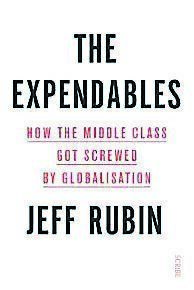
- The Expendables: How The Middle Class Got Screwed By Globalisation
- Jeff Rubin
- Scribe €12
IF my granddaughter gets around to asking me what I did during the Great 2020 Covid-19 Lock-In, I shall tell her: I wasted time in the shed, wrench-and-screwdriver-in-hand ripping stuff apart. I went to work on a clapped-out PC and a couple of ancient laptops. What sparked this moment of madness? The shed was – and still is – packed to its crumbling window frames with cardboard boxes, the debris of the six-month Online Shopping Experience. A kitchen trash bin had been in one of them. ‘Made in China’ read the print on the box.
I looked at the old PC and the laptops, and wondered: how much of this kit comes from China? I don’t know what the bits did, but most of them were stamped Made in China; a few were made in Malaysia. Malaysia rang a bell: some of the printing ink I get is made in Malaysia, but not all of it; that’s made in China, too. That’s globalisation, in bits in my grubby shed.
Canadian economist Jeff Rubin has spent some of his Covid-19 house arrest months writing a forensic study of globalisation, and what it has meant for millions of families in the West. He squanders no time in getting to his point, which is that in its currently defined and recognised form it has devoured the middle class – as measured by income – across the developed world.
“The middle class,” he finds, “represents a shrinking percentage of the population. That is particularly true in the United States, where for the first time in four decades the middle class comprises a minority of Americans. Moreover, those still fortunate enough to call themselves middle class, are far more vulnerable to being thrown out of it … Staying in the club is a lot harder.”
Leo Varadkar, Tony Blair, Bill Clinton, and Barack Obama have been among the cheerleaders for globalisation, albeit with varying degrees of enthusiasm.
This was Mr Varadkar, speaking at Dublin’s European Financial Forum in 2019:
“At the moment, some people think the solution is to … row back on globalisation. To re-introduce barriers to trade. That is not the approach of the Irish government … At a time when attitudes to globalisation, free trade and multilateralism are hardening in much of the world, Ireland is holding firm to liberal political and economic values and policies.”
Like it or lump it was Tony Blair’s terse advice to the UK’s Labour Party in 2005: “I hear people say we have to stop and debate globalisation. You might as well debate whether autumn should follow summer. They're not debating it in China and India. These nations have labour costs a fraction of ours. The character of this changing world is indifferent to tradition. Unforgiving of frailty. It has no custom and practice. It is replete with opportunities, but they only go to those swift to adapt, slow to complain … The dam holding back the global economy burst years ago.”
While international trading empires are far from new – Rome, Mongolia and Britain had them – Rubin traces the origin of today’s world order, or at least the pre-Corvid-19 one, back to the 1950s, when two of the dams restricting tariff-free trade were demolished: one was the 1956 Geneva Round of the General Agreement on Tariffs and Trade (GATT), which wiped out protections worth $2.5 billion between 26 countries, and the other was the 1957 Treaty of Rome that created a common economic market comprising its six founder-member states.
“It was, says Rubin, “a form of free trade and a precursor of what was to follow. Free trade was an idea that was sweeping the world.” The “hope”, he explains, “was that in a world of economic growth, workers and industries wouldn’t need protection because “there would be so much wealth around that everyone would better off”.
In his rigorous analysis of how wrong it’s gone, he looks back to the West’s pre-1960s economies, citing 1957, when Elvis Presley was on the Ed Sullivan Show, Canada produced its Avro Arrow jet fighter, Ford unveiled the ugly and overpriced Edsel car, Dwight D. Eisenhower was sworn in as US president, and Asian Flu plagued the planet.
Now, when Western countries need face masks they must get them from China, where factories – many of them owned by US and Canadian companies – were last year churning out 115 million a day. “Sure, our companies still make things. It’s just that the factories are somewhere else. And the jobs are somewhere else. And when we need them the masks are somewhere else, too.” When push came to shove, masks and other medical kit made by US- and Canadian-owned factories in China were not sent to North America; China’s government took them.
Rubin laments: “Canadian diplomats are reduced to sending out messages on social media, hoping that Chinese alumnae of Canadian universities will be willing to help find a few boxes of gloves and masks. Hardly the commanding heights of the global economy globalism promised.” The slow-fuse burn of GATT and globalisation, he writes, has left an industrial landscape every bit as cratered as the destruction left by a nuclear warhead. What, he asks, would a worker from 1957 think if he or shecould see Detroit – or vast parts of the rest of the US – today? “The shuttered factories across the North America, the boarded-up Main Streets, the empty union halls – the physical toll of globalisation would be inescapable.”
In a summarised tale of woe, Rubin reports that in current USA dollars, average real salaries paid in the US hit their highest point in 1975, and goods-sector employment (GSE) peaked around 2000. More steel is used to make bottle caps than cars. In Canada, as a share of total employment, current GSE is the lowest it’s been since 1945. Canada’s manufacturing base has lost 600,000 jobs – a quarter of its labour force – since 2000. Right now, scarcely two in every ten Canadian workers are employed making stuff. No great search is needed to find out what’s created this collapse in manufacturing, which Rubin says was foreseeable from the outset: the share of global manufacturing output in the US and Canada has been cut by a similar proportion as trade barriers against everything from textiles to cars have either been eliminated or dramatically cut.
No G7 economy has been spared. When in 2017 Germany had almost full employment, nine million workers were getting by on low-wage contracts. More than a third of middle-income households in Britain report difficulty making ends meet. Median wages after inflation in the UK are below what they were in 2008. Having a job, he notes, ain’t what it used to be.

Rubin makes the connection between the anxiety – if not anger – about the hollowing out of the country’s industrial heartlands and its coastal regions that fuelled England’s Brexit vote and the so-called populist revolts against the political class in France, where the Marine Le Pen’s Right-wing National Rally (formerly National Front) and the Communists have made the most of President Macron’s inability to stop the impoverishment of the industrial working class. And, of course, it was the sacking of industrial America that helped to get Donald Trump – the wrong answer, it’s been said, to the right question – across the line in 2016. The book’s title resonates: Mrs Clinton, in her campaign, described contemptuously the rustbelt victims of globalism as a ‘basket of deplorables’.
There is another grim side to the coin. While the corporates and their Top People have been outsourcing work from their homelands to low-wage states with dire human rights records and lousy employment laws, they’ve been offshoring capital gains and dividends to tax shelters. An estimated $5 trillion (€4.2 trillion) was held in offshore accounts in 2007; it was reckoned to be $8.7 trillion (€7.3 trillion), or 11.7% of global household wealth, in 2015.
Not all tax havens are in the sunny Caribbean. Rubin’s eye is caught by one in the cold North Atlantic: Ireland. “If you knew the dollar figure of the profits booked [in Dublin], you’d be forgiven for thinking we were talking about New York or London.”
Its 12.5% corporate tax rate – a third of that in most European Union states – and its 6.5% intellectual property rate had the tech giants lining up to park most of their European revenues in Ireland.
What’s to be done, now that we can see not only what globalism has done to the middle classes but also the chaos it means for supply chains when Just in Time delivery becomes You Get it Sooner or Later or Never? Rubin sees what could be a Post-Plague silver lining.
Scorched by Trump’s China tariffs and worried about supply chains from Beijing’s Celestial Empire, some US corporations – Apple, Dell, Hewlett-Packard – are planning to move production out of China, but so far they’ve shown no interest in bringing it home; and if they did, they’d probably be employing robots on Ohio, Michigan and New Jersey, not people. They’re looking instead at Taiwan, Vietnam, and India.
But that could be just the edgy start of radical change. Covid-19 closed borders once thought eternally open. The EU’s Schengen Zone was binned overnight. “Will,” he asks, “there even be an EU in the aftermath? Or will the union itself become another failed experiment in globalisation?”
Rubin ends this pugnacious study – written not for Goldman Sachs graduates but in plain English for the expendables and deplorables among us – with the suggestion that the change will come not so much from protectionist US presidents but from shareholders who will lose interest in companies that can have their Chinese factories quarantined or stolen and turn it to organisations that are immune from supply chain worries. He sees economic self-sufficiency moving from populist hymn sheets to mainstream thinking.
“What is likely to emerge,” he says, “is the polar opposite of globalisation. Local sourcing means local production by local workers paid at local wage rates. That means that many of us won’t be quite as expendable anymore.” But, hey, let’s not hold our breath.