Maureen O'Hara: 'She was calling out the Harvey Weinsteins of the day 70 years ago'
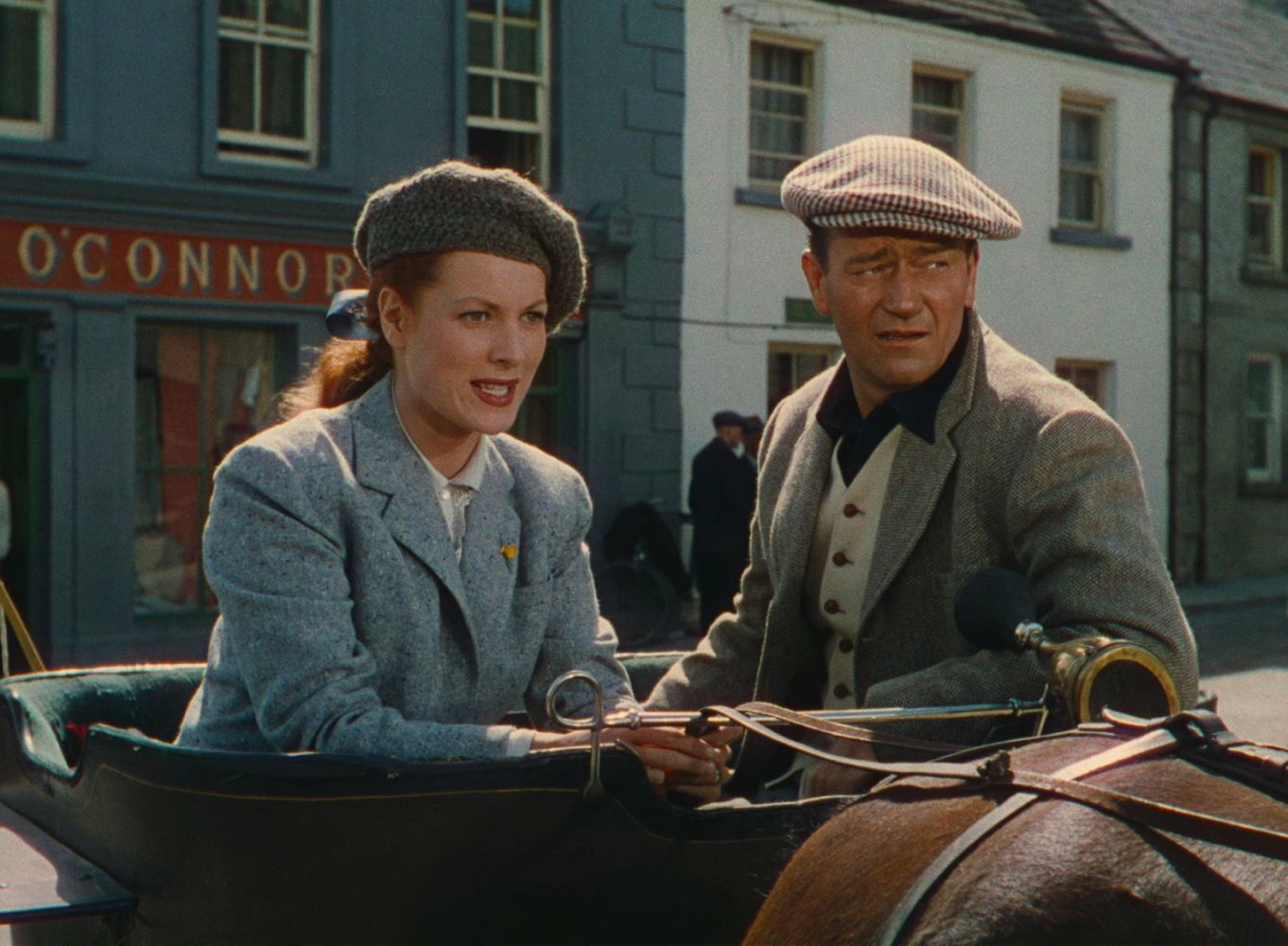
Maureen O'Hara and John Wayne in The Quiet Man.
Apart from being arguably Ireland’s greatest film actor, Maureen O’Hara was one helluva lady, which comes across in a charming TG4 documentary to be screened on Christmas Day. As John Wayne – who’s forever linked with her from co-starring together on several classic films, most notably The Quiet Man – remarked: “The greatest guy I ever knew.”
When O’Hara arrived in Hollywood in the 1940s, she was mainly cast as the leading lady in decorative roles, which came with steamy publicity trailers like those for Baghdad (“love on hot desert sands, the story of a princess with a hundred moods”) or Sinbad the Sailor (“Shireen, beautiful and dangerous, who had flame in her hair”).
The action films also gave her a chance, though, to bring out her dashing side. She could hold her own at the bar with the macho stars of the era, among them John Wayne, Anthony Quinn and the director John Ford. She liked to drink her whisky straight up, with one ice cube.
“The little boy in me liked her swashbuckling movies, jumping from one mast to another with a knife in her mouth and sliding down the mast of a pirate ship,” says Conor Beau FitzSimons, her grandson, who grew up in Dublin, while spending summers in West Cork with O’Hara in her house in Glengarriff.

“I got to watch those films in the 1970s on a little black-and-white TV on RTÉ, sitting in my house in Blackrock in front of a fireplace with all my friends. We’d dress up and play pirates and swordfights with the Zorro swords that had the little chalk at the end. I always thought it was cool that my grandmother was a badass. It was kind of like having your own superhero as a grandmother.”
Off screen, O’Hara also had a forceful personality. She could stand her ground. In 1957, for example, she sued Confidential magazine for libel after it printed a story claiming she had sex at the back of the theatre during the premiere of the movie, Ben Hur. In her defence, O’Hara presented her passport to prove she was out of the country when the film was screened. After winning her case, the magazine went out of business.
O’Hara was also a vocal critic of the “casting couch” culture in Hollywood when it wasn’t profitable to do so, as she risked becoming a pariah in the industry and being labelled, in her words: “cold, frigid and a statue”. To take a stand was typical of her courage.
“One of the first movies she made in Hollywood was with the director John Farrow, who later became Mia Farrow’s father,” says Brian Reddin of Dearg Films, director of Maureen O’Hara – Banríon Hollywood.
“He was married to Maureen O’Sullivan, another Irish actress from Boyle, Co Roscommon, but he was chasing Maureen O’Hara. He used to follow her home, trying to get her into bed. She had an awful time with him. She actually punched him in the face on set, nearly knocking him out.
“John Wayne would have known these details about her – that you didn’t mess with Maureen O’Hara. She gave as good as she got. Back in the 1940s and 50s in interviews, she spoke out against sexual harassment and the ‘casting couch’. She avoided and despised it. She would never lower herself to that level, at one point saying, ‘If that’s what it takes to be in Hollywood, I don’t want to be in Hollywood.’ She was calling out the Harvey Weinsteins of the day 70 years ago.”
After shooting Big Jake alongside John Wayne in 1971, O’Hara stepped away from the silver screen. She had married the love of her life, the famous aviator, Captain Charles Blair, three years beforehand. The pair bought a dream home, Lugdine, in Glengarriff. Blair used to fly them directly from their home in the Caribbean to Glengarriff, dramatically landing his seaplane on the lake in front of their house.
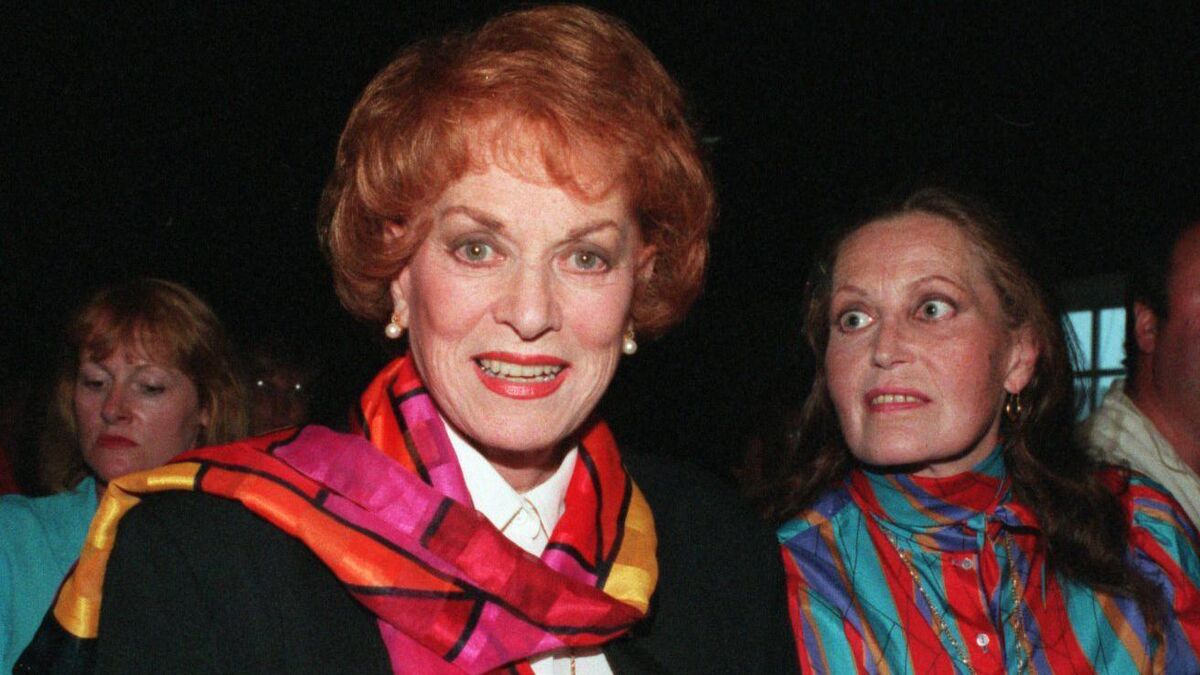
“My grandmother liked Glengarriff so much, and treated it as her home, because the locals treated her like a normal person and not a celebrity,” says FitzSimons. “Even though she came into church on a Sunday with black sunglasses on and a big red scarf and red lipstick, thinking she was ‘incognito’. The locals played along and let her be just a normal part of the village.”
O’Hara’s husband died in a plane crash in 1978 in the Virgin Islands. In another typically gutsy and independent manoeuvre, O’Hara assumed his position as head of Antilles Air Boats, the world’s largest airboat airline. She wanted to prove a point for him, in his memory. It meant O’Hara became the first female president of an airline in the United States, and the appointment wasn’t a formality – she had to be voted in by the company’s board of directors.

She returned to film acting in 1991 in the movie Only the Lonely, playing the Irish mother of John Candy’s character. To get through a love scene in the movie, she drew up a “kissing list” for the movie’s director Chris Columbus of acceptable actors, which resulted in her old cohort Anthony Quinn getting the role.
After a few more insignificant film roles she retired from movie acting a decade later. She was awarded an honorary Oscar in 2014, less than a year before she passed away. An Post commemorated O’Hara earlier this year with a stamp to mark the centenary of her birth. She grew up in Ranelagh, Dublin but, of course, will always be synonymous with West Cork.
“She really embraced life in Glengarriff,” says Reddin. “A friend Donal Deasy, who is interviewed in the documentary, will tell you that she used to go into Casey’s hotel in Glengarriff every Friday night for dinner. She always sat in the same chair and ordered the same thing: for starters, chicken wings and for the main course, scampi and chips. She used to love finger food. When she was eating, she was left alone but when she was finished eating she’d be happy to pose for photographs and have a chat with people.
“The one thing she hated – and this goes back to her old Hollywood training – was that she should never be photographed with a drink in her hand. If she was having a glass of wine with her food or a glass of whiskey that was quickly hidden for the photo. Presumably back in the day in Hollywood, the actors would always have to be very prim and proper.”