Battling the bishops: How Seán Hendrick did his bit for culture in Cork
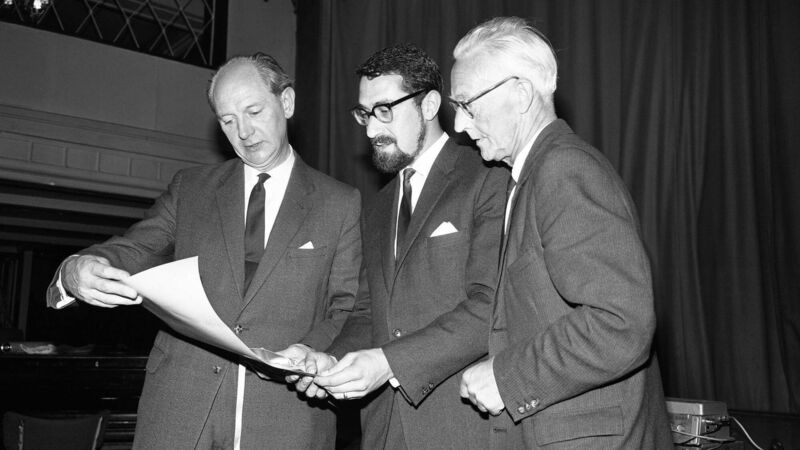
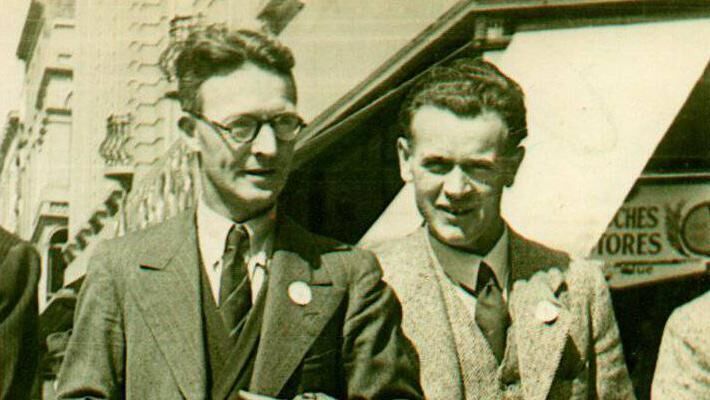
Jack Lynch; Louis Marcus and Sean Hendrick in 1967 at the first showing of Fleá Cheoil at the Metropole Cinema, Dublin. Picture: Lensmen, Irish Photo Archive
“An end to the society if we oppose his Lordship and an end to it if we don’t.”
Such was the dilemma facing Seán Hendrick, chairman of the Cork branch of the Irish Film Society, over attempts by Bishop of Cork Cornelius Lucey to prohibit the showing of risqué American movie Baby Doll.
The 1956 Elia Kazan film, based on Tennessee Williams’ text, had been rated ‘C’ for ‘condemned’ by US Catholic body the National Legion of Decency, and denounced from the pulpit by New York’s Cardinal Spellman. The film was banned in Ireland, but as a members-only organisation with private screenings, the Cork Film Society was not, officially, subject to such censorship.
When Bishop Lucey got wind of its inclusion on the society’s 1960 programme, however, he demanded its removal. Seán Hendrick stood his ground.
In a letter to his friend, Cork-born filmmaker Louis Marcus, Hendrick wrote that complying with the bishop’s orders “would mean that all future programmes would have to be compiled from the innocuous section of the National Legion of Decency lists, or else submitted for his imprimatur”.
Hendrick’s verdict, faced with such an appalling vista, was that it was “best to go ‘with a bang, not a whimper’. Ten years’ work down the drain,” he told Marcus, anticipating the society’s imminent liquidation if the showing went ahead.
For Hendrick though, this was a matter of principle. “The worth or the worthlessness of Baby Doll’ is not the issue,” he insisted. “The real issue to me is that mature, thoughtful people whose work and aims are worthy of support are to be denounced and treated as naughty children.”
As events unfolded, the bishop’s next move was to instruct the Pavilion cinema, where Baby Doll was to have been shown, to cancel the screening. It was something of a pyrrhic victory, however.
The bishop’s authoritarian approach had the effect of swinging opinion against him at a heated general meeting of the film society, which passed motions objecting to the bishop’s intrusion into its affairs and expressing full confidence in the society’s committee.
“It is doubtful if any comparable motion had been passed criticising a bishop for a very long time,” said Marcus, reflecting 60 years later on the impact of the incident. “In 1969, Bishop Lucey instructed the Cork International Film Festival not to show an Ardmore Studios-made film, I Can’t I Can’t. His demand was ignored.”
It was self-censorship that sparked Hendrick’s resignation in 1968 from the executive council of the Cork International Film Festival.
The council had, by majority decision, banned Russian entries to the festival in response to the country’s invasion of Czechoslovakia.
Hendrick resigned in protest at the ban, claiming the festival’s council had no business “fishing in the muddy waters of power politics”.
“Nobody condones what the Russians did,” he stressed, but to Hendrick, the bigger picture was maintaining the festival’s artistic freedom by accepting quality entries from every quarter. As a film council, he said, “if we allow our reactions to dictate our policy we will get nowhere”.
Front and centre of battles over screen censorship through his involvement in both film society and festival, Hendrick had been equally opposed to the literary prohibitions rife in the early years of the State.
He was a close friend of writers Frank O’Connor and Seán O’Faoláin, both of whom had works banned, and especially of sculptor Séamus Murphy, who dedicated his book Stone Mad to Hendrick following his instrumental role in its creation.
Murphy remarked that O’Connor and Ó Faoláin were “named in the pulpit for writing ‘dirty’ books about their own”. What Murphy referred to as the “puritan mentality” of Catholic Ireland in the “terrible 30s and early 40s” had prompted O’Connor, Ó Faoláin, and Hendrick to voice their opposition to the 1942 banning by the Censorship of Publications Board of The Tailor and Ansty for its “indecent” earthy depiction of rural life.
The trio had, wrote Murphy in the Irish Times following Hendrick’s death in 1971, “said their piece…when three priests came to the Tailor’s house and made the old couple burn the book that their friend Eric Cross had written about them. They spoke out in public and tried to defend the book when Mr de Valera’s government condemned it”.
Tim Buckley the tailor and his wife Anastasia were well known to Hendrick, who as a pivotal member of a Cork-based group of artists, intellectuals, and free-thinkers was a regular visitor to storytelling sessions at their home and the nearby Cronin’s Hotel in Gougane Barra.
Confronting censorship was but one of the principled stances taken by Hendrick during a lifetime of outspoken advocacy on behalf of all things Cork and cultural.
“From the 1930s to the 1960s the fight against obscurantism, censorship and clericalism – virtually interchangeable terms – had to be waged at local as well as national level,” he said.
“Seán Hendrick fought that good and heroic fight in Cork against a philistine bourgeois society and a clerical establishment that were relatively much more powerful than in Dublin.”
Born in 1900, Hendrick’s deep appreciation of the arts in every form had its foundations in the cultural nationalism propounded by the likes of Daniel Corkery, author of The Hidden Ireland.
Louis Marcus, who as a young film-maker became part of the liberal-minded “underground cell” where Hendrick & Co held court, said: “Corkery discovered and mentored a quartet who went on to enrich Irish art and cultural life - writers Frank O’Connor and Seán O’Faoláin, sculptor Séamus Murphy, and Seán Hendrick, lifelong friend of all three.
“Corkery opened their minds to a world of literature, art, and ideas. O’Connor and O’Faoláin later came to reject him as his view of an Irish Ireland narrowed, but his earlier hopes for the cultured and open quality of an independent Ireland remained Seán Hendrick’s key ideal.”
Active on the Republican side during the Civil War, Hendrick had been involved alongside O’Connor and Erskine Childers in the propaganda battle, producing anti-Treaty newspaper Poblacht na hÉireann. O’Connor, is his autobiographical An Only Child, detailed at length their activities, including hiding out near Baile Mhúirne, where Childers’ portable printing press was concealed. He recalled how, shortly before his execution by firing squad in 1922, Childers foresaw his imminent demise and “gave Hendrick instructions about what to do with all his papers if he was killed”.
With O’Faoláin and O’Connor, Hendrick had, according to Marcus, “looked forward to a really culturally vibrant Ireland on independence - and they were all shatteringly disappointed”.
Unlike O’Connor and O’Faoláin, who left the city of their birth, “Seán remained in Cork and fought always the good fight,” said Marcus.
While politically he had flirtations with Fianna Fáil and Aiséirí, and opposed Ireland’s entry into the Common Market in the years before his death in 1971, culturally “he was behind every good thing that was happening,” Marcus added.
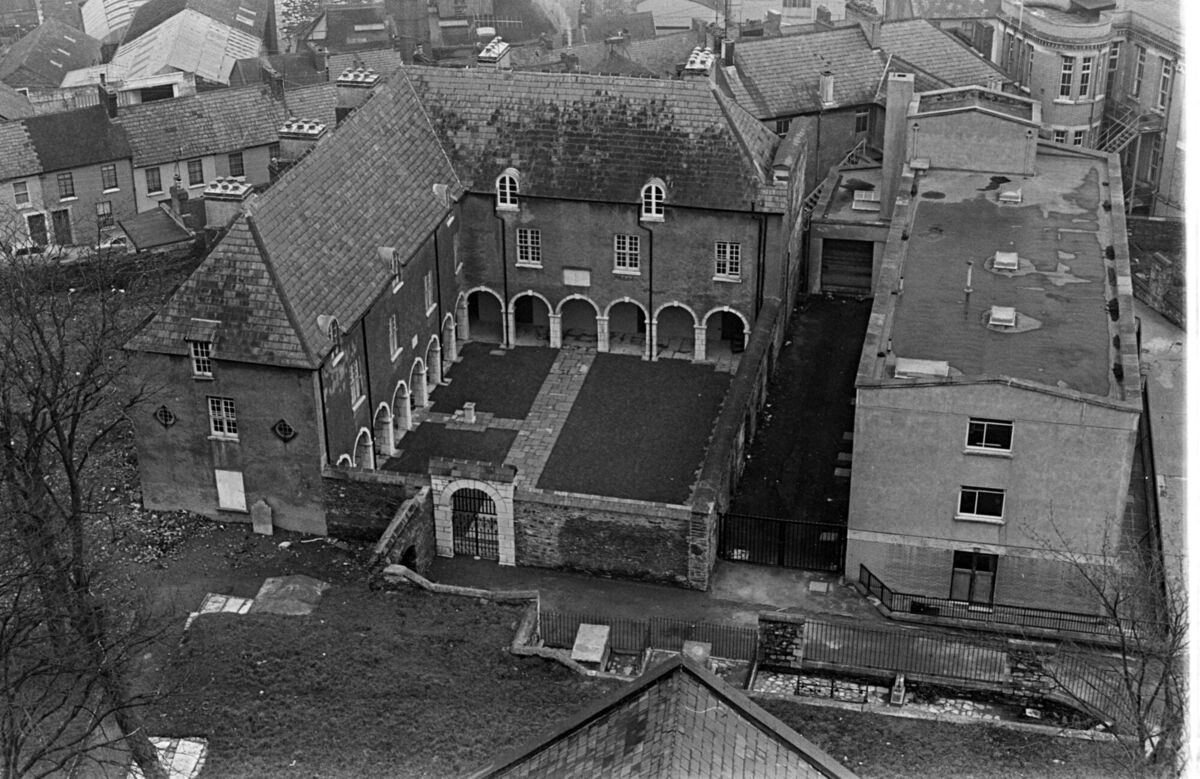
“He was on the first committee of the film festival, the committee of the choral festival, the film society, orchestral society, he was the stage manager for the ballet company. He was behind the sculpture park in Fitzgerald Park. He helped to restore Skiddy’s Almshouse - there was nothing of value going on in Cork that Seán wasn’t behind.”
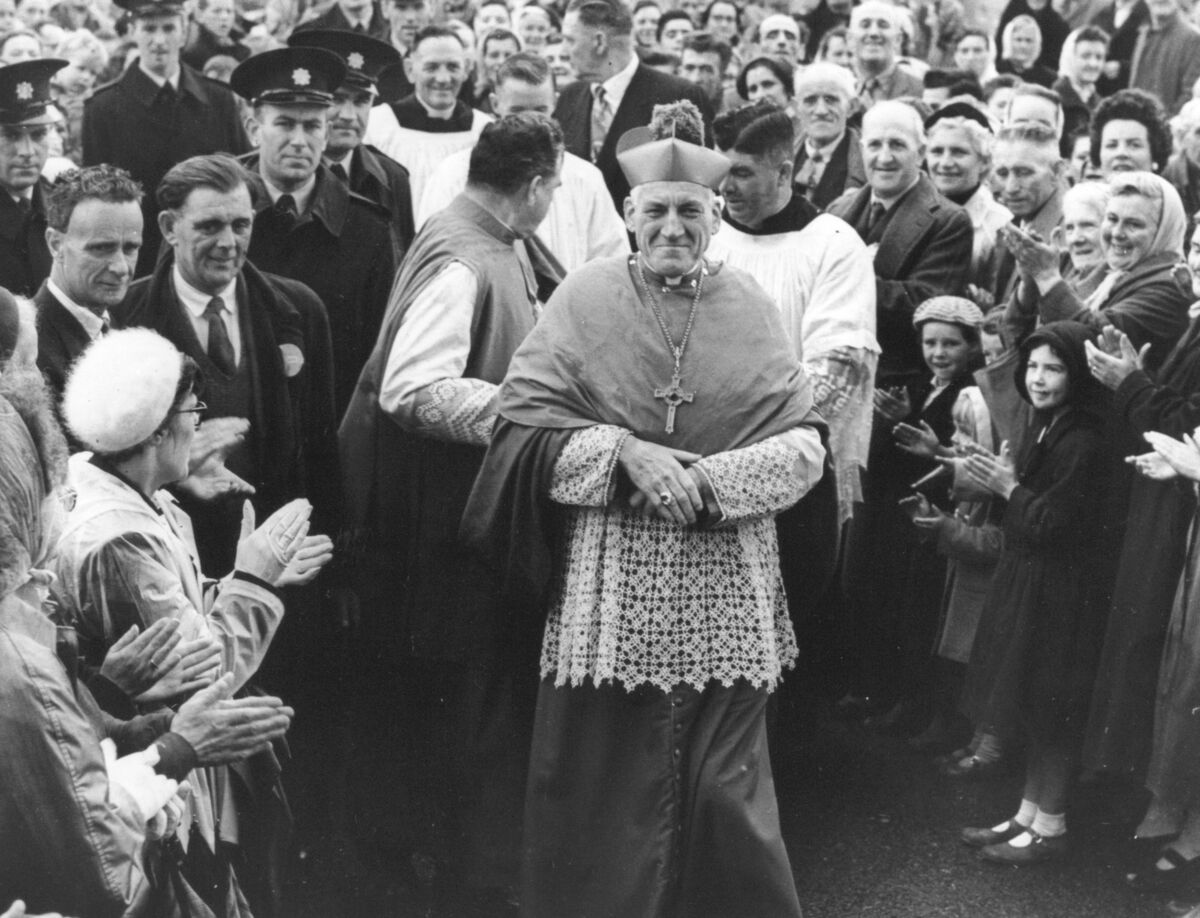
The youngest of eight, Seán Hendrick was born in Strawberry Hill Lane, Sunday’s Well, in 1900. “His father made the staves for brewery barrels but during the First World War that trade was gone because the timber went to make the trenches, so his father was out of a job, and they were very badly off.
“He went to the North Monastery School and he was educated to second level. There was no question of further education.”
“He was born within half a mile of Frank O’Connor and they were introduced by Corkery, a teacher in the local national school, St Patrick’s Boys’ School. Corkery suggested that he should meet John Hendrick, as my father was known in those days, and perhaps set up some sort of literary society.
"My father was interested in literature and poetry - though I don’t think he had access to a great deal of books in those days. Frank O’Connor was a very volatile, impulsive person and my father was the direct opposite. Perhaps Corkery thought that Dad would have a calming influence on Michael O’Donovan [O’Connor], as he was then, and perhaps direct him in his thinking.
“Frank O’Connor fell out with [Corkery] but my father did visit Corkery in his later years. I got the impression that their thinking had evolved beyond Corkery’s thinking.”
“He and Frank O’Connor were both running around West Cork hiding the printing press and minding Erskine Childers. They were Childers’ secretaries.
“One of my strongest childhood memories is of the sound of the tap-tap of the old Remington coming from our front room, which contained his huge bookcase, typewriter, and one framed photograph on our mantelpiece of Erskine Childers.
“I think he revered Childers’ idealism, intellect, and character above all the activists, rebels, and political figures of his time. Like Childers, he had his principles and he stuck to them come hell or high water.”
“He felt that anything Dublin could do, Cork could do equally well. He was a Corkonian through and through and his cultural activities grew out of that.
“He was involved [founder member, 1927] with the Cork Drama League, with Frank O’Connor and Nancy McCarthy. He was involved with Cork Orchestral Society. He was a great classical music fan and because of that he became involved with the Cork Ballet Company’s productions as stage manager when they had shows in the Opera House with Joan Denise Moriarty and Aloys Fleischmann, the conductor of the Cork Symphony Orchestra. He was also involved for a while with the Cork Choral Festival.
“For the Cork Sculpture Park [Fitzgerald Park], they gathered works from prominent sculptors, first of all for an outdoor exhibition centred around Séamus Murphy’s sculpture of the Virgin of the Twilight and his bust of Michael Collins.
“Anything to do with Cork and the cultural life of Cork, he thought that was worthwhile, and anyone who showed any interest or helped in any way, he respected those people and tried to involve them, even though on other subjects he might have disagreed totally with them.”
Séan Hendrick and his lifelong friend, sculptor Séamus Murphy, were, according to Professor John A Murphy, the “respected senior counsel rather than presiding judges” of the group of independent thinkers who held court several times a week in MacCurtain St hostelries of the 1950s and 60s.
The pair “were the grey eminences of the gathering”, he added. “They had influenced successive Cork artists and intellectuals not simply because of their literary and artistic good sense but because both possessed in high degree a moral integrity and a flinty independence of intellect”.
Holding equal weight in these discussions were Murphy’s wife Maigread, daughter of sculptor Joseph Higgins, and chemist Nancy McCarthy, leading actress in the Cork Drama League. Both, according to Hendrick’s daughter Nuala Wren, “were feminists in the days before the term was invented. They weren’t shrinking violets at all and they weren’t just tolerated; they had their say on everything”.
The group, whose transient membership included poet Seán Ó Ríordáin, gravitated to the Palace cinema bar after earlier residencies at the New Look and Corrigan’s Hotel, also meeting in Séamus and Maigread Murphy’s home in Wellesley Terrace.
“At closing time in The New Look, the main lights would be switched off and the blinds pulled down,” recalled Louis Marcus. “The semi-darkness and the nonconformist views created the feeling of an underground cell. It was serious discussion of the arts, history, ideas, and, most of all, ‘the country’… specifically how the bright hopes of independence had been dashed in the stultifying conservatism of the time.”
Ms Wren, a “fly on the wall” as meetings moved to the homes of group members, said: “It was like being in a different world. If you were quiet you’d be allowed to sit in the corner and listen and I found them so interesting, so out of the ordinary. It’s one of the things that I still miss most about him [Seán], the way he could stimulate your mind and your interest. He was wise in his thinking. He was liberal, open-minded, and tested all other opinions against his own intellect.”
Her father, by day an office worker in the accounts departments of Simcox bakeries and Cork Milling Company, was to the group “a pivotal figure” and “had a lot of satellites moving around him”, she added.