Four-Faced Liar reflects a lot of truths for Cork theatre couple
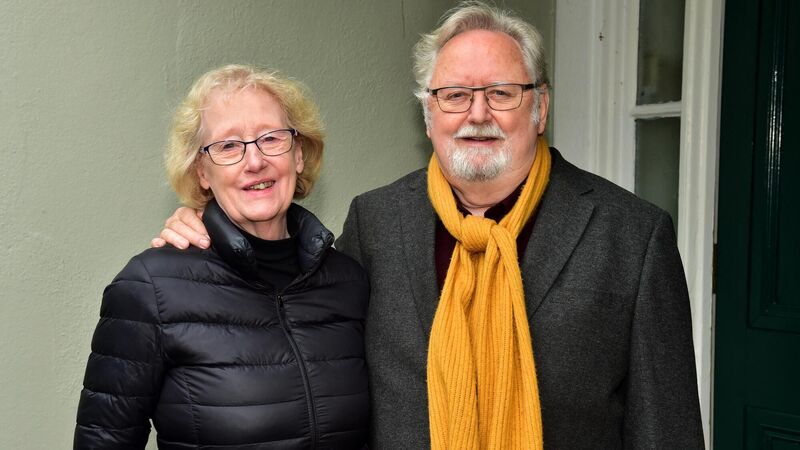
Emilie and Ger Fitzgibbon have collaborated on a new play. Picture: Dan Linehan
They have been stalwarts of the theatrical scene in Cork and beyond for many decades but for Ger and Emilie FitzGibbon, the magic of the stage has never waned. So the husband and wife team’s recent return to a shuttered Everyman theatre in Cork was understandably a significant one.
“It is absolutely a privilege to be even inside a theatre at the moment,” says Ger.
“You should have seen us standing on the stage, looking out into the auditorium, we were so excited,” adds Emilie.
The couple were on stage in the Everyman for a rehearsal of The Four-Faced Liar, written by Ger and directed by Emilie, part of ‘Play It By Ear’, an innovative programme of rehearsed plays, comedy and music transmitted from the Everyman through live audio broadcast.
The ‘play for voices’ features six actors playing a wide range of characters.
Ger says he was delighted to hear his play come to life, but also acknowledges how ‘weird’ it was being back in a theatre under Covid protocols.
“It was the first time hearing voices on it and it was lovely. We are very lucky, the six actors we have are just perfect for it. It is a wee bit strange, though, for the theatre tribe to get together and not be able to hug each other,” he says.
While Ger, who was previously head of theatre and drama at UCC and Emilie, founder and former artistic director of Graffiti youth theatre company, finished up in their the day jobs several years ago, they have not retired from the theatre.
“When you are involved in the theatre business, you are kind of in it all the time anyway, you stay connected,” says Ger. “In Emilie’s case, she is still involved in Youth Theatre Ireland; in mine, I found I have been doing far more writing.”
The Four Faced Liar is a recent piece, inspired by one of Cork city’s most famous landmarks, the bell tower of St Anne’s Church in Shandon; the title refers to the colloquial name given to the different facets of its clocks.
“We had moved back into the city from the country, where we had been living for a few years and it really bore in upon me that we can see Shandon from our bedroom, and it can also be seen from almost every part of the city,” says Ger. “It struck me that if we can see and hear Shandon from all over the city, maybe Shandon steeple can see and hear the city, and could see into our dreams and nightmares, hearts and minds. That was the seed of it.”

He was also inspired by the classic 1954 radio drama, Under Milk Wood, by Dylan Thomas.
“We were into lockdown, I wasn’t sure where theatre was going and I thought I would have a go at doing a play for voices. That gives you enormous liberty, you can go anywhere; with a tiny budget and six actors, we have something like 60 characters, and I don’t know how many locations,” says Ger.
The couple both chuckle when I ask how well they work together. “You’ll have to be diplomatic,” Ger says to his director.
“There would occasionally be a discussion, shall we say, but we work reasonably well together,” says Emilie.
““My director did raise one thorny issue,” interjects Ger. “I think the word ‘edit’ was mentioned.”
“I am still working through the script,” laughs Emilie.
They say they both feel lucky to be just creating work at such a precarious time for the theatre industry and the arts in general.
“It has been such a shock, particularly to the theatre sector,” says Emilie. “The day of rehearsal we had was just life-affirming. We have been missing it in the lockdown, we haven’t been able to do anything really.”
“At the moment, I find myself saying ‘keep the faith’ a lot,” says Ger. “People are really struggling, I think they are struggling even more with the frustration of not being able to make work than anything else. Long-term, as a country, we have to rethink where we position our culture in terms of our priorities. There is great heart within the theatre community, there is a hunger to make work, and people are finding all sorts of ingenious ways of doing that. But you can’t live on that forever. At some point, you have to get an audience in and have paying customers. I think what the Everyman is doing is super, in terms of just keeping a light on in the building — it really has been a lighthouse in the fog.”