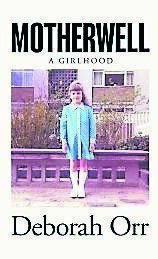
Motherwell: A Girlhood - an unflinching look at a childhood lacking love
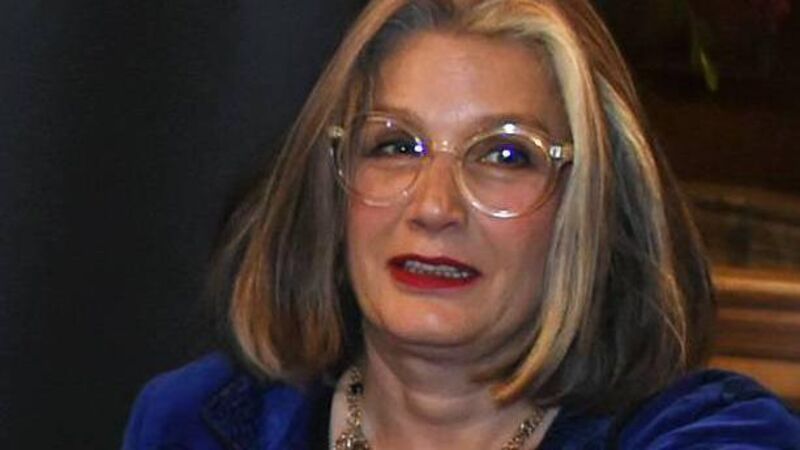
Deborah Orr speaks at An Evening With Vivienne Westwood discussing her new book "Get A Life! The Diaries Of Vivienne Westwood" at St James' Church on October 14, 2016 in London, England. (Photo by David M. Benett/Dave Benett/Getty Images)
- Motherwell: A Girlhood
- Deborah Orr
- W&N, €18.99
Deborah Orr was 15 when she took a 30p bottle of pink pearlized nail varnish from her mother’s bedroom.
When Orr’s mother, Win, noticed the bottle missing, she started shouting at her daughter.
Panicked by Win’s reaction, Orr denied the accusation. Win became enraged: “You’re a liar! You’re a coward! You’re a sneak! Get out of my sight!”
Hours later, Orr confessed. But the shame of this trivial incident endured because it underscored Orr’s sense that she was not good enough.
Throughout her life, if anyone implied that Orr was defective it felt like a knife penetrating a disguised bruise and sounded “like a truth about myself that I want to hide and they can see”.
If Orr’s Motherwell accretes a catalogue of both small and significant childhood hurts, the chemistry of the memoir is the way Orr transforms these wounds by forensically dissecting how they informed her adult behaviour.
Being disliked by her family and treated with little value meant that when people told Orr that she was the problem or she was unlovable, Orr believed them.
As a child, Orr was typically accused of telling lies when she was telling the truth. As an adult, Orr invariably expected to be doubted and compelled to prove her honesty.
Before she was 30, Orr became the first female editor of the Guardian’s Weekend magazine and she later established a reputation – over two decades – as an incisive columnist.
“My childhood,” Orr writes, “was like growing up in a religious cult without the religion”.
The titular Scottish town that was Orr’s home for the first 18 years of her life emerges as claustrophobic and sectarian: John, Orr’s father, expressed his hatred of Catholics by deriding them as “Boghoppers” and “Fenians”.
But in a coal and steel town where conformity was treasured and difference was criticism, Orr’s family didn’t fit in.
Traumatised by the vision of a fellow steelworker’s near-miss from an horrific accident, John lost his nerve – a condition incompatible with the macho culture of Motherwell’s steelworks.
Meanwhile, Win felt excluded because of her nationality: in Motherwell, being English was regarded as a failure to be Scottish.
The family rented a series of council flats in Motherwell and Win’s dream was a “house with a back and front door”.
Orr evokes the period through details like watching the football results broadcast through a telex typing machine, always using lard for frying, and being repeatedly told to “Put that light off”.
Orr’s love-hate relationship with Motherwell is mirrored by her ambivalent relationship with her family.
John and Win were strict disciplinarians who regularly administered punishments and public shamings.
After the 10-year-old Orr cheated at Scrabble, Win made her walk around the town centre with a big badge declaring ‘I am a cheat’.
Orr was a nervous, shy child who loved reading and macramé, and recognised – even from the start – that school was a place to escape her family.
In character and looks, Orr and John were alike. But it’s only in retrospect Orr understands that John’s life was dominated by fear: he internalised the belief that the scarcity in his life corresponded to his self-worth.
Tragically, John was unaware of Orr’s love for him and there’s a searing poignancy when on his deathbed John says of his distraught children to Win: “I never knew how much they loved me.” John’s sense of worthlessness was echoed and amplified in Win.
Their bond was reinforced by an impervious co-dependence and Win wanted her family to both protect her from the world and confirm her preciousness.
Frightened and embittered, defensive and needy, Win – who considered her daughter a rival for John’s love – directed her petty, caustic rages at Orr.
“You must spend a lot of time thinking about ways to humiliate us,” Win interrupted her daughter during a phone call after Orr’s honeymoon.
Win’s outburst was provoked by Orr writing “semi-skilled labourer” as John’s occupation on the marriage certificate that Win collected for Orr from the registry office.
Orr’s attempts to explain that she didn’t know what to write on the certificate received an unsympathetic response from a furious Win: “Lies. You’re a liar…Why do you never stop lying to us?” The anxieties in Orr and Win’s relationship partly stemmed from a persistent dichotomy: Orr wanted to both defy Win and secure Win’s approval.
But the primary strain was more fundamental: Win couldn’t accept that her daughter was a separate person and Win wanted to keep Orr with her “in the same way as she wanted to keep her arm with her”.
The tone of the book shifts when Orr moves to university.
Conflicting generational mores exacerbated pronounced tensions: John and Win grew up in a prudish, sexually repressed culture while Orr came of age in an era when women having sex before marriage became more widely accepted.
Orr claims that John and Win never forgave her for defying them (“Your father and I forbid you from going away to university”) by leaving home before she was married.
With an unflinching candour, Orr charts, in her college years, her experiences of rape and physically abusive relationships.
The devastation is enhanced by Orr’s later realisation that her sense of powerlessness – founded on her parents’ belief that she failed to become who they wanted her to be – established a destructive pattern that repeated itself in the poisonous intimate relationships that Orr pursued.
Orr’s 21-year marriage to the English novelist Will Self ended in 2018.
Never named, Self is glanced only fleetingly.
Orr recalls the scandal of Self’s admission of taking heroin on the private plane of the-then prime minister John Major while Self was working for the company that employed Orr, but only in the context of her fraught relationship with Win – and then with blistering succinctness.
“I myself married in large part to console Win,” Orr writes. “Neither the marriage nor the attempt at consolation worked.” Orr writes in an understated, conversational style and, despite her story’s severity, uses a quiet, frequently humorous palette.
But Orr’s occasional introduction of psychological theories, such as drama triangles, to account for her family’s dynamics jars as it pulls us away from the intimacy of Orr’s narrative.
After the death of her parents and the breakup of her marriage, Orr was diagnosed with complex post-traumatic disorder. The symptoms of the condition – including panic attacks and obsessive rumination – present themselves only after you stop repressing your emotions.
In Motherwell, Orr shows us how her undimmed love of her parents overlapped with her relentless attempts to persuade them that she was worthy of their love.
Yet even Orr’s brittle assertion that it was her relationship with Win that was defective – rather than either of them – is tempered by crippling uncertainty.
“Part of me knew it,” Orr writes of her 15-year-old self, “but the most vulnerable part of me never did and maybe never will.”
Shortly before Motherwell’s publication, Orr died of breast cancer.