Weekend Books: Bolton pulls his punches in tell-all book on Trump
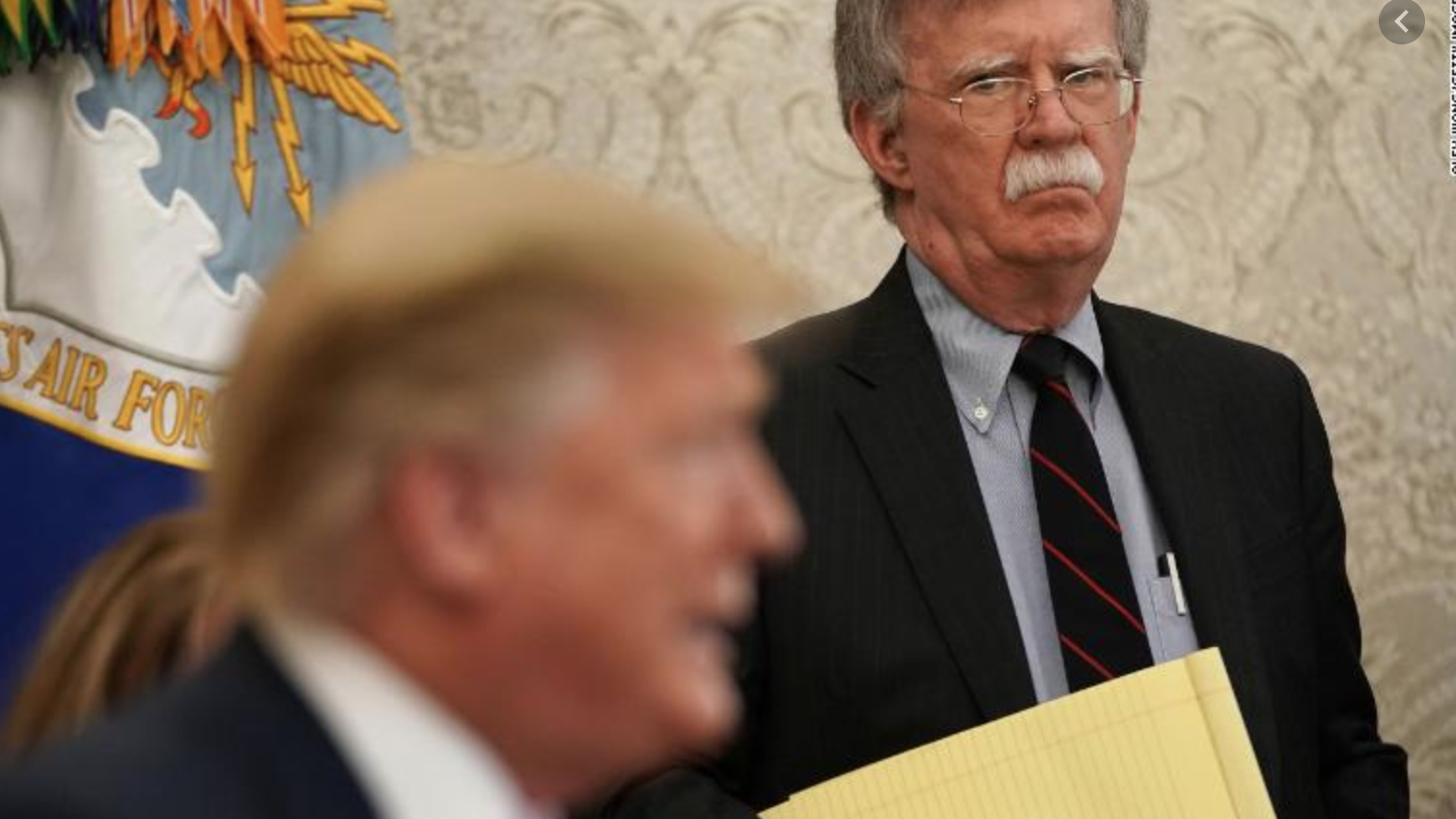
Former national security adviser John Bolton in the Oval Office of the White House in Washington with US president Donald Trump in the foreground. Picture: AP
THOSE who see Donald Trump as a war-craving menace will be disappointed by The Room Where It Happened, the dyspeptic tell-all by his former National Security Advisor, John Bolton.
What comes across instead in this memoir – currently number one on the New York Times non-fiction best seller lists -- is a portrait of a U.S. president who is far too feckless and vacillating for any proper dictator to take seriously, much less fear.
As seen by Bolton, a former assistant attorney general under Ronald Reagan, ambassador to the United Nations under George W. Bush, staunch conservative, and self-described “Americanist,” the problem with Trump is that he has no brimstone and no backbone either.
Bolton clearly scorns Trump as an attention-seeking egomaniac exhibiting far more randomness and whimsy than focus or coherence when it comes to prosecuting international affairs. A bellicose figure, John Bolton lasted but 17 months (April 2018-September 2019) before being forced out, his failure partially in being a loose cannon, even if at times correctly so in warning Trump that he was constantly confusing his personal interests with those of his nation at large.
Bolton’s tenure covered the U.S. withdrawal from the controversial nuclear deal with Iran, the North Korean nuclear proliferation crisis, the trade wars with China, and American meddling with the chaos in Venezuela.
He also enjoyed an insider’s view on Trump’s lurches and about-faces regarding American disengagement from Syria, Iraq, Afghanistan, and Africa – “Why are we in Africa?” Trump shouted in many meetings. And then there were wild threats concerning leaving NATO and South Korea. There are big chunks of history to contemplate within these 577 pages.
The Room Where It Happened is often intriguing yet somehow also constantly irksome. At times it veers almost to the comic.
In any number of important settings, beginning in the White House itself, we find Trump stunning his advisers and fellow heads of state by constantly blurting out whatever fantastical thing comes into his head. To a room full of European leaders in Brussels in April 2018, he blurts out that NATO’s lavish new headquarters was a colossal waste of mainly American money and could be taken down by a single Russian tank.
Still, Trump insisted that he is behind NATO “a thousand million percent.” Trump then turned to Angela Merkel, demanded that Germany pay perhaps billions more for European defence and insinuated that she was a lackey of Russia, before finally turning to kiss her on both cheeks. “I love Angela,” he declared.
Time and again, the American president muddles crucial negotiations with weird free-associations and malapropisms in the manner of Peter Sellers as Chauncey Gardner in Being There. Or for that matter in the hilarious Doctor Strangelove. Bolton cites this astonishing tweet from the American president in April 2019:
After some very important meetings, including my meeting with President Xi of China, I will be leaving Japan for South Korea (with President Moon). While there, if Chairman Kim of North Korea sees this, I would meet him at the Border/DMZ just to shake his hand and say Hello(?)!
It just happens that Trump is talking of the leader of one of the most oppressive regimes on the planet, yesterday’s “Rocket Man” who had been furiously shooting prototype nuclear ICBMs – not tweets - over Japan and threatening to obliterate the United States. On August 1, Trump went even wackier:
Chairman Kim has a great and beautiful vision for his country, and only the United States, with me as President, can make that vision come true. He will do the right thing because he is far too smart not to, and he does not want to disappoint his friend, President Trump!
Calling Peter Sellers, please. Of course Cork had a taste of this very medicine in 1985 by electing Bernie Murphy, an endearing but illiterate sandwich board salesman as a City Councillor, which position he used to lead the fabled St. Patrick’s Day Parade in San Francisco and to generally pontificate for Ireland while awaiting free dentures in the City by the Bay.

But John Bolton was not amused by Donald Trump. And as his boss began to sour on him, the national security advisor took notes, lots of notes, in preparation for settling scores.
A central flaw of his book that it is really about one person foremost and his name is not Donald but John, the fluent but fraught author. Every person who ever stood in Bolton’s way toward becoming the next Kissinger gets taken down, some for 100 pages in a row.
His worst sniping is conducted against James Mattis, the former U.S. Marine general who served as Secretary of Defence from January 2017 to January 2019. His high crime was to attempt to thwart Trump and Bolton’s frantic push to renege against Obama’s deal with the Supreme Ayatollah, with the agreement that attempted to at least slow bellicose Iran’s drive to become a nuclear power.
The thorny issues there, including the cravenness of the Obama-Kerry deal are discussed with thoroughness and insight.
Bolton’s roving finger of recrimination next turns to Steven Mnuchin, the U.S. Secretary of the Treasury, and he is accused over and over again of being a secret Democrat, worm-like globalist and way too close to Jared Kushner, Trump’s oleaginous son-in-law – see page 412,. “Mnuchin apparently never saw a negotiation where he couldn’t make enough concessions to clinch a deal.” European leaders are in for many swipes as well, especially the scheming French President Emmanuel Macron, about whom Trump said to Bolton, “Everything he touches turns to shit.”
In the last quarter of the book, Bolton turns his daily kicking to his former chief ally, Mike Pompeo, the C.I.A. director now the U.S. Secretary of State. One does get the impression, just as Trump alleged, that The Room Where It Happened is yet another tale by a disgruntled employee seeking retribution.
Along the way Bolton betrays the confidences of one head of state after another among America’s closest allies, likely jeopardizing future international trust and cooperation – quite an act of love of country by the so-called “Americanist.”
This book’s biggest flaw is that it neither begins nor ends with any coherent description of Bolton’s own vision and philosophy about the state of the world and what guiding principles must be rekindled now – which is exactly what he finds so lacking in the ever rash and impulsive boss who got rid of him. Don’t bet on things being better under Biden either – he won’t even speak about foreign policy at this point. A sad situation for all.