Secret Diary of an Irish Teacher: lauding the work of women
“I'm not letting that get anywhere near my nan,” blurts an emotional Dave. We’re discussing coronavirus in class.

Secret Diary of an Irish Teacher: lauding the work of women

“I'm not letting that get anywhere near my nan,” blurts an emotional Dave. We’re discussing coronavirus in class.

As it happens, I hear about Dave’s nan quite often. “She always wants me to dance with her when she’d had a drop of brandy,” he confesses. He visits her for a cup of tea a few times a week; she looked after him as a baby and he’d walk to and from her house from primary school.

Many of us grow up under the watchful eye of such women. For me, it was my grandaunt. She cared for my own mum and her two young sisters when both their parents died.

What a woman. To take on and in three young girls after such tragedy. To fill the void around them through those trying teenage years. I can only grasp the feat of it now I’m a mother of three myself. How different her life must have become overnight. Incidentally, she took on my grandparents’ business too. It helped that she was so capable. I remember her discussing politics and economics with my dad, still predominately “men’s talk” back then.

When my grandparents died, we became hers in a way. We spent weeks in that house, amidst her sonorous grandfather clock, an odd-looking marble bust on a marble table, and her huge CS Lewis-sized wardrobes. I leaf through her journal now, erudite discussions in an elegant hand. At the back is a scrawl of family names — mine, my cousins — her solitary efforts to remember our three families in her final years.

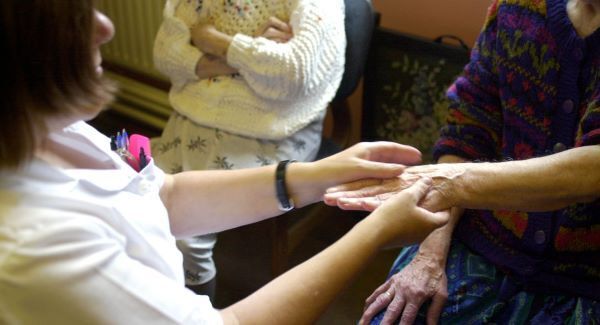
Being a teacher keeps you in touch with these women: single mums, mums of children with disabilities, fighting the system for recognition. I meet wonderful fathers too, but most unpaid caring is still done by women. Inside the home and beyond it. Globally, women perform 76.2% of total hours of unpaid care work, more than three times as much as men. In Asia and the Pacific, this rises to 80%.

We all know that such caring is tough. I won’t go into that here, but I sometimes worry that we’ve feminised it. This viewpoint simultaneously reduces our recognition of it. A single mum is a common story. Countless times, women have marvelled at my husband’s ability to make a cake or to organise a children’s party. If I did the same, it wouldn’t get a mention. Or it might, but with an underlying lack of surprise or wonder. Caring is still perceived as being intrinsic to a woman’s nature and so, it doesn’t require the same fervour or adulation. There are countless women, as you read this article, caring for children or for their elderly parents.

They are quietly managing the bodily functions of our most dependent citizens.

Paid caring is also the domain of women. According to the most recent study by the CSO, 76% of graduates in Health and welfare are women. On their last count they recorded that 87% of primary teachers and 71% of secondary teachers are female. Feminism is about equality and boys have very specific needs of their own. Chiefly, they need positive male role-models. Particularly, when they far too often lack one at home. According to various studies, boys are sometimes seen by female teachers as troublesome. A recent Irish study co-authored by Prof Dympna Devine of University College Dublin found that teachers characterised girls as “obedient, mature and quiet” as compared to “boisterous, energetic, noisy and competitive” boys. Boys still trail girls academically; it’s little wonder.

In a school setting the ‘watchful eye’ of a good woman is often that of the secretary. It’s certainly the case in my school. She’s the one you’ll have a cry with; she’s the one who knows exactly how to approach each individual parent; she ties the whole school community together in an elaborate, intricately wound bow that nobody dares unpick — we wouldn’t know where to start.

Only a minority of school secretaries, almost exclusively women, get paid by the department of education, with most being employed by the school’s board of management. This means that they have no pension and an annual salary of less than €13,000. These are the women in charge of the school system, the wages and the budgets, but they’re also the ones tending to various scratches on knees and bruises on egos. Walk past any secretary’s office and you’re bound to find a child, like a bird with a broken wing, perched on a chair outside. Or a staff member, behind the glass, discussing some professional or personal injury. The school office is the hub, the heart, of our school communities. But the conditions of these women’s work don’t reflect that.

This weekend as we celebrate International Women’s Day, I intend to raise a glass to everyday women, women whose quotidian priority is to look after others — women who won’t get gongs of recognition, who might not even get a pension.

In October 1975, 90% of Iceland’s women went on strike, to highlight the low value we place on women’s work, inside and beyond the home. I’m not sure we’re ready for that here. I’m not sure we ever will be. But this week we can laud these women and, like Dave, acknowledge how vital, how precious they are, to who we are, and to who we eventually become.

x

More in this section

Cookie Policy Privacy Policy Brand Safety FAQ Help Contact Us Terms and Conditions

© Examiner Echo Group Limited













