Cork artist OisIn Burke's exhibition to open in Waterford
SCULPTORS Often seem to have a love-hate relationship with the pieces they create.
Perhaps it’s because 3D is physically intrusive; a painter can always throw a sheet over a two-dimensional artwork that they’re tired of looking at, but a sculptor is dogged by the presence of the objects they’ve created.
Or so Oisín Burke explains, while describing his own paradoxical relationship with his sculptures.
“I hate it and I love it at the same time,” Burke says with a rueful smile. “It kills me sometimes. You build a relationship with your pieces, you really do. It’s not quite an affair but it’s a deep, completely tactile relationship.
“I can’t wait for them to leave the studio, but then there’s part of me that finds it really difficult to come in and not look at these things I’ve been working on for months anymore. It will be weird when they’re gone, but I can move on and start fresh and see where it brings me.”
Burke has reached the lonely phase of one such cycle; after months of work, his most recent series of sculptures is being packed up and sent to Waterford from his Cork studio. The exhibition, When The Wind Blows, will be held in Waterford’s Gallery of Modern Art (GOMA), part of a collaborative series between the gallery and the Backwater Artists Studio in Cork, which is currently celebrating its 30th anniversary.
Burke, a Dubliner who relocated to Cork for his studies, has been based in the Backwater Studios for the past year, having graduated from CIT Crawford College of Art and Design in 2018.
He had worked in graphic design for an educational publishing company in Dublin before being offered a voluntary redundancy, he explains. “I jumped at the opportunity, because I had been there for 13 years,” he says. “Before that, I had family members who were quite ill and it stopped me pursuing other things, but I was constantly doing night-courses in art all the time I was working there.”
His early interest in art was discouraged in secondary school on the basis of its perceived impracticality, he says: “I was put off in third year and told there was no work in art and ended up doing a course in accountancy. But when I finished up my job, I went to a careers guidance specialist and did all these tests and everything pointed towards art.”
The irony of having been pushed towards accountancy, an area once considered sure-fire employment but made increasingly obsolete by automation, and away from a creative career, which, it is now realised, is one of the very few areas immunised against technological disruption of jobs, is not lost on Burke.
“I watched a TED talk where the guy was saying that in 30 years there will be 700 million jobs obsolete around the world because of automation, and the only thing you can’t reproduce is creativity,” he says. “So maybe I’m just 30 years too early.”
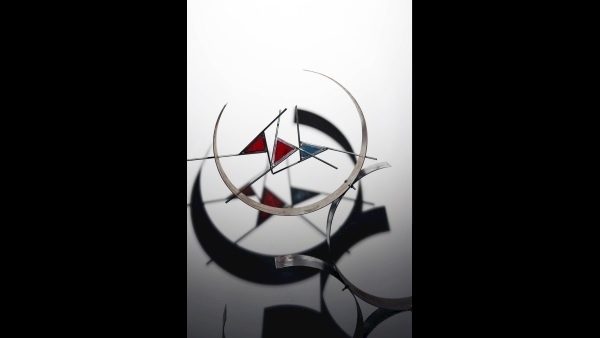
Concerns of industrialisation and our changing landscapes infuse Burke’s sculptural work. For this most recent cycle, executed in welded steel, glass and accompanying stitched canvas blueprints, Burke was inspired by a new word he happened upon.
‘Solastalgia’ is a neologism that describes a form of emotional or existential distress caused by environmental change, a “violation of your sense of space”, according to the man who coined the term, Australian philosopher Glenn Albrecht.
In an era of seeming environmental catastrophe, Burke thinks it’s an increasingly important phenomenon of the human psyche.
“I think I’m trying to bring that into my own work, that sense of how our space is affected by how you feel,” he says.
“I’m using stainless steel to bring this uncomfortable, industrial sense of something manufactured. I allow rust to form on some of the pieces, and then work into it with patinas. I’m also using stained glass: there’s something there about the fragility of glass.”

CONNECT WITH US TODAY



Be the first to know the latest news and updates









