Appliance of Science: Could humans copy insects' ability to walk upside-down?
Dr Naomi Lavelle explores some questions about walking upside-down

Appliance of Science: Could humans copy insects' ability to walk upside-down?

Dr Naomi Lavelle explores some questions about walking upside-down

How can some insects walk upside-down?

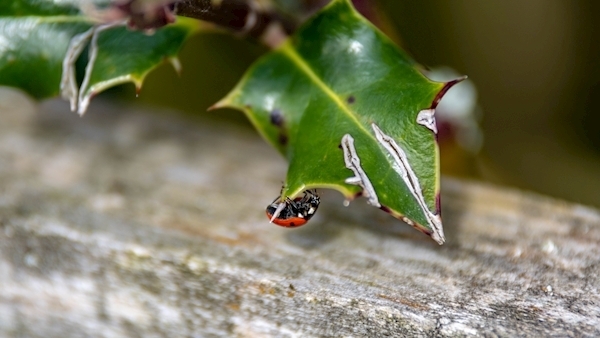
Some creatures, including many insects, seem to have evolved the gravity defying ability to walk up and down smooth surfaces and even walk upside-down but how do they do it and could humans copy them?

How smooth is smooth?

Before looking at how insects can walk on smooth surfaces, such as glass, it is worth first examining the surfaces themselves. They may look completely smooth but, when viewed using electron microscopic imaging, they are not as smooth as they appear. They actually contain a number of bumps, grooves and irregularities in the surfaces which can aid the insects’ grip.

Sticky footpads

Insects and other gravity-defying creatures have special pads on their feet to increase their contact with the surfaces they scale. Insects have two of these pads on the ends of each of their feet, called pulvilli pads. They are flat and broad.

Splitting hairs

The pulvilli pads are covered in tiny hairs called setae. These setae are hollow and curved at the top, which led scientists to initially think they helped the fly grip the surface, like tiny hooks. Spiders and geckos have setae on their foot pads too and it is know that their setae actually form weak bonds with the surfaces on which they climb. These weak bonds are called Van Der Waal bonds and are miniscule in magnitude. However, when the forces between setae and surface are combined they create a force large enough to suspend the creature in an upside-down position. The force generated by the gecko as it hangs upside-down on a glass surface could actually hold 100 times its body weight.

It’s a sticky subject

Due to these strong combined forces, geckos use dry-adhesion to stick to the surfaces they scale. Insects however appear to rely on wet adhesion too. They secrete a substance through the hollow setae that creates a film between the pulvilli pads and the surface. This liquid is composed of special sugars and oils and may act as a natural glue, helping to stick the insect to the surface it is climbing. The substance may help in a more indirect way through something called capillary adhesion; the same principle that applies when a glass with a wet base sticks to a smooth surface. Other studies actually suggest that this liquid layer is not there to help to stick the insect to the surface, but rather to help it unstick itself.

The unsticking

Insects have two claws at the end of each foot, as well as the pulvilli pads. It is thought that these claws play a part in unsticking the foot once it is time to move on. The claws likely push against the surface, thereby helping to release the pads and leave the insect-free to move its foot.

What about humans?

So could humans ever create the technology to mimic this gravity-defying movement? Although some advances have been made in this area (a person has managed to scale part of a vertical glass wall using special, gecko-inspired pads) the possibility of a general application is unlikely. It is all down to something called the surface to volume ration. We humans would need to cover at least 40 per cent of our bodies in suitable sticky pads to achieve the same as the gecko.

More in this section

Cookie Policy Privacy Policy Brand Safety FAQ Help Contact Us Terms and Conditions

© Examiner Echo Group Limited













