Bruce Springsteen's Western Stars documentary more than just a music film
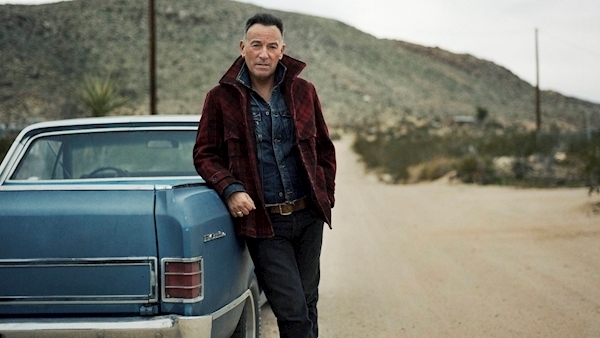
It’s the personal stories from Bruce Springsteen that turn his new ‘Western Stars’ documentary into something special, the director tells
In one of many intimate moments in his new film Western Stars, Bruce Springsteen confesses that for many years, he would hurt the ones he loved.
“How do you change yourself?” he reflects.
“The older you get, the heavier that baggage comes that you haven’t sorted through. So you run. And I’ve done a lot of that kind of running.”
Later, he adds: “I’ve spent 35 years trying to let go of the destructive parts of my character. And I still have days when I struggle with it.”
A concert movie but so much more, Western Stars sees Springsteen making his directorial debut,performing songs from his most recent album.
He does so with a 30-piece orchestra, in a barn on the grounds of his family ranch in New Jersey. But it is the personal short stories between the songs that really set it apart.
For co-director and longtime collaborator Thom Zimny, they came as a surprise — and a reminder to expect the unexpected when it comes to The Boss.
“The passages between the songs was something I’d never planned for, never knew we were going to have,” he says.
“That’s the exciting part of working with Bruce — one day he gave me a call and said: ‘I wrote a script. I wrote a script for our movie’.
"Our movie at that point was just a concert film. Now all of a sudden everything would change. There’ll be scripting and voiceover. And when you hear those voiceover pieces, you realise that he’s being very honest in he tone and musicality in his voice."
As he listened to what he calls “the tone poems” being recorded, Zimny, whose background before directing was in editing, knew they would form the backbone of the film.
“The first time I heard the spoken pieces between the songs I was really deeply moved and connected to them. I took that feeling and brought it to the cutting room where I knew as a film director that I had something very special.
It seems to me that the one thing that is guaranteed in working with Bruce is not to expect an understanding of what the film will become or is about. And I returned to the idea: be prepared. Get ready for something different. Spontaneous. Because with Bruce, you never know what’s going to happen.
Zimny’s relationship with Springsteen spans two decades, since the two men first met when he was asked to be on editor on his concert film, Live in New York. In the years since he has edited and directed many of the star’s music videos and last year won an Emmy for his directorial work on Springsteen on Broadway.
As a young man who grew uplistening to his music in New Jersey, getting to work with him for the first time was a dream come true — but he quickly realised he had to rise to it. “I immediately went into a place of what does the film need and really put the fan part of me aside. I knew I had a great challenge, which was how to cut the E Street Band and how to present that concert.”
Using the album as his inspiration on Western Stars, Zimny set about capturing visual images — of galloping horses and big skies — to accompany the passages. They were shot in the Joshua Tree desert in California. “I am a lover of cinema that is big and expansive, the light of colourwesterns and the textures of the hot sun in the desert.
“They were themselves the qualities the album evoke. All kinds of references in my mind that really become a shorthand in the cutting room, in terms of discussing what you put up on screen. You find yourself in this space listening to lush strings and closing your eyes and visuals come to mind.”
It didn’t come as a surprise to the filmmaker that Springsteen, in his directorial debut, was a true creative collaborator. That cinematic quality has always been there in his songs, he says.

“He brings an understanding of the power of editing, of a narrative arc. He has an amazing visual quality. He understands the beauty of composition. This is what Ienjoyed the most of the collaboration, because when you think about Bruce Springsteen, who created ‘Born to Run’, yourealise that this man does have acinematic sense.
“The solo in ‘Jungleland’ is a sonic landscape that’s pure cinema. Bruce brings a tremendous amount to the cutting room and to the filmmaking process, he’s not someone who drops in at the end.
“He’s very gracious about it — but at the end of the day, you’re in the cutting room in the early morning hours, stumbling through old footage from home movies, finding this movie together. He was running back and forth from the edit room to the studio, scoring. He was there from day one.”
Uniquely, the film was recorded in front of an audience of just fifteen friends, in the barn where numerous get-togethers had been held.
“We’d just recently finished a film, Springsteen on Broadway, which gave the sense of a full audience at times.
This being his home, a barn, a place of celebration, he wanted to fill it with 15 friends, who could be there to support him, but also appreciate the music.
"It was this unique idea of setting up a few tables and really using the barn no differently than he had in the past.”














