Percussion is a big hit with Cork musician Alex Petcu
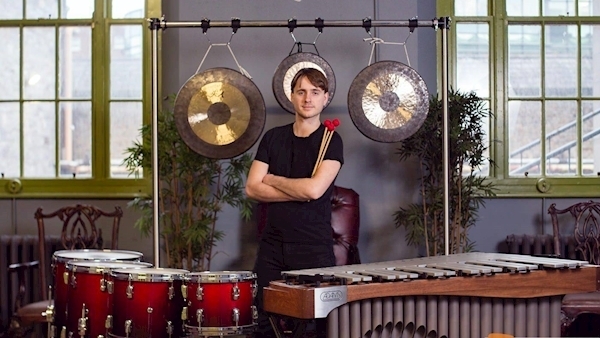
From soup bowls to car brakes, Cork musician Alex Petcu is constantly searching for new sounds in the instruments he strikes, writes Ellie O'Byrne

Percussion is a big hit with Cork musician Alex Petcu

From soup bowls to car brakes, Cork musician Alex Petcu is constantly searching for new sounds in the instruments he strikes, writes Ellie O'Byrne

ALEX Petcu picks up a glass placemat from his table and raps it with his knuckle: it makes a pleasing gong-like note. He smiles. In intervals between making coffee –— the machine whirrs and hums –— he’s explaining his approach to percussion.

“People think percussion is just providing a beat,” he says, busying himself with coffee cups, spoons and milk. “But we’re showing that you can play melodies. There’s a whole range of sounds you can use to evoke different emotions and feelings: you can let your imagination run wild. Loud, soft, quiet: anything you hit is a percussion instrument.”

Petcu’s world is a world of potential: a sonic wonderland where everyday objects become instruments, where music is a part of the fabric of our mundane reality.

MUSICAL FAMILY

The classically trained percussionist is a member of contemporary new music group Crash Ensemble and was born into quite the musical dynasty. His mother, Romanian violinist Ruxandra Colan, came to Ireland in 1978 to play with the RTÉ String Quartet, and was followed by his father, Adrian Petcu. Both his parents have taught violin in Cork School of Music and his older sister, Ioana, is also a violin player, and associate leader with the Ulster Orchestra.

Petcu also started with the violin, but by the age of twelve had discovered that he just didn’t want to do it anymore. “There was the attraction of the drums, and seeing people at the back of the orchestra hitting stuff… at the age of twelve, what other reason is there to want to do something?”

Petcu and his wife, the soprano and music teacher Kelley Lonergan, are currently lodging in his parents’ house, where Petcu is variously serving up coffee and nuggets of wisdom on the importance of percussion. He’s in rehearsal for his next round of performances with Bangers and Crash, the percussion group he’ll be touring with throughout October.

“We’re not really a band, we’re a collective of percussionists who play together kind of regularly,” he says of the group. “It can be two people, or it can be six. We do gigs but we also go to schools. Once a year we go around to ten schools in a week. We divide them into groups and get them clapping and learning the basics.

“But even the concerts are kind of outreach in a way, because it’s kind of showing people all the sounds around them that they might have known already but not paid attention to: it’s getting them to listen to the world in a different way.”

STRIKE ONE

Having released his first ambitious album for solo percussion, Alex Petcu: In Time, in 2015, the Cork-born musician has developed a reputation for innovation in the world of contemporary percussion, utilising improvised instruments including bottles, beer-kegs, scrap metal, car parts: “everything makes a sound when you hit it.”

On top of the material potential for innovation, Petcu says he’s tapping into musical cultures from every corner of the globe.

“Percussion has a huge history because percussion instruments are easy to make,” he says. “Every indigenous culture in the world has percussion instruments. There are thousands of instruments you can find, and nowadays with the internet you can easily find out about them all and assimilate them.”

    Bangers and Crash percussion group will tour Ireland throughout October, performing eight dates in venues nationwide with a programme including Steve Reich and Phillip Glass, and a new composition by Alex Petcu.
    Dates include: tomorrow (Weds) Sugar Club, Dublin; and Thurs, Oct 10, CIT Cork School of Music.
    Further info: www.musicnetwork.ie

Thinking outsidethe (sound) box:

Stage Riser Chimes (made by Petcu)

“I was in a concert hall in Dublin and they had all of these risers to change the height of the stage. I saw two of these uprights being thrown into a box and thought they sounded good. You can make chimes out of lots of different things.

“I did physics in college; with a little knowledge of where to cut them and where to drill the holes, you can tune them. I just cut them with a hacksaw. There’s a formula you use where you make a test piece to calculate theparameters; then if you want a G, for example, you can use the formula to find out the length.”

Water Bowls

“The idea for this comes from Chinese Rice Bowls, but these are just soup bowls from the gaff. I just put water in at different heights to tune them; the more water you put in, the lower the pitch and you just use a watering can or a jug.

“You want ones that are nice and round — square wouldn’t work, because the sound wouldn’t circulate in the same way. There are multiple factors that contribute to how they sound, and they’re all going to be different.”

Marimba

“This is made of Honduran rose wood: It’s a huge instrument; it’s difficult to find a venue in Cork where you can set up an instrument like this to rehearse and leave it there. It comes apart in pieces and there are ten cases to transport it.

“The marimba is often played with four sticks, so you can play chords. It’s used a lot in Steve Reich’s music. Its origins are a mix of Guatemalan and African. In Guatemala they took the xylophone and put resonators under it, tuned to the same note as the bar above it, which makes the sound louder. With Bangers and Crash, there’s one piece where three of us are playing this together.”

Crotales

Crotales are small tuned brass or bronze discs, a bit like small, thick cymbals. They can be heard on everything from Debussy and Ravel to ‘Wuthering Heights’ by Kate Bush, Rufus Wainwright and the Low Anthem.

“I don’t know where they’re from, although cymbals are originally Turkish. These are called antique cymbals. Debussy managed to find two that were tuned to specific notes. In the last century, they were used a lot by contemporary composers.

“They’re used a lot in film music: in an orchestra, they really cut across the other instruments and lend this very sparkly top end to the sound.”

Car Brake Drums

Brake drums were used in thepercussion ensemble classic ‘Double Music’, by Lou Harrison and John Cage. Since then, Petcu says, they’ve been a perennial favourite withcontemporary composers.

“They are just fixed to normal snare stands. They’re actually used in a lot of compositions, but it’s getting harder to get them, and brake discs just don’t sound as good.”

Chromatic Gamelan Strips

“These are made of industrial steel checker plate, but they’re actually made by a bespoke instrument company called Morfbeats. I borrowed them from my friend Seán Mac Erlane. There’s a tuned octave of them and they sound great. Bangers and Crash will be playing them on tour, in a piece called ‘A Man With A Gun Lives Here’ by Steven Snowden.”

x

More in this section

Cookie Policy Privacy Policy Brand Safety FAQ Help Contact Us Terms and Conditions

© Examiner Echo Group Limited













